Essaouira from Marrakech: a day trip, or two nights on the Atlantic
Three hours west of Marrakech, the heat breaks, the light turns silver and a walled port opens onto the Atlantic. Essaouira is the gentlest escape from the red city: here is how to reach it, whether one day is enough, and when the wind, the music and the sea are at their best.
Reviewed 12 November 2026 · Sources at the end
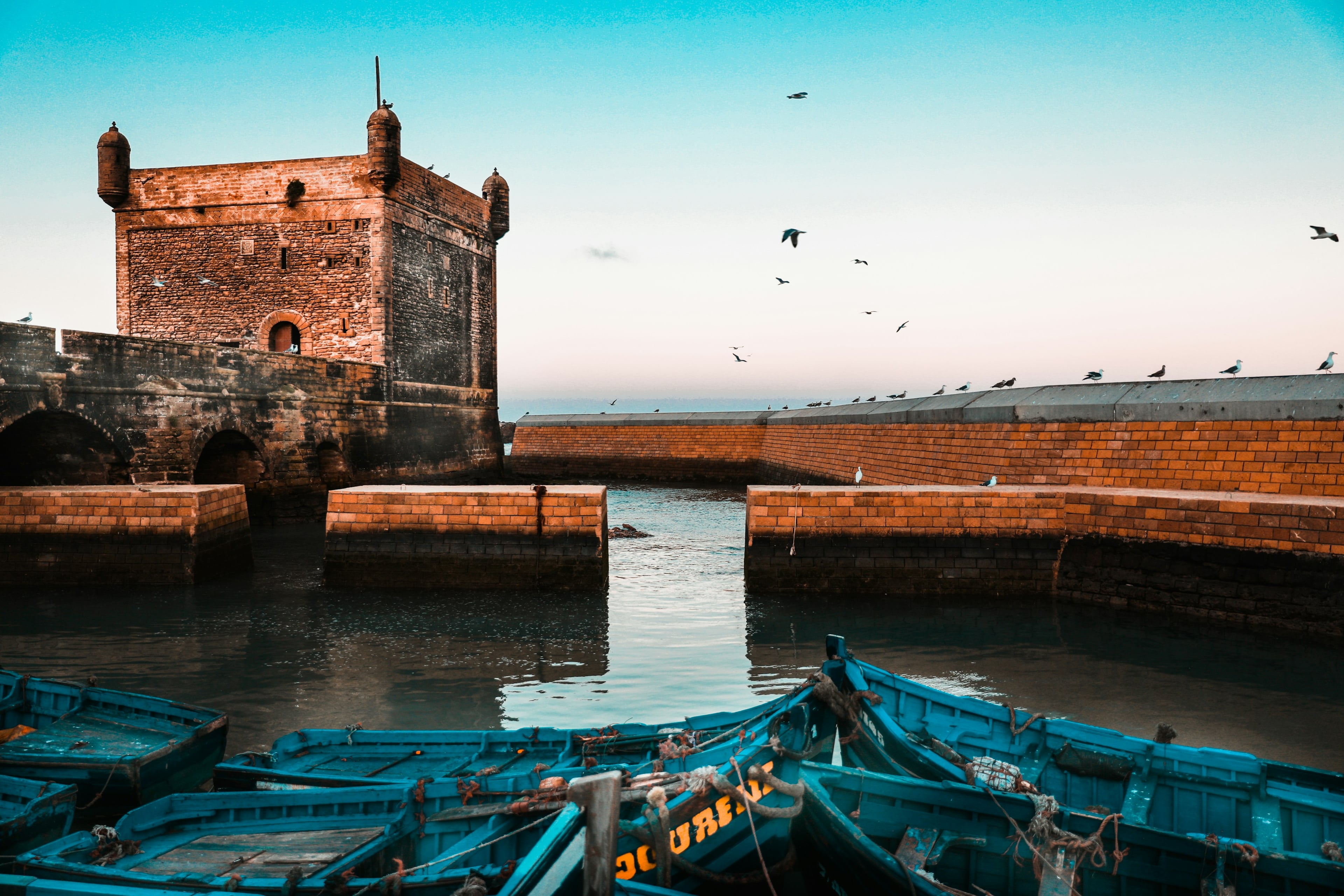
Essaouira lies about 185 km west of Marrakech, some two hours and forty minutes by road without stops. A day there is possible, but it spends more than five hours of the day in a car; two nights give the medina, the port and the sea the time they deserve. An Essaouira day trip from Marrakech suits adults short of time. Everyone else, from grandparents to children, will be happier with two nights, in any month of the year: the coast keeps its days between 18 and 23 °C on average from January to December.
Below: the road and the flights, the choice between a day and two nights, what to see and do, the sea, the weather month by month, and meals. Sehra Morocco plans tailor-made journeys across Morocco for families, couples and groups from India and around the world. The facts come from UNESCO, the World Meteorological Organization, Morocco’s national tourist office and the other sources listed at the end, read on 12 November 2026, and from information published by local businesses; the advice that follows from them is ours.
Essaouira, at a glance
The essentials, checked on 12 November 2026:
- Where
- On the Atlantic, west of Marrakech; its medina, the former Mogador, has been a UNESCO World Heritage site since 2001
- By road from Marrakech
- About 185 km: some two hours and forty minutes without stops, by private car or minibus
- By air
- Essaouira-Mogador airport, about 18 km by road from the medina, has direct flights from a few European cities; there is no flight from Marrakech
- Nights
- Two, in our view; a day trip is possible, but long
- Weather
- Average highs of 18 to 23 °C in every month of the year, and nights of 11 to 18 °C
- The wind
- Strong wind on about 186 days a year, most often from March to August
- The sea
- A cool Atlantic; many Moroccan beaches have limited or no lifeguard cover
- At the table
- Vegetarian when asked for in advance; Jain on request
- Gnaoua festival
- The 28th edition is announced for 24 to 26 June 2027
Flights, roads and local arrangements change: check them again before you book.
Mogador, the walled port on the Atlantic
Essaouira was long called Mogador, a name UNESCO traces to the Phoenician migdol, a small fortress. The town you see today is younger than most Moroccan medinas. It was founded in the mid-eighteenth century by the Alaouite sultan Sidi Mohamed Ben Abdallah, who wanted a royal port open to the world, and laid out by a French architect who had learnt from Vauban’s fortifications at Saint-Malo. The result, in UNESCO’s words, is a European fortified town in a North African setting, in harmony with the rules of Arab-Muslim town planning. The medina was inscribed on the World Heritage List in 2001.
For more than a century this was one of the great Atlantic ports between Africa and Europe; UNESCO notes that it was long known as the port of Timbuktu, linking Morocco and its Saharan hinterland with Europe and the rest of the world. Amazigh, Arab, African and European families lived side by side here, with Muslim, Christian and Jewish communities. Morocco’s tourist office calls it the city of wind.
What strikes a traveller from Marrakech first is the air. At Essaouira’s weather station, July afternoons average 22 °C, against nearly 38 °C in Marrakech; on winter nights, the coast is some five degrees warmer. The ochre of the red city gives way to white walls and blue shutters, and the sound of the souks to gulls and surf.
How to get to Essaouira from Marrakech
By road: two hours and forty minutes, without stops
Calculated on OpenStreetMap, the road from the centre of Marrakech to the medina of Essaouira covers about 185 km and some two hours and forty minutes at the wheel; Morocco’s tourist office gives about two and a half hours. The way runs west across the plains, then through the argan country that announces the coast. With a pause for tea, or to watch argan oil being made, count on three hours or more.
Travel by day, in both directions. The UK government asks drivers to be alert to other vehicles, pedestrians and animals, and notes that poor lighting makes driving at night dangerous. If you stay inside the medina, ask before you arrive how your luggage will reach the door.
By air: from Europe, not from Marrakech
Essaouira has its own airport, Essaouira-Mogador, about 18 km by road from the medina. Its flights come from Europe: on 12 November 2026, Ryanair’s published network linked Essaouira with London Stansted, Paris Beauvais, Brussels Charleroi, Düsseldorf Weeze, Madrid and Marseille. There is no flight between Marrakech and Essaouira, and Royal Air Maroc does not list Essaouira in its domestic network. For travellers from India, the journey starts at Marrakech or Casablanca, as explained in our guide to flights from India and the journey to Morocco; for travellers from Europe, flying into Essaouira and out of Marrakech, or the reverse, saves a drive.
Beyond Essaouira: Agadir or Casablanca
Essaouira need not be a return trip. The coast road runs south to Agadir, about 175 km and close to three hours away, and north to Casablanca, about 360 km and four hours and forty minutes away, where some journeys to and from India begin and end. A week in Morocco can therefore run from Marrakech to Essaouira and on to Casablanca without driving the same road twice. Our guides: things to do in Agadir, El Jadida and the Atlantic coast and things to do in Casablanca.
An Essaouira day trip from Marrakech, or two nights?
A day trip: what fits, and what does not
Leave Marrakech early, and you can be in Essaouira by late morning: a walk through the medina, the ramparts of the Skala, the fishing port, lunch with a view of the sea, an hour in the workshops, and the road back before dark. It is a fine day for adults who want a breath of sea air between two stays in Marrakech. What it leaves out is just as clear: more than five hours on the road, no time on the beach or on the water, and a departure in the afternoon, when the day visitors leave and the town is at its loveliest.
Two nights: the rhythm we recommend
Morocco’s tourist office suggests two days, and we agree. The first day, arrive for lunch, settle in, and walk the ramparts in the late afternoon light. The second, go down to the port in the morning, when the night’s catch reaches the market, then give the afternoon to the beach, a ride, a lesson on the water or a workshop. The third, take the road back to Marrakech, or on to Agadir or Casablanca. A third night adds a slow day by the sea, and suits families and anyone who wants to learn to surf.
Five questions to choose
- Who is the oldest, and who is the youngest? Five hours of driving in a day tire a grandparent and a small child more than any walk in the medina.
- Do you want the sea, or the town? The medina and the port fit in a day; the beach, the horses and the water sports need a night at least.
- Which month? In summer, Essaouira is a refuge from the heat of Marrakech; from March to August, expect wind; from November to January, a few days of rain.
- Where do you fly home from? Casablanca, or Essaouira itself from some European cities, can end the journey on the coast.
- Who will cook? Vegetarian is easy when asked for in advance; Jain is on request, agreed in writing before you book.
The medina, the ramparts and the Skala
The medina is compact: the World Heritage property covers about 57 hectares, held within ramparts that, according to UNESCO, were already complete by the nineteenth century and still keep their original outline, built in a local stone called manjour. Morocco’s tourist office describes walls pierced with monumental gates and flanked by two citadels, the Skala of the kasbah and the Skala of the port. Old cannon still stand by the city wall; one of them, cast in The Hague in 1744, came from the Netherlands. Walk the ramparts on the sea side in the late afternoon, to watch the waves break below and the light fall on the islands.
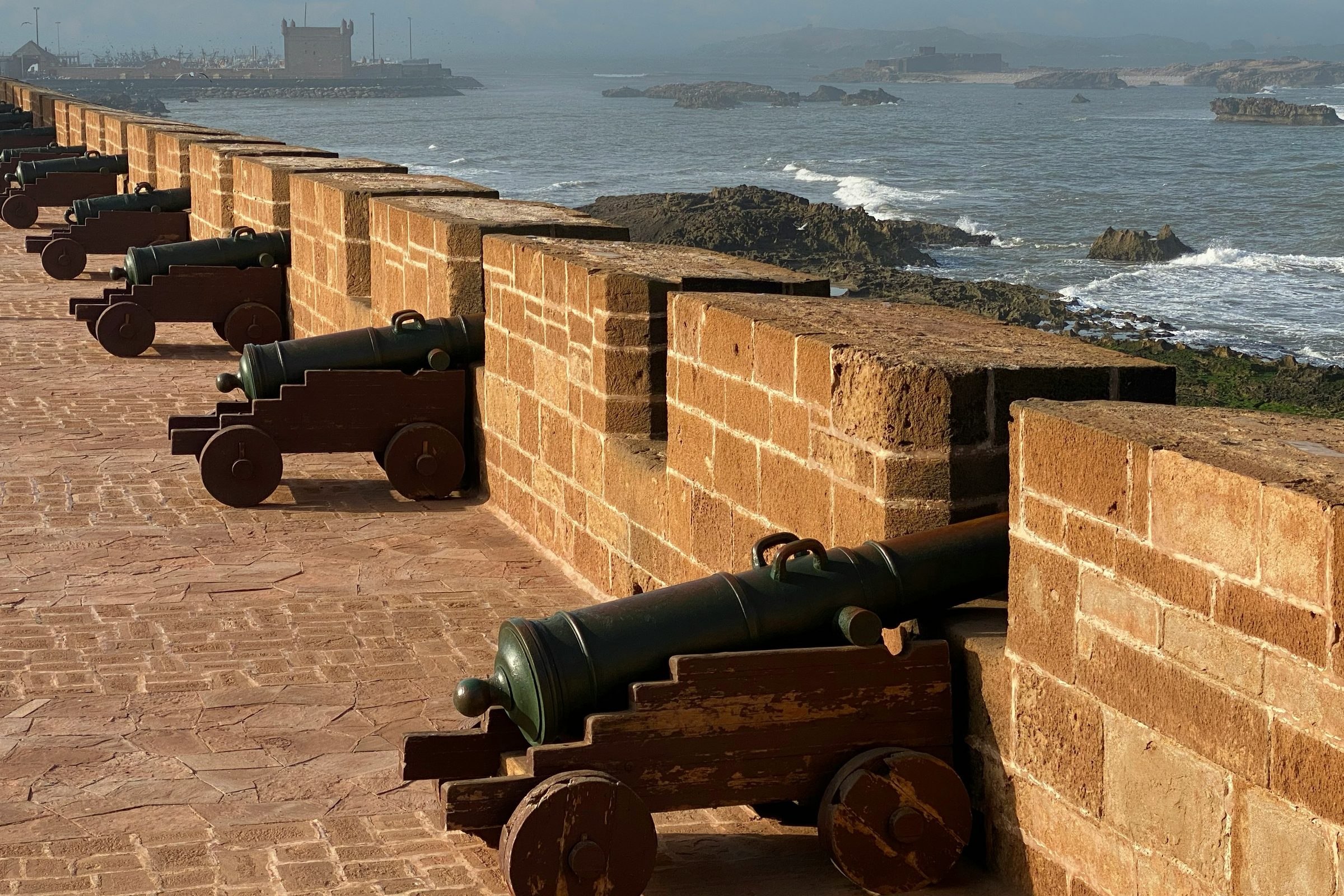
Beneath the ramparts and along the casemates, the woodworkers carry on Essaouira’s best-known craft: marquetry in thuya, a wood of the region, inlaid with silver and copper wire, mother-of-pearl and bone, as the tourist office describes it. Boxes, chessboards and small pieces of furniture are made there, and watching a craftsman at work is the best introduction to the town. The Sidi Mohamed Ben Abdallah Museum keeps the memory of the region’s crafts and popular traditions, and the many galleries tell of the artists who have made Essaouira their home.
The mellah, the old Jewish quarter, recalls a time when Jews made up a large part of the town’s population. Bayt Dakira, a house of memory devoted to the Jewish heritage of Essaouira, was visited by King Mohammed VI in January 2020. Film lovers may know that Orson Welles stayed in Essaouira while filming his Othello, released in 1952, and teenagers that the fortified harbour stood in for the city of Astapor in Game of Thrones.
For a guided walk, the UK government advises using a guide with an official badge and permission from the local authority, and warns that people posing as official guides are common. We would add one thing: choose a guide who knows the history of the mellah and of the port, not only the shops.
The port, the blue boats and the islands of Mogador
Beyond the Skala of the port lies an active fishing harbour, the blue boats of the photograph at the top of the page, and the tourist office notes that its fish is sold at the market after being caught overnight. Come in the morning, when the night’s catch comes in and the gulls circle low: even for a vegetarian family, the port is a walk to remember, and the view of the ramparts from the harbour is the classic picture of Essaouira.
Facing the harbour, the islands of Mogador shelter the bay from the Atlantic swell. UNESCO describes the archipelago as inseparable from the medina, and its islands and dunes are listed together as a wetland of international importance under the Ramsar Convention. The tourist office calls them a preserved nature area, home to Eleonora’s falcon and to seabirds. Their history runs deep: Juba II, king of Mauretania in Roman times, set up a workshop there to make the famous Tyrian purple dye from local shells. Today the islands are best admired from the ramparts or the beach, binoculars in hand.
The wind, the waves and the water sports
Essaouira’s wind is its signature. The trade winds blow hard along this coast, and the long-term averages of the station show it: on about 186 days a year, the wind reaches at least 36 km/h, ten metres a second, with the windiest months from March to August and a peak in July, on more than twenty days of the month. The same winds help keep the summer mild, and draw cold water up along the shore.
That is why the tourist office names Essaouira among the favourite places of surfers, windsurfers and kitesurfers (far to the south, the weather station at Dakhla records winds of 36 km/h or more on some 323 days a year: see kitesurfing on the Dakhla lagoon). Schools in the town teach in sessions of about two hours, in small groups, with certified instructors and the equipment provided; they move a lesson when the weather is wrong, so keep a free morning in the plan. Wind sports suit the windier months; surfing depends on the swell rather than the wind. South of the town, Sidi Kaouki, about 23 km and twenty-five minutes away, is known for its waves; the tourist office describes a long beach there, with rides by camel or on horseback across the sand.
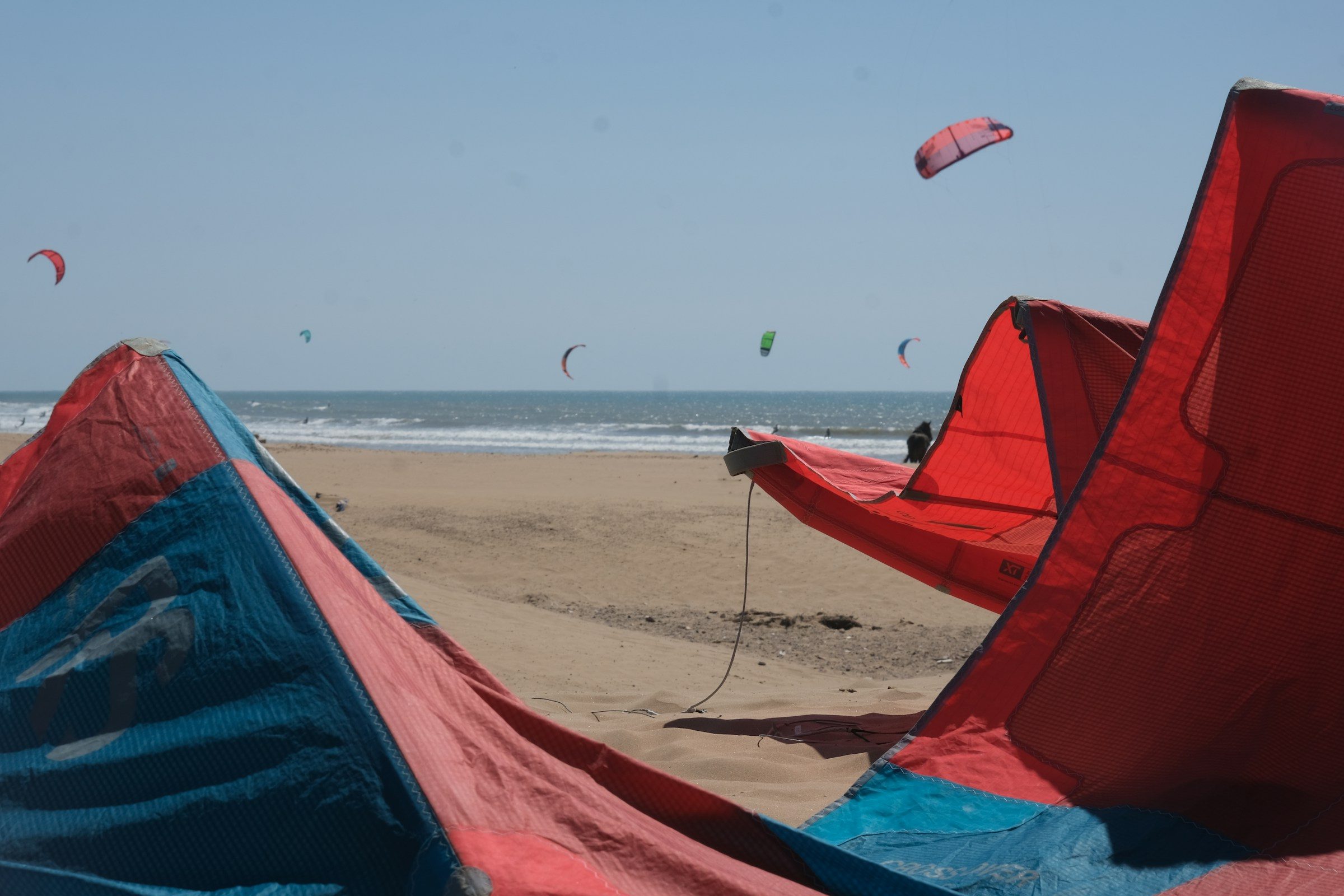
Riding on the beach is the gentlest way to meet the coast. Riding centres at Diabat, just south of the town, offer rides of one or two hours along the sand, from the age of six, with helmets provided. The UK government notes that providers of adventure activities may not meet UK safety standards and that some insurance policies do not cover them: check both before anyone takes the reins or the board.
What else to do around Essaouira: quads, horses, souks and kitchens
Beyond the medina and the waves, the coast south of the town and the argan country inland fill a second or third day. These are the outings local providers run around Essaouira; durations are indicative, and each is arranged in advance with the right ages and the weather in mind.
By quad: Diabat, the Cap Sim dunes and Sidi Kaouki
Quads leave from just south of the town. An hour is enough to ride along Diabat beach; two or three hours reach the dunes and the forest of Cap Sim; a full day follows the wild beaches as far as Sidi Kaouki. Riders ride alone or two to a machine, with a helmet, gloves and a scarf against the sand; ask each operator for the minimum age before promising it to a teenager.
Longer rides, and guided walks
Beyond the one- or two-hour rides described above, a ride on a horse or a camel can last three hours, or a whole day with a picnic. Guided walks from Essaouira run for half a day or a full day, with transport and a meal in a local home.
By 4x4 to Sidi Kaouki
For grandparents who would rather not ride, a day by 4x4 reaches Sidi Kaouki and the beaches to the south, with a picnic and stops along the shore: the same landscapes, seated.
The country souks
Each village of the hinterland holds its souk on a fixed day of the week: Had Dra on Sundays, Meskala on Thursdays, Talmest on Saturdays, among others. A morning at a country souk, with its spices, its mules and its tea stalls, is the opposite of the medina’s shops, and pairs well with a visit to an argan cooperative on the way back.
Argan, olive oil and a cooking class
Inland, estates open their groves for an olive-oil or argan-oil tasting, with a walk among the trees in about two hours and, if you wish, lunch. Half-day cooking classes end at the table; tell the host of any diet in advance; Jain food is on request.
Hammam and massage
After the wind, the warmth: hammams in the town offer the traditional steam bath with black soap and a scrub, from half an hour to over an hour, and massages with argan oil.
Can you swim in Essaouira?
Yes, on calm days, but this is not a bathing beach in the Mediterranean sense. The islands soften the swell in the bay, as the tourist office explains, yet the Atlantic here stays cool, and the wind often blows hard and carries the sand across the beach. The UK government warns that many Moroccan beaches have limited or no lifeguard cover, that safety signage may be minimal, and that strong currents and unexpected waves can occur.
So walk the beach, paddle at the water’s edge in the morning, leave the open water to those with an instructor, and keep a pool for swimming: Essaouira is a beach for long walks, rides and wind, not for long swims.
The argan country
The road to Essaouira runs through the argan forest, and the tourist office notes that argan trees, thuyas and other conifers cover almost half of the province. The argan tree is native to south-west Morocco, where it grows within the Arganeraie Biosphere Reserve, which also takes in the walled town of Taroudant, in the Souss, and in 2014 UNESCO inscribed the practices and know-how of the argan tree on its list of the intangible heritage of humanity.
UNESCO describes the work in detail: the fruit is harvested, dried, pulped, ground, sorted and milled on a hand mill made by local craftspeople, then mixed with warm water added in exact quantities, a skill the women of the region pass on to their daughters. The oil serves in the kitchen, in medicine and in cosmetics, and the tourist office notes that buying it supports the women who run the cooperatives. Choose one where you can see the work done by hand: for children, the hand mill is often the highlight of the drive.
Gnawa music, in June and all year
Essaouira’s name is bound to Gnawa music. UNESCO inscribed Gnawa on its Representative List of the Intangible Cultural Heritage of Humanity in 2019: a Sufi brotherhood music, first practised by communities that came out of slavery and the slave trade, in which the city’s musicians play a stringed instrument and castanets, in colourful embroidered costumes, through ceremonies of rhythm and trance that can last all night.
Every summer the town hosts the Gnaoua and World Music Festival, which the tourist office describes as a celebration of Afro-Maghrebin rhythms. Its official site announces the 28th edition for 24 to 26 June 2027. If you plan to come for it, decide early: the town is small, and the festival is its busiest moment of the year. At any other time, an evening of Gnawa music can be arranged on request, and it is an hour every generation of a family can share.
When to go: Essaouira’s weather, month by month
Essaouira’s climate is remarkably even. The long-term averages of its own weather station, published by the World Meteorological Organization, show average highs between 18 and 23 °C in every month of the year, and only about seventeen days a year reach 25 °C. Rain falls on about five days a month from November to January, and almost never in summer. The real variable is the wind.
Essaouira’s averages, month by month
- January
- 18 °C by day · 11 °C at night · strong wind on 12 days
- Mild days, cool evenings; rain on about five days
- February
- 19 °C by day · 12 °C at night · strong wind on 14 days
- Mild; the windy days begin to return
- March
- 19 °C by day · 13 °C at night · strong wind on 18 days
- Spring light, and the wind picks up
- April
- 20 °C by day · 14 °C at night · strong wind on 18 days
- Fresh and bright; little rain
- May
- 21 °C by day · 16 °C at night · strong wind on 18 days
- Dry and breezy
- June
- 21 °C by day · 17 °C at night · strong wind on 17 days
- Dry; the Gnaoua festival in late June 2027
- July
- 22 °C by day · 18 °C at night · strong wind on 22 days
- The windiest month, and some 15 degrees cooler than Marrakech
- August
- 22 °C by day · 18 °C at night · strong wind on 18 days
- Warm, dry and still windy
- September
- 23 °C by day · 18 °C at night · strong wind on 13 days
- The warmest days, with calmer air
- October
- 22 °C by day · 17 °C at night · strong wind on 12 days
- Warm and calmer; the first rains
- November
- 21 °C by day · 14 °C at night · strong wind on 12 days
- Mild; rain on about five days
- December
- 19 °C by day · 13 °C at night · strong wind on 13 days
- Mild days; rain on about five days
| Month | Average high | Average low | Days of strong wind | What to expect |
|---|---|---|---|---|
| January | 18 °C | 11 °C | 12 | Mild days, cool evenings; rain on about five days |
| February | 19 °C | 12 °C | 14 | Mild; the windy days begin to return |
| March | 19 °C | 13 °C | 18 | Spring light, and the wind picks up |
| April | 20 °C | 14 °C | 18 | Fresh and bright; little rain |
| May | 21 °C | 16 °C | 18 | Dry and breezy |
| June | 21 °C | 17 °C | 17 | Dry; the Gnaoua festival in late June 2027 |
| July | 22 °C | 18 °C | 22 | The windiest month, and some 15 degrees cooler than Marrakech |
| August | 22 °C | 18 °C | 18 | Warm, dry and still windy |
| September | 23 °C | 18 °C | 13 | The warmest days, with calmer air |
| October | 22 °C | 17 °C | 12 | Warm and calmer; the first rains |
| November | 21 °C | 14 °C | 12 | Mild; rain on about five days |
| December | 19 °C | 13 °C | 13 | Mild days; rain on about five days |
Long-term averages for 1991–2020 at Essaouira, from Morocco’s Direction de la Météorologie Nationale, published by the World Meteorological Organization and rounded to the nearest degree; days of strong wind are days on which the wind reaches 10 metres a second (36 km/h). A given day can be warmer, colder or calmer than the average.
On these figures, every season has its reason. From June to August, Essaouira is a cool escape within reach of Marrakech, with long, dry, windy days: the months for kitesurfers and for families fleeing the heat, and for the festival in June. September and October bring the warmest and calmest days, perhaps the finest of the year for a beach walk. From November to February the town is quiet and mild, with a few rainy days and cool evenings: pack a jacket for the ramparts at dusk. Spring brings the wind back.
Ramadan changes the rhythm of the day more than the sea; its expected dates, and the rest of Morocco region by region, are in the best months to visit Morocco from India.
Vegetarian and Jain food in Essaouira
Essaouira is a fishing town, and its fish is part of its legend; but a vegetarian family eats well here. Several hotels in and around the town serve vegetarian meals for a whole group when asked in advance, in a Moroccan and Mediterranean style rich in spices, vegetables and lentils. Indian dishes made to order are another matter, which not every kitchen will promise: if they matter to your party, say so before you book.
Vegetarian is therefore simple when asked for in advance, and Jain food is on request: set out the rules in writing, from no onion, garlic or root vegetables to no egg or honey, and ask for the hour as well as the dishes. The words to use, and a list in French to show the kitchen, are in how to ask for a Jain meal as a traveller in Morocco.
Who Essaouira suits
Grandparents and older parents find in Essaouira what Marrakech rarely gives in summer: a mild day, a short drive, a small town and a sea view. Keep the walks to the ramparts and the port, with pauses on a terrace, and ask about stairs where you sleep.
Children have the beach, the boats and the gulls of the port, the hand mills of the argan road, and a short ride on the sand from the age of six. Teenagers have a surf lesson, the harbour of Game of Thrones and the wind.
Couples have the light, the galleries, the music and the evenings. Groups should know that the town is small and the medina’s lanes narrow: plan the walks in smaller parties, and the arrival with the luggage in mind.
For the days in the red city before or after the coast, see things to do in Marrakech with grandparents and children; for a desert evening an hour from Marrakech, see the Agafay desert from Marrakech, and for the mountains, the Atlas Mountains from Marrakech.
So, Essaouira from Marrakech: a day trip or two nights?
Two nights, whenever you can. A day trip from Marrakech shows the medina, the Skala and the port, and it is worth making if a single day is all you have; but the road takes more than five hours of it, and you leave before the town is at its best. Two nights give the morning port, the ramparts at the end of the day, a ride on the beach, a lesson on the water, an evening of Gnawa music, and the cool Atlantic air that makes Essaouira one of the gentlest stops in Morocco, in every season.
The rest is preparation: the road by day, the luggage to the door, the kitchen told in advance, and a jacket for the wind. Flying in from India? Start with the journey from India, from flights to dirhams.
Planning Essaouira for your family or your group? Write to us with your dates, the ages in your party and the nights you can give the coast, and we will answer by e-mail or video call.
Questions travellers ask about Essaouira
How far is Essaouira from Marrakech?
Is an Essaouira day trip from Marrakech worth it?
How many days do you need in Essaouira?
Can you fly from Marrakech to Essaouira?
Can you swim in the sea at Essaouira?
When is the Gnaoua festival in Essaouira?
Is Essaouira good for elderly parents and young children?
Editorial note
This guide draws on UNESCO, for the Medina of Essaouira (formerly Mogador), Gnawa, and the practices and know-how of the argan tree; the World Meteorological Organization’s climate normals for 1991–2020, for the long-term averages of Morocco’s Direction de la Météorologie Nationale at Essaouira and Marrakech; Morocco’s national tourist office; the official site of the Gnaoua and World Music Festival; the UK government’s travel advice for Morocco; the published network of Ryanair and the domestic network of Royal Air Maroc; and Wikipedia, for the trade winds, the cannon of the Skala, the mellah and Bayt Dakira, Orson Welles and the purple dye of the islands. Road distances and driving times were calculated with the OSRM route planner on OpenStreetMap data. Details of riding, water sports lessons and meals come from information published by businesses in Essaouira. All were read on 12 November 2026.
Activity durations and ages come from information provided by local activity providers in 2026; check them when you book.
Flights, roads, festival dates and local arrangements change, sometimes without notice: check them before you book. Apart from airlines and public bodies, no business is named, and none is recommended. This guide describes no journey of our own.
- UNESCO World Heritage Centre: Medina of Essaouira (formerly Mogador), inscribed in 2001
- UNESCO, Intangible Cultural Heritage: Gnawa, inscribed in 2019, and Argan, practices and know-how concerning the argan tree, inscribed in 2014
- World Meteorological Organization, climate normals for 1991–2020, stations of Essaouira (60220) and Marrakech (60230), as archived by the US National Centers for Environmental Information
- Moroccan National Tourist Office: Essaouira-Mogador, with its pages on the medina, sport, beaches, nature and shopping
- Festival Gnaoua et Musiques du Monde (in French), 28th edition announced for 24 to 26 June 2027
- GOV.UK, Morocco travel advice: safety and security, updated 19 August 2026
- Ryanair, timetable and route network from Essaouira; Royal Air Maroc, our network
- Wikipedia: Essaouira
- Road distances and driving times: OSRM on OpenStreetMap data, calculated on 12 November 2026, without stops
- Information published by hotels, riding centres and water sports schools in Essaouira.
Written by Sehra Morocco. Last reviewed: .
Tell us about your trip.
By e-mail or video call. We reply within two working days.