Best time to visit Morocco from India: month by month, region by region
Morocco keeps several seasons at once. While Marrakech enjoys mild winter days, the desert nights turn cold; when India’s summer holidays begin, the Atlantic coast keeps its cool. Here are the months that work, set against India’s own holidays.
Reviewed 30 October 2026 · Updated 23 November 2026 · Sources at the end
For travellers from India, Morocco is at its best from October to April, and finest of all in October and November, then in March and April, when Marrakech and the desert are both at their gentlest. Set against India’s calendar, the best time to visit Morocco from India is the Dussehra and Diwali break, followed by the spring holidays around Holi and Easter. Christmas and the New Year bring mild days and cold nights; the summer school holidays of May and June suit the Atlantic coast better than the desert; and July and August are very hot inland.
This guide sets India’s holidays, from Diwali to the summer vacation, against Morocco’s weather month by month and region by region: Marrakech, the High Atlas, the desert, the Atlantic coast around Essaouira, and Fès. Sehra Morocco plans tailor-made journeys and Indian weddings across Morocco for travellers from India. The temperatures below are long-term averages published by the World Meteorological Organization, the holiday dates come from the Government of India’s own list, and the dates of Ramadan from astronomers’ forecasts; the sources are listed at the end. The advice that follows from them is ours.
The short answer, holiday by holiday
India’s main breaks, and the Morocco each one finds:
- Dussehra and Diwali
- October and November; in 2027, Dussehra on 9 October and Diwali on 29 October
- Warm days and mild nights: 29 °C by day in Marrakech in October, 23 °C in November
- Best for: Marrakech, the desert and the Atlas
- Keep in mind: Rain returns to Fès, the north and the coast from October; snow is possible on the High Atlas passes from November
- Christmas and the New Year
- 25 December to 1 January
- Mild, mostly dry days and cold nights: about 20 °C by day in Marrakech, 6 to 7 °C at night
- Best for: Marrakech and the coast; the desert, with warm layers
- Keep in mind: Desert nights of 2 to 4 °C; a busy time for travel in many countries, so book early
- Republic Day to early March
- Late January to early March
- Mild days and cool nights; Ramadan expected to begin about 8 February 2027, with Eid al-Fitr around 10 March
- Best for: Marrakech and the coast
- Keep in mind: The rhythm of Ramadan; cold nights in the desert
- Holi and Easter
- Late March; in 2027, Holi on 23 March and Good Friday on 26 March
- Spring: 24 °C by day in Marrakech in March, 26 °C in April
- Best for: Marrakech, the desert and the Atlas valleys
- Keep in mind: March is Marrakech’s wettest month; spring wind can lift the sand in the dunes
- The summer school holidays
- May and June
- Warm to hot inland, 29 °C by day in Marrakech in May and 34 °C in June; 24 to 26 °C on the coast
- Best for: The Atlantic coast, and Marrakech early and late in the day
- Keep in mind: The desert is very hot by June; Eid al-Adha expected around 16 or 17 May 2027
- Independence Day and the late summer
- July to September
- Very hot inland, 37 to 38 °C by day in Marrakech in July and August; about 27 °C on the coast
- Best for: The Atlantic coast
- Keep in mind: Afternoons in the city and the desert; a summer risk of wildfires
| India’s break | Morocco then | Best for | Keep in mind |
|---|---|---|---|
| Dussehra and Diwali October and November; in 2027, Dussehra on 9 October and Diwali on 29 October | Warm days and mild nights: 29 °C by day in Marrakech in October, 23 °C in November | Marrakech, the desert and the Atlas | Rain returns to Fès, the north and the coast from October; snow is possible on the High Atlas passes from November |
| Christmas and the New Year 25 December to 1 January | Mild, mostly dry days and cold nights: about 20 °C by day in Marrakech, 6 to 7 °C at night | Marrakech and the coast; the desert, with warm layers | Desert nights of 2 to 4 °C; a busy time for travel in many countries, so book early |
| Republic Day to early March Late January to early March | Mild days and cool nights; Ramadan expected to begin about 8 February 2027, with Eid al-Fitr around 10 March | Marrakech and the coast | The rhythm of Ramadan; cold nights in the desert |
| Holi and Easter Late March; in 2027, Holi on 23 March and Good Friday on 26 March | Spring: 24 °C by day in Marrakech in March, 26 °C in April | Marrakech, the desert and the Atlas valleys | March is Marrakech’s wettest month; spring wind can lift the sand in the dunes |
| The summer school holidays May and June | Warm to hot inland, 29 °C by day in Marrakech in May and 34 °C in June; 24 to 26 °C on the coast | The Atlantic coast, and Marrakech early and late in the day | The desert is very hot by June; Eid al-Adha expected around 16 or 17 May 2027 |
| Independence Day and the late summer July to September | Very hot inland, 37 to 38 °C by day in Marrakech in July and August; about 27 °C on the coast | The Atlantic coast | Afternoons in the city and the desert; a summer risk of wildfires |
Holiday dates follow the Government of India’s list for its offices in Delhi in 2027; states and school boards set some dates of their own. Moroccan temperatures are averages for 1991–2020, rounded; the Indian figures quoted in this guide are older long-term averages (mostly 1901–2000), so read the comparisons as indications.
Morocco’s weather, month by month
Morocco is not one climate but several. Marrakech, on its plain below the High Atlas, has hot summers and mild winters; Fès, further north, is cooler and much wetter in winter; the desert of the south-east swings from cold winter nights to fierce summer days; and the Atlantic coast, tempered by the ocean, changes least of all. The table gives the average high and low of each month at four stations of Morocco’s weather service, one for each of those regions.
Average temperatures by region, month by month
Average daily high / low, month by month:
- January
- Marrakech 19 / 6 °C · Fès 16 / 4 °C
- Desert 16 / 2 °C · Coast 21 / 8 °C
- February
- Marrakech 21 / 8 °C · Fès 17 / 4 °C
- Desert 18 / 5 °C · Coast 22 / 10 °C
- March
- Marrakech 24 / 10 °C · Fès 20 / 7 °C
- Desert 22 / 9 °C · Coast 23 / 12 °C
- April
- Marrakech 26 / 12 °C · Fès 22 / 8 °C
- Desert 26 / 13 °C · Coast 23 / 14 °C
- May
- Marrakech 29 / 15 °C · Fès 26 / 12 °C
- Desert 30 / 17 °C · Coast 24 / 16 °C
- June
- Marrakech 34 / 18 °C · Fès 31 / 15 °C
- Desert 35 / 22 °C · Coast 26 / 18 °C
- July
- Marrakech 38 / 21 °C · Fès 35 / 18 °C
- Desert 40 / 26 °C · Coast 27 / 19 °C
- August
- Marrakech 37 / 21 °C · Fès 35 / 18 °C
- Desert 38 / 25 °C · Coast 27 / 20 °C
- September
- Marrakech 33 / 19 °C · Fès 30 / 16 °C
- Desert 33 / 20 °C · Coast 26 / 19 °C
- October
- Marrakech 29 / 16 °C · Fès 26 / 13 °C
- Desert 27 / 14 °C · Coast 26 / 17 °C
- November
- Marrakech 23 / 11 °C · Fès 20 / 8 °C
- Desert 21 / 8 °C · Coast 24 / 13 °C
- December
- Marrakech 20 / 7 °C · Fès 17 / 5 °C
- Desert 17 / 4 °C · Coast 22 / 10 °C
| Month | Marrakech | Fès | The desert (Errachidia) | The coast (Agadir) |
|---|---|---|---|---|
| January | 19 / 6 °C | 16 / 4 °C | 16 / 2 °C | 21 / 8 °C |
| February | 21 / 8 °C | 17 / 4 °C | 18 / 5 °C | 22 / 10 °C |
| March | 24 / 10 °C | 20 / 7 °C | 22 / 9 °C | 23 / 12 °C |
| April | 26 / 12 °C | 22 / 8 °C | 26 / 13 °C | 23 / 14 °C |
| May | 29 / 15 °C | 26 / 12 °C | 30 / 17 °C | 24 / 16 °C |
| June | 34 / 18 °C | 31 / 15 °C | 35 / 22 °C | 26 / 18 °C |
| July | 38 / 21 °C | 35 / 18 °C | 40 / 26 °C | 27 / 19 °C |
| August | 37 / 21 °C | 35 / 18 °C | 38 / 25 °C | 27 / 20 °C |
| September | 33 / 19 °C | 30 / 16 °C | 33 / 20 °C | 26 / 19 °C |
| October | 29 / 16 °C | 26 / 13 °C | 27 / 14 °C | 26 / 17 °C |
| November | 23 / 11 °C | 20 / 8 °C | 21 / 8 °C | 24 / 13 °C |
| December | 20 / 7 °C | 17 / 5 °C | 17 / 4 °C | 22 / 10 °C |
Average daily high / low in °C, long-term averages for 1991–2020 from Morocco’s Direction de la Météorologie Nationale, published by the World Meteorological Organization and rounded to the nearest degree. Errachidia is the nearest station to the dunes of the Erg Chebbi, about two hours’ drive away; Agadir, further south than Essaouira, stands for the Atlantic coast. A given day can be warmer or colder than the average.
Three things stand out. Rain is scarce south of the Atlas and modest in Marrakech, where March, the wettest month, averages about 35 mm over six days; Fès receives more than twice Marrakech’s rain in winter, about 60 mm over eight days in January. The desert has the widest swing, from nights of about 2 °C in January to days of about 40 °C in July. And the coast barely moves: at Agadir, days average 21 to 27 °C all year round. For Marrakech alone, with its rainy days and the forecasts for Ramadan in 2027 and 2028, see Marrakech’s weather and Ramadan, month by month.
India’s holidays, and the Morocco each one finds
India’s own calendar offers four natural breaks: around Dussehra and Diwali, over Christmas and the New Year, in the spring week of Holi and Easter, and in the long school holidays of May and June. Each of those breaks opens a different Morocco.
Dussehra and Diwali: Morocco’s golden autumn
In 2027, Dussehra falls on Saturday 9 October and Diwali on Friday 29 October, both holidays across India’s central government offices, and Guru Nanak’s birthday follows on Sunday 14 November. These are Morocco’s kindest weeks. Marrakech averages about 29 °C by day in October and 23 °C in November, with nights of 16 and 11 °C; the desert has warm days and mild nights, about 27 °C and 14 °C in October at Errachidia; and on the coast, Agadir keeps 26 °C by day.
For a family arriving from Delhi, a Moroccan November will feel some five degrees cooler by day than home: New Delhi averages 28 °C by day and 13 °C at night in that month. For a family from Chennai, it will also feel dry, since November is Chennai’s wettest month, at about 350 mm of rain against some 30 mm in Marrakech. The autumn rains return from October to Fès and the north, and to the coast from Casablanca northwards. If the journey is to include the desert, the Atlas and the city, this is the season we would choose first.
Christmas and the New Year: mild days, cold nights
Christmas Day falls on Friday 25 December 2026, and New Year’s Day, which the Government of India leaves to each employee’s choice, on Friday 1 January 2027: two long weekends, a week apart, for those who can take both. Morocco then offers mild, mostly dry days and properly cold nights. In January, Marrakech averages 19 °C by day and 6 °C at night, within two degrees of New Delhi (21 °C and 8 °C); for families from Mumbai (31 °C and 17 °C), Bengaluru (27 °C and 15 °C) or Chennai (29 °C and 20 °C), it is a real winter, and the suitcase should say so.
Further afield, the cold sharpens. At Errachidia, the station nearest the dunes of the Erg Chebbi, January nights average 2 °C, and Fès, at 16 °C by day and 4 °C at night, has rain on eight or nine days a month from November to March. Snow often falls on the Tizi n’Tichka, the pass over the High Atlas, between November and March, and the UK government warns that heavy rain can cause flash floods in the winter months, particularly in the mountains or near rivers. The coast stays mild, at about 21 °C by day in January at Agadir. The year-end weeks are a busy time for travel in many countries, so book flights and rooms early.
Late January to early March: Ramadan in 2027
Republic Day falls on Tuesday 26 January 2027, and the weeks around it are mild in Marrakech, about 19 to 21 °C by day. Then comes Ramadan, expected to begin around 8 February 2027, with Eid al-Fitr around 10 March: forecasts by the Astronomy Centre of the United Arab Emirates give 9 or 10 March, but the crescent cannot be seen from Morocco on the evening of 8 March. In Morocco, the Ministry of Endowments and Islamic Affairs announces the first day only on the eve, as it did on 18 February 2026 for that year’s Ramadan, and each date may fall a day later.
Travel goes on through the month, at a different rhythm. The UK government notes that eating, drinking or smoking in public during the day may cause offence and that it is worth checking the opening hours of shops and restaurants; driving, it adds, may be erratic around dusk, as people hurry home, so keep long drives away from sunset. What the month changes for a visitor, from the hours of the fast to the evenings after iftar, is set out in visiting Morocco during Ramadan.
Holi and Easter: spring, with a little rain
In 2027, Holi falls on Tuesday 23 March, after Holika Dahan on the Monday, and Good Friday on 26 March: one week that can carry a family a long way. By then, on current forecasts, Ramadan will have ended. Marrakech averages 24 °C by day in March and 26 °C in April, and March is its wettest month, though still modest. In the desert, days reach 22 to 26 °C and nights soften; spring wind can lift the sand in the dunes, so keep a spare day in the plan. Fès, still wet in March, is better kept for May.
One more long weekend follows: Mahavir Jayanti falls on Monday 19 April 2027, when Marrakech averages 26 °C by day and 12 °C at night. Against India in spring, Morocco is the cooler of the two: in March, New Delhi already averages 30 °C by day, and Ahmedabad 36 °C.
The summer school holidays: the coast, and the mornings
India’s long school holidays fall at the height of its heat. In Delhi, the Directorate of Education set the summer vacation of its schools from 11 May to 30 June in 2026; other states and school boards set their own dates. In May, New Delhi averages about 40 °C by day and Ahmedabad 41 °C, and June brings Mumbai some 500 mm of rain on average.
Morocco is markedly less hot then, and Marrakech and the coast are largely dry, though not every region is cool. Marrakech averages 29 °C by day in May and 34 °C in June, with little rain: a city for mornings, a long rest, and evenings outdoors. The desert, at about 35 °C by day in June, is best left for another season. The Atlantic coast is the summer answer, at 24 to 26 °C by day at Agadir, and about 25 °C in June at Casablanca. One date to note: Eid al-Adha, one of Morocco’s religious holidays, is expected around 16 or 17 May 2027; India’s list sets Id-ul-Zuha on Monday 17 May.
July to September: the heat inland
Independence Day falls on a Sunday in 2027, and Janmashtami on Wednesday 25 August. Inland Morocco is then at its hottest: about 38 °C by day in Marrakech in July, 35 °C in Fès and 40 °C at Errachidia. The coast stays near 27 °C, at Agadir as at Casablanca, and the UK government notes a risk of wildfires during the summer season. If these are your only weeks, base the journey on the coast and give Marrakech its early mornings; in September, the city averages about 33 °C by day.
Region by region: when each one is at its best
Marrakech
The city is good company from October to May. Its finest months are October and November, then March and April; from December to February, days of 19 to 21 °C come with nights of 6 to 8 °C, and from June to September the afternoons belong indoors. How to pace a stay for three generations is set out in things to do in Marrakech with grandparents and children.
The High Atlas
The mountains begin between one and one and a half hours from Marrakech, and keep their own seasons. In winter they wear snow: it often falls on the Tizi n’Tichka pass between November and March, and the Oukaïmeden ski area, which Morocco’s tourist office describes as rising to 3,200 metres, offers skiing by day with the evening atmosphere of Marrakech to come home to. Spring and autumn are the seasons for walking, and in summer the valleys are for early starts. For any hike, the UK government advises hiring a professional guide.
The desert: the Agafay and the Sahara
Morocco has two deserts within reach. The Agafay, a stone desert about 35 km from Marrakech, is an evening rather than an expedition, best from October to May, with a warm layer for winter evenings. The great sand dunes of the Sahara lie some ten hours’ drive away, around Merzouga, and they ask more of the calendar: at Errachidia, the nearest station, October and November and then March and April bring days of 21 to 27 °C and nights of 8 to 14 °C, whereas winter nights fall to between 2 and 5 °C and summer days climb to between 35 and 40 °C. The road, the nights and the camps are set out in the Merzouga desert from Marrakech.
The Atlantic coast and Essaouira
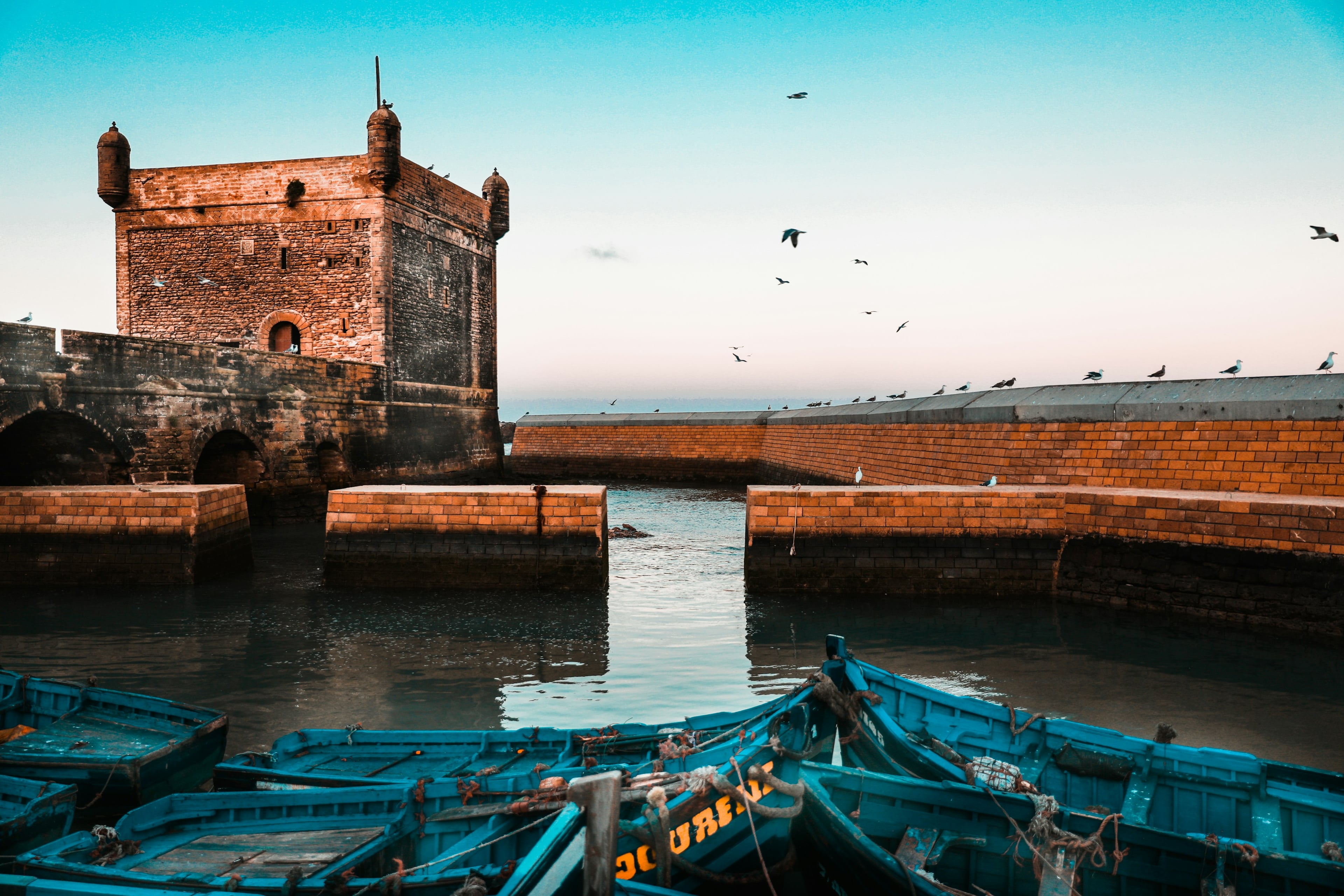
Essaouira lies about 180 km west of Marrakech, some two hours and forty minutes by road without stops. Morocco’s tourist office calls it the city of wind, where the Atlantic’s winds and waves draw surfers, windsurfers and kitesurfers, adding that the town hums to the beat of music every summer and that its Gnaoua festival celebrates Afro-Maghrebin rhythms. At the coastal stations that frame it, Casablanca to the north and Agadir to the south, August averages about 27 °C by day, ten degrees below Marrakech. In winter the coast is mild by day, about 21 °C at Agadir in January and 22 °C at Dakhla, on its lagoon in the far south. Swimmers should know that many Moroccan beaches have little or no lifeguard cover, and that strong currents and unexpected waves can occur. More on the town, the road and the nights it deserves: Essaouira from Marrakech.
Fès and the north
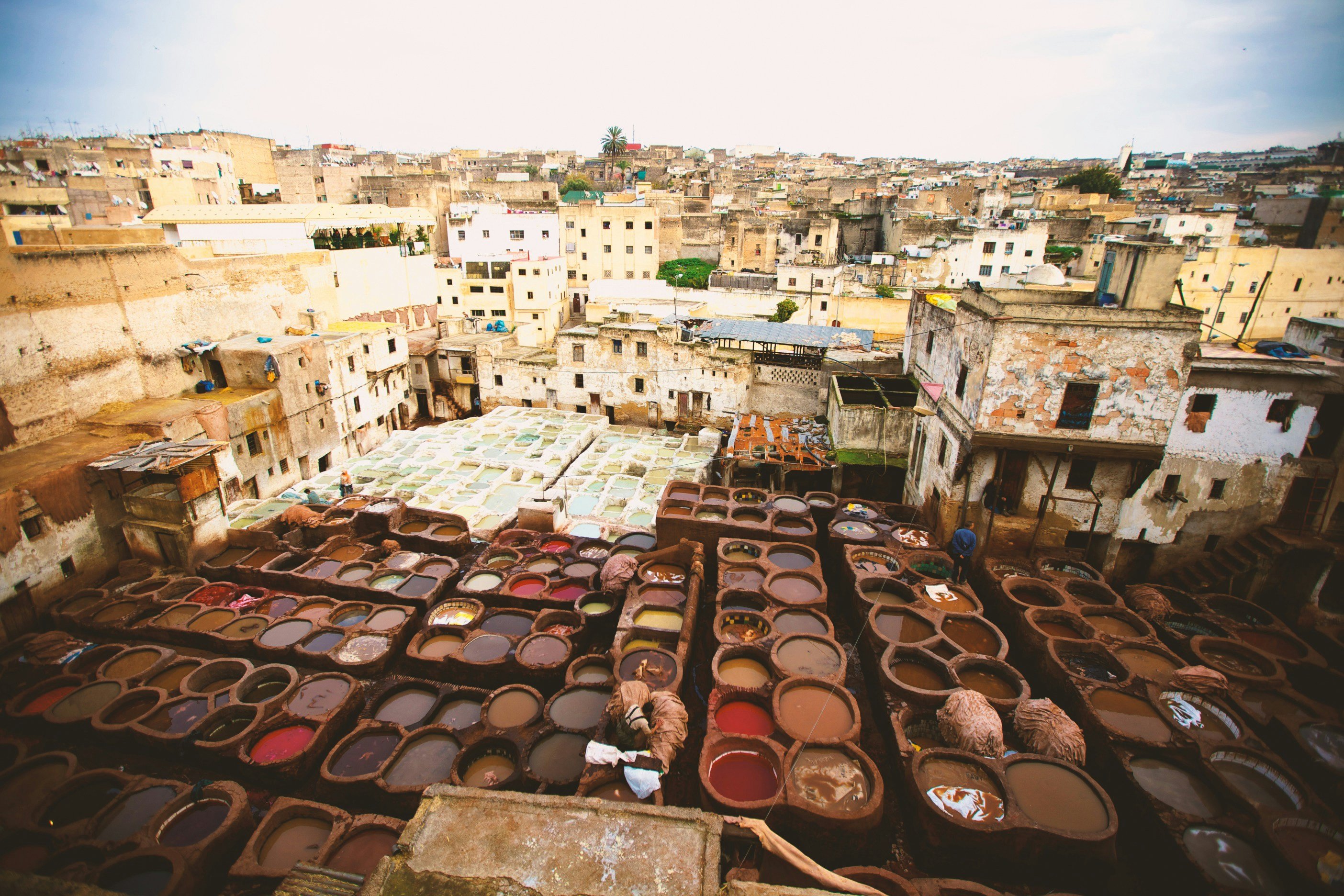
Fès lies about 530 km north-east of Marrakech, some six hours by road without stops. It is cooler than Marrakech in winter and much wetter, at 16 °C by day in January with rain on eight days of the month, and nearly as hot in high summer, at 35 °C in July and August. Its kindest months are May and September, when days average 26 to 30 °C and rain falls on four to six days of the month.
Which months suit your party?
Families with school-age children travel when the schools close. The Diwali break gives the finest Morocco of the year; Christmas and the New Year suit Marrakech and the coast, with warm layers for the evenings; and in May and June, the coast and Marrakech’s mornings make the better plan than long days in the desert.
Grandparents and older parents are happiest in October and November, then March and April, away from both the winter nights of the desert and the summer heat. Keep time on the road to about five hours a day, and settle the meals before you leave: vegetarian is easy when asked for clearly, and Jain food is on request, agreed dish by dish with each kitchen, as explained in how to ask for a Jain meal as a traveller in Morocco.
Couples have the whole calendar to choose from, and the shoulder months reward them most: the desert in October or April, Marrakech in March, the coast in June. For a night under the stars in the dunes, dates near the new moon show the sky at its darkest.
Groups of friends and extended families need the dates that suit the most people, then room to spread out. Plan the year-end weeks well ahead, and choose a season that asks for a single wardrobe: in October, November or April, light clothes and one warm layer serve the city, the mountains and the desert.
Six questions to choose your dates
- When is everyone free? School calendars differ from one state and one board to the next; start from the dates of the youngest travellers.
- Who is the oldest, and who is the youngest? Heat and cold weigh more on them than on anyone: favour the spring and autumn months.
- Is the desert part of the journey? Then choose October to April, with warm layers from December to February.
- Do your dates cross Ramadan? In 2027, it is expected to begin around 8 February, with Eid al-Fitr around 10 March: travel remains possible, at a different rhythm.
- Which connection suits your city? At present there is no non-stop flight between India and Morocco: see the journey from India, from flights to dirhams.
- What will each kitchen need to know? Write down the rules of the strictest eater in the party, and send them before you book.
So, when is the best time to visit Morocco from India?
In October and November, around Dussehra and Diwali, when Marrakech and the desert are at their gentlest and the coast is still warm; then in March and April, around Holi and Easter, when spring warms the cities and the desert. Christmas and the New Year offer mild days and cold nights, a fine season for Marrakech and the coast. The summer school holidays belong to the Atlantic, and July and August, inland, to the early mornings.
The right month, in the end, is the one that suits the oldest and the youngest in your party, and the regions you most want to see. Planning a journey for your family or your friends? Write to us with your dates, the ages in your party and the regions you have in mind, and we will answer by e-mail or video call.
Questions travellers ask about the seasons in Morocco
What is the best month to visit Morocco from India?
Is December a good time to visit Morocco?
Is Morocco too hot in May and June?
What is the weather in Morocco during Diwali?
When is Ramadan in 2027?
Does it snow in Morocco?
Editorial note
This guide draws on the World Meteorological Organization, for the long-term averages of Morocco’s Direction de la Météorologie Nationale (1991–2020) at Marrakech, Fès, Errachidia, Agadir and Casablanca, and of the India Meteorological Department at New Delhi, Mumbai, Bengaluru, Chennai and Ahmedabad (1901–2000, except Mumbai, 1951–2000); the Government of India’s list of holidays for its offices in Delhi in 2027 (Department of Personnel and Training, Office Memorandum of 16 July 2026, as circulated by the Department of Posts on 8 September 2026); the Directorate of Education of Delhi, for the summer vacation of 2026; the forecasts of the Astronomy Centre of the United Arab Emirates for Ramadan and the Eids of 2027, as reported by Khaleej Times and The National; the announcement of Ramadan 2026 by Morocco’s Ministry of Endowments and Islamic Affairs, as reported by Hespress; the Kingdom of Morocco’s list of religious and national holidays; the UK government’s travel advice for Morocco; Morocco’s national tourist office; and Wikipedia, for the Tizi n’Tichka. Road distances and driving times were calculated with the OSRM route planner on OpenStreetMap data. All were read on 30 October 2026. The distances to the Agafay, the Atlas and Merzouga, and the absence of a non-stop flight between India and Morocco, follow our guides to Marrakech with family, to the Merzouga desert and to the journey from India. The expected dates for Morocco were checked on 23 November 2026 against the new moons published by the US Naval Observatory and the crescent visibility maps of the International Astronomical Center.
Averages describe a typical year, not a forecast, and religious dates remain estimates until they are announced: check both before you book. Apart from the news outlets and public bodies cited as sources, no business is named, and none is recommended. Sehra Morocco plans Indian weddings and journeys in Morocco; it has not yet delivered a wedding, and this guide describes no journey of its own.
- World Meteorological Organization, World Weather Information Service: Marrakech, Fès, Errachidia, Agadir, Casablanca, New Delhi, Mumbai, Bengaluru, Chennai and Ahmedabad
- Government of India, Department of Personnel and Training, Office Memorandum F. No. 12/2/2023-JCA of 16 July 2026, holidays to be observed in Central Government offices during the year 2027 (PDF, as circulated by the Department of Posts on 8 September 2026)
- Government of NCT of Delhi, Directorate of Education, circular on the summer vacation of 2026 (PDF)
- Forecasts for Ramadan and the Eids of 2027: Khaleej Times, 22 August 2026; The National, 9 September 2026, updated 6 October 2026
- International Astronomical Center, crescent visibility for Ramadan 1448 and Shawwal 1448; US Naval Observatory, phases of the Moon, read on 23 November 2026
- Hespress, Morocco to begin Ramadan on Thursday, 18 February 2026
- Kingdom of Morocco, religious and national holidays
- GOV.UK, Morocco travel advice: safety and security, updated 19 August 2026
- Moroccan National Tourist Office: Essaouira-Mogador, Essaouira, sport and Marrakech, a big playground
- Wikipedia: Tizi n’Tichka
- Road distances and driving times: OSRM on OpenStreetMap data, calculated on 30 October 2026, without stops
Written by Sehra Morocco. Last reviewed: . Text last updated: .
Tell us about your trip.
By e-mail or video call. We reply within two working days.