The Merzouga desert from Marrakech: the road, the nights and the dunes of the Erg Chebbi
Merzouga is where the Moroccan Sahara looks the way every child draws it: the dunes of the Erg Chebbi, rising behind a village at the edge of the sand. From Marrakech it is a journey rather than an excursion, by road over the High Atlas or by air to Errachidia; here is how to make it, when, and for how long.
Reviewed 29 October 2026 · Updated 23 November 2026 · Sources at the end
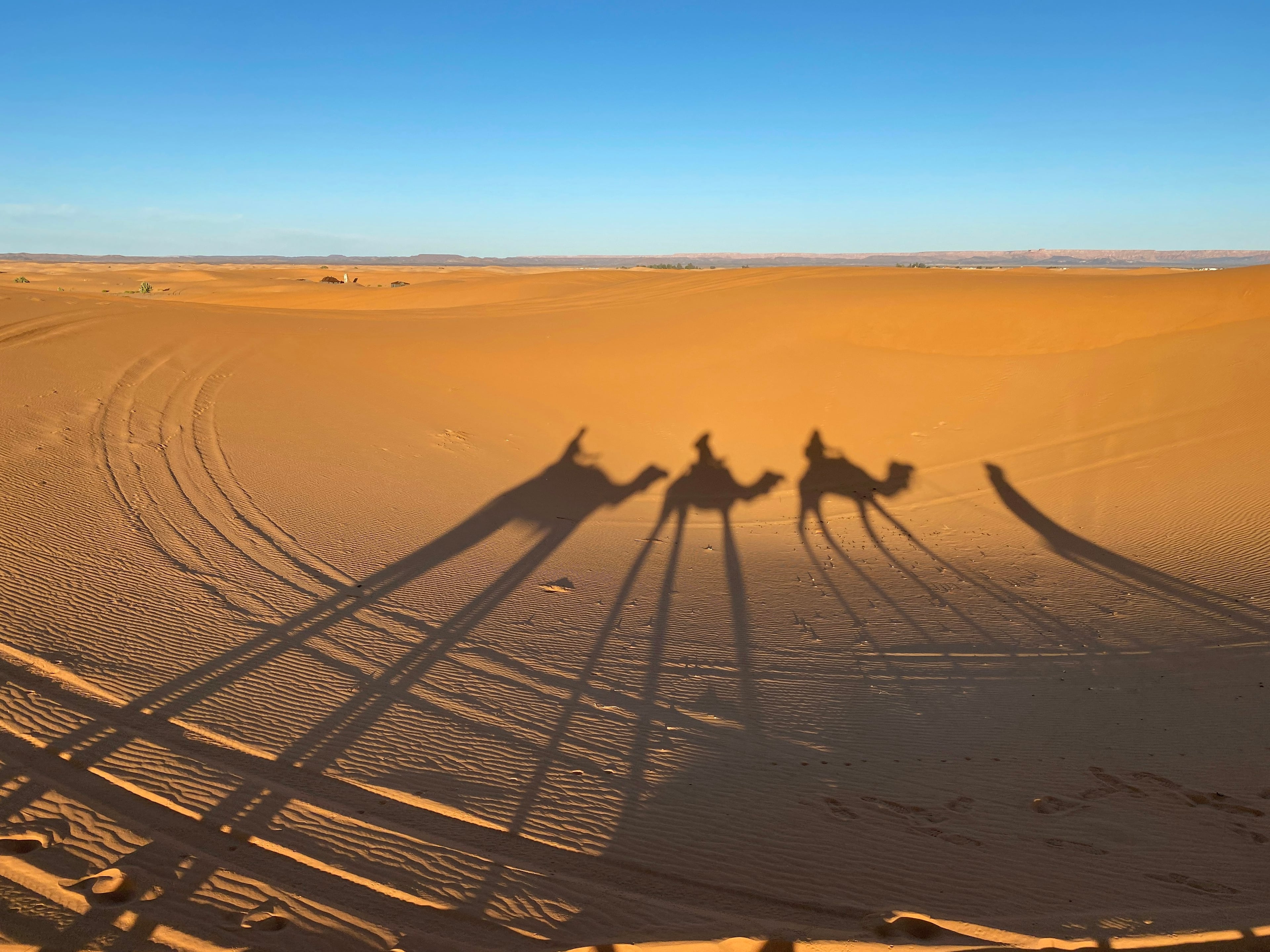
Merzouga lies some 560 km from Marrakech, on the far side of the High Atlas: about ten hours at the wheel before a single stop, which is why the road is best taken over two days, or shortened by a one-hour flight to Errachidia and two hours by road to the dunes. The Merzouga desert from Marrakech is, in other words, a journey of its own rather than a day out. Give the dunes two nights, choose the months between October and April, and shape the route around the oldest and the youngest in the party.
This guide sets out where Merzouga and the Erg Chebbi are, the two ways of getting there, how many nights to allow, the weather month by month, what to do among the dunes with grandparents and children, vegetarian and Jain meals far from any city, the official advice near the border, and how Merzouga compares with the Agafay and with Zagora. Sehra Morocco plans Indian weddings and tailor-made journeys across Morocco for travellers from India. The facts below come from official sources and from the published pages and written answers of desert camps, read in October 2026 and listed at the end; the practical advice that follows from them is ours.
Merzouga, at a glance
The essentials, checked on 29 October 2026:
- Where
- A village of Errachidia province, in south-eastern Morocco, on the western edge of the Erg Chebbi dunes
- The dunes
- Up to about 150 metres high, more than 20 km from north to south
- By road from Marrakech
- About 560 km over the Tizi n’Tichka pass: some ten hours of driving without stops, best split over two days
- By air
- Marrakech to Errachidia in about an hour, on Fridays and Sundays until 26 March 2027, then on Tuesdays, Thursdays and Saturdays from 30 March; about two hours by road to the dunes
- Nights
- Two in the dunes, in our view, plus the nights of the road
- Best months
- October and November, March and April; from December to February, nights of 2 to 5 °C on average
- At the table
- Vegetarian when asked for in advance; Jain on request
- The border
- Merzouga lies near Morocco’s border with Algeria, which is closed
Flight schedules, road conditions and camp arrangements change: check them again before you book.
Where is Merzouga, and what is the Erg Chebbi?
An erg is a sea of dunes shaped by the wind, and the Erg Chebbi is one of Morocco’s great ergs, at the western edge of the Sahara. Its dunes rise in places to about 150 metres above the surrounding stony plain, the hamada, and stretch for more than twenty kilometres from north to south and a few from east to west. Merzouga is the village along their western side, with hotels and camps strung out at the foot of the sand; the two are so close that the Erg Chebbi is often simply called the dunes of Merzouga.
Morocco’s national tourist office calls Merzouga one of the gates of the Sahara, and the Erg Chebbi a world of dunes, palm groves and tracks. The village belongs to the province of Errachidia, in the Drâa-Tafilalet region; the nearest towns are Rissani, about 35 km away, and Erfoud, about 55 km. This is a desert of sand, of a different nature from the Agafay, the stone desert an hour from Marrakech: the comparison comes at the end of this guide.
How to get to Merzouga from Marrakech
There are two ways in, and many journeys use both: the road on the way out, for the kasbahs and the gorges, and the air on the way back, to spare a second long day.
By road: over the High Atlas, in two days
Calculated on OpenStreetMap, the drive from Marrakech to Merzouga covers about 560 km and some ten hours at the wheel, before a single stop for tea, lunch or photographs. The road climbs over the High Atlas by the Tizi n’Tichka, a pass at more than 2,200 metres, and comes down to Ouarzazate, about 200 km and nearly four hours from Marrakech; near Ouarzazate, the earthen ksar of Aït Ben Haddou, a UNESCO World Heritage site since 1987, stands on the old caravan route (see our guide to Ouarzazate and Aït Ben Haddou). From Ouarzazate the road runs east to Boumalne Dadès, two hours further, and on to Tinghir, the gateway to the Todra gorges, an hour beyond; the last stretch, by way of Erfoud, takes about three and a half hours more.
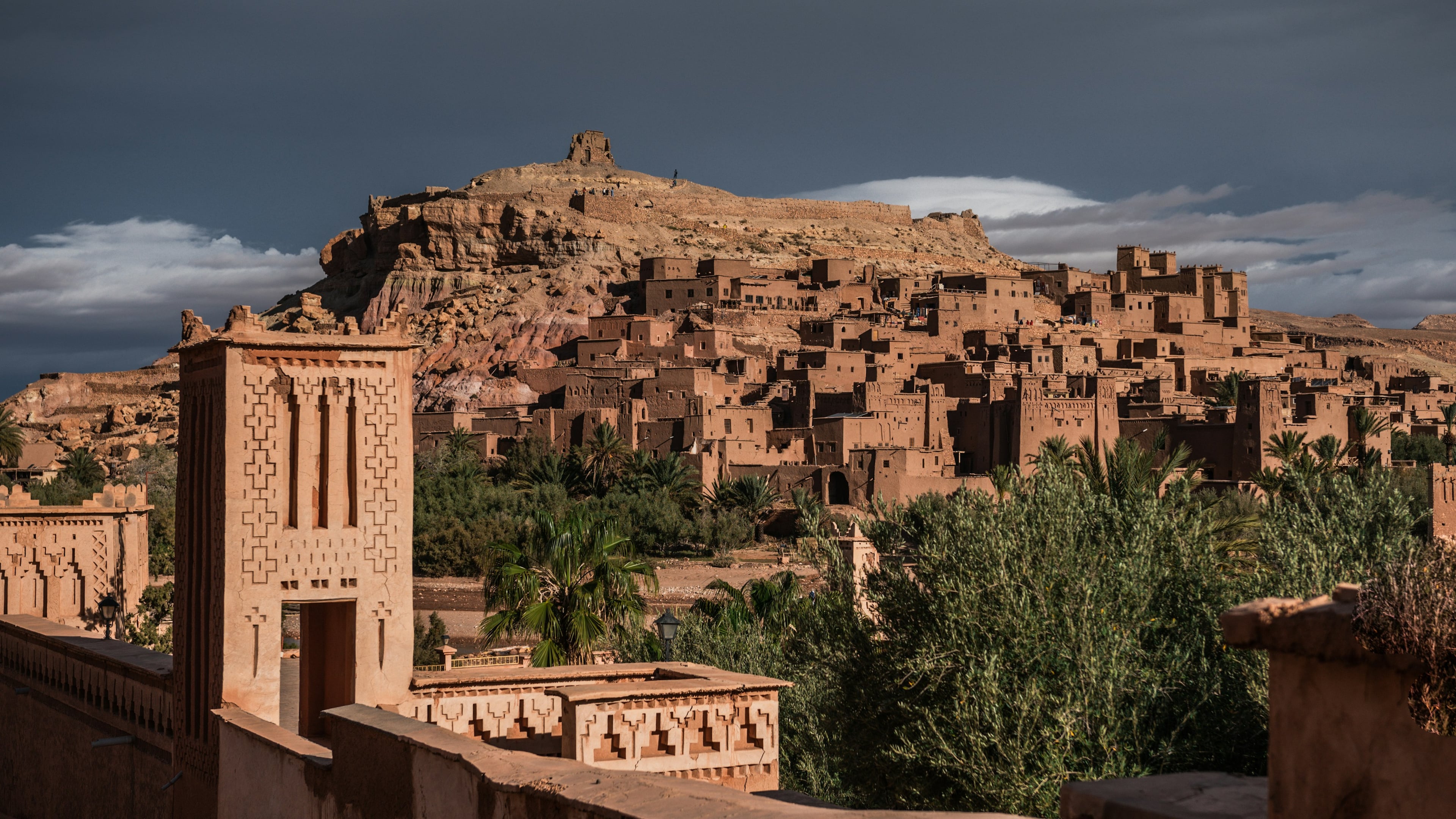
Those times are for a car that never stops; with a coach or a minibus, rests and lunch, every stage takes longer. Hence the classic rhythm: a night in the Dadès valley or near the Todra gorges, and the dunes reached the next afternoon, in time for the evening light. The gorges deserve the pause. The Dadès runs between walls of 200 to 500 metres, and near its end the Todra narrows to about ten metres, between rock faces up to 160 metres high.
In winter, the pass sets the pace. Snow often falls on the Tizi n’Tichka between November and March, and the UK government notes that mountain roads can be especially hazardous in poor weather, and that poor lighting makes driving at night dangerous. Cross by day, and never on the day of a flight home: keep a night in Marrakech between the road back and the airport.
By air: Marrakech to Errachidia
The flight changes the arithmetic. Ryanair’s published timetable, read on 29 October 2026, links Marrakech and Errachidia twice a week until 26 March 2027, on Fridays and Sundays, with no flight on Christmas Day. On Sundays, the flight leaves Marrakech at 1.10 pm and lands in Errachidia at 2.10 pm, and the return leaves at 2.35 pm to land in Marrakech at 3.35 pm; on Fridays, the same journey runs in the evening, from 8.35 pm to 9.35 pm, and back from 10 pm to 11 pm. From 30 March 2027, the same timetable lists three flights a week instead, on Tuesdays, Thursdays and Saturdays, at other times: on Saturdays, the flight leaves Marrakech at 12.10 pm and lands at 1.15 pm, and the return leaves Errachidia at 1.40 pm. Check which dates are open for booking.
Errachidia’s airport, Moulay Ali Cherif (ERH), lies about 120 km from Merzouga, some two hours by road, and camps in the Erg Chebbi publish pick-ups there by 4x4, with the luggage taken to the tent. Of the two winter flights, the Sunday one is the kinder for a family: the dunes are reached by late afternoon, whereas the Friday flight ends with two hours on the road in the dark.
Royal Air Maroc lists Errachidia, Ouarzazate and Zagora in its domestic network, served from Casablanca; on 29 October 2026 its pages showed fares between Casablanca and Errachidia, but no timetable. That route suits travellers who reach Morocco through Casablanca, as some journeys from India do: the connections are set out in flights from India and the airport for Marrakech. Ryanair, for its part, publishes no flight between Marrakech and Ouarzazate.
Road one way, air the other
Because the winter flights run only on Fridays and Sundays, flying both ways fixes the length of the stay: a late Friday arrival with a Sunday return gives two nights in the dunes, but begins with a night drive and ends with a Sunday morning on the road; a Sunday arrival with the following Friday’s return gives five nights. Most families will find the middle path easier: drive out over two days by the gorges, and fly back to Marrakech on a Sunday. The Saturday flight listed from the end of March, which lands at 1.15 pm, would play the part of the Sunday flight.
How many nights in Merzouga?
Two, at the least. One night means arriving at dusk, tired from the road, and leaving at dawn; two leave a whole day among the dunes, a sunset and a sunrise without hurry, and a margin if the wind rises. It is the minimum we recommend for any journey to the desert. Desert trips of two or three days from Marrakech are sold, but with some ten hours of driving each way, the road takes up most of their daylight.
Counted from Marrakech, that gives three shapes of journey:
- Four nights, by road both ways. A night in the Dadès valley or near the Todra on the way out, two in the dunes, a night around Ouarzazate on the way back, and Marrakech on the fifth day.
- Three nights, by road and by air. The same road out, two nights in the dunes, and the Sunday flight from Errachidia back to Marrakech (from the end of March, the timetable lists a Saturday flight instead).
- A loop to Fès. Two nights in the dunes, then north to Fès, about 460 km and some eight hours of driving away, by the Tafilalet oases and the Middle Atlas, with a night on the way for elders; the journey can as well begin in Fès and end in Marrakech. What to see there: things to do in Fès.
Is a day trip possible? Not to Merzouga: twenty hours of driving do not fit in a day. For a desert evening without a night away, the Agafay, an hour from Marrakech, is the answer, as the comparison below explains.
When to go: the Merzouga weather, month by month
The nearest station for which the World Meteorological Organization publishes long-term averages is at Errachidia, about two hours’ drive to the north, and its figures give the shape of the year: a gentle autumn and spring, mild winter days with cold nights, and a summer of fierce heat. Little rain falls in any month, on three to five days on average.
Errachidia’s averages, month by month
- October
- 27 °C by day · 14 °C at night
- Warm days, mild nights: among the gentlest months
- November
- 21 °C by day · 8 °C at night
- Soft light and cool nights: among the gentlest months
- December
- 17 °C by day · 4 °C at night
- Mild days, cold nights
- January
- 16 °C by day · 2 °C at night
- Mild days, nights close to freezing
- February
- 18 °C by day · 5 °C at night
- Cold nights; Ramadan expected from around 8 February 2027
- March
- 22 °C by day · 9 °C at night
- Warmer days; spring winds can lift the sand
- April
- 26 °C by day · 13 °C at night
- Warm days, comfortable nights; wind still possible
- May
- 30 °C by day · 17 °C at night
- Hot afternoons
- June
- 35 °C by day · 22 °C at night
- Very hot
- July
- 40 °C by day · 26 °C at night
- The hottest month: the dunes at dawn and dusk only
- August
- 38 °C by day · 25 °C at night
- Very hot
- September
- 33 °C by day · 20 °C at night
- Hot, easing towards the end of the month
| Month | Average high | Average low | What to expect |
|---|---|---|---|
| October | 27 °C | 14 °C | Warm days, mild nights: among the gentlest months |
| November | 21 °C | 8 °C | Soft light and cool nights: among the gentlest months |
| December | 17 °C | 4 °C | Mild days, cold nights |
| January | 16 °C | 2 °C | Mild days, nights close to freezing |
| February | 18 °C | 5 °C | Cold nights; Ramadan expected from around 8 February 2027 |
| March | 22 °C | 9 °C | Warmer days; spring winds can lift the sand |
| April | 26 °C | 13 °C | Warm days, comfortable nights; wind still possible |
| May | 30 °C | 17 °C | Hot afternoons |
| June | 35 °C | 22 °C | Very hot |
| July | 40 °C | 26 °C | The hottest month: the dunes at dawn and dusk only |
| August | 38 °C | 25 °C | Very hot |
| September | 33 °C | 20 °C | Hot, easing towards the end of the month |
Long-term averages for 1991–2020 at Errachidia, from Morocco’s Direction de la Météorologie Nationale, published by the World Meteorological Organization and rounded to the nearest degree. The dunes lie about two hours’ drive away, and a given night can be colder or warmer than the average.
On these figures, October and November, then March and April, are the gentlest months, with days in the twenties and nights that ask for no more than a jacket. December to February bring mild, sunny days and nights of 2 to 5 °C on average: a January night at Errachidia averages 2 °C, several degrees colder than a January night in New Delhi, at about 8 °C. One camp in the Erg Chebbi publishes heaters in its tents, hot-water bottles or electric blankets for the winter months; ask yours what it provides, and pack a warm layer for the early morning, when the cold is sharpest. From June to August, the averages climb to 35–40 °C by day: the dunes are then for the first and last hours of light, and hardly for grandparents.
Spring has one caveat. A camp in the Erg Chebbi warns that sandstorms can blow up in spring; its tents are built for strong winds and, in the worst case, it moves its guests to a hotel for the night. In March and April, keep a spare day in the plan, and ask the camp in writing what it does when the wind rises.
Ramadan, next expected from around 8 February to 9 March 2027, and from around 28 January to 26 February 2028, changes the rhythm of the day more than the desert itself. The UK government notes that eating, drinking or smoking in public in the daytime may cause offence, and that driving may be erratic around dusk, as people hurry home: keep the long drives away from sunset. The dates and their sources are in our guide to travelling in Morocco during Ramadan.
One more calendar matters to stargazers: the moon. A camp in the Erg Chebbi notes that the stars are harder to see at full moon; if the night sky is the point of the journey, choose dates near the new moon.
For the rest of Morocco, region by region, and how its seasons meet India’s holidays, see the best months to visit Morocco from India.
Dawn on the dunes, and what else to do
The light is the event. In the late afternoon the dunes turn from gold to copper and their shadows lengthen; at daybreak, as Morocco’s tourist office puts it, the sun rises over the dunes in a magical scene, and camps send their guests up the dune behind the tents to watch it. Between the two, the desert asks for very little: a walk along a ridge, tea in the shade, a long lunch, and the silence.
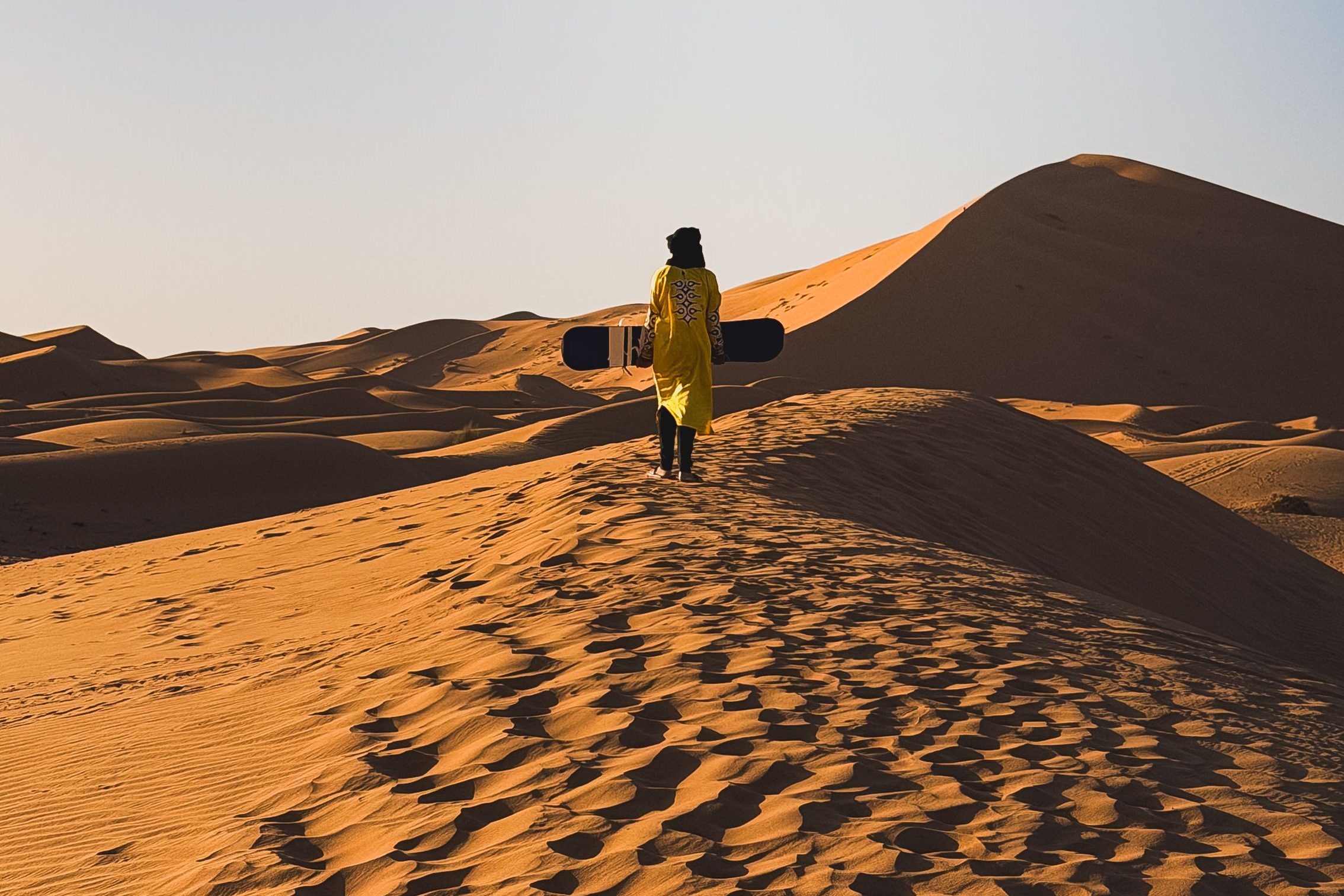
Camps in the Erg Chebbi publish a familiar list of things to do: camel rides at sunset or sunrise, sandboarding, 4x4 outings to nomad families, villages and fossil sites and, in some camps, an evening with a telescope and someone to explain the sky.
A camel, or another way up the ridge
The camel is the picture everyone brings home, and it need not be an ordeal. According to the camps’ own pages, a ride can be as short as twenty minutes or last a whole day, and the ride from the edge of the dunes to a camp takes about forty minutes to an hour. No one is obliged to ride, though: camps also take guests and their luggage to the tents by 4x4. Ask whether a grandparent can go ahead by 4x4 while the others ride, and whether a small child can take a short loop at sunset rather than the long way in. Ask, too, about the last few metres: from the vehicle to the tent, and from the tent to the viewpoint, the way may be on foot, in soft sand.
Quads and buggies are the noisier choice. The UK government notes that providers of adventure activities may not meet UK safety standards, and that some insurance policies do not cover quad biking: check both before anyone in the family takes the handlebars.
Khamlia and the music of the Gnawa
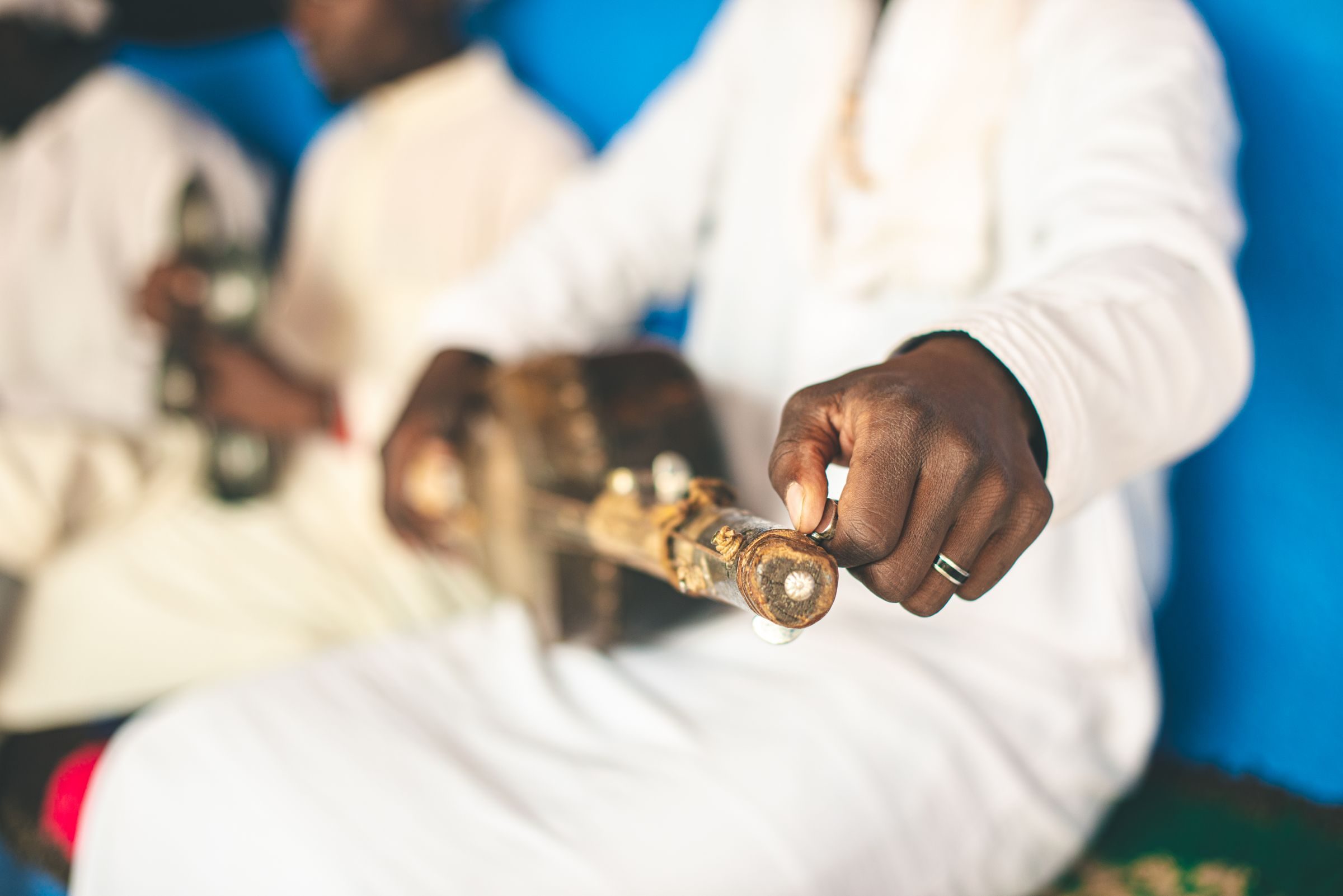
Some 7 km from Merzouga, at the edge of the dunes, the village of Khamlia is known for its Gnawa music, and 4x4 tours from Merzouga can include it. UNESCO inscribed Gnawa on its Representative List of the Intangible Cultural Heritage of Humanity in 2019: a Sufi brotherhood music, first practised by communities that came out of slavery and the slave trade, which in the countryside plays on large drums and castanets, its musicians dressed in white. Ask your camp whether an evening of Gnawa music can be arranged: it is an hour every generation can share.
Rissani and the memory of Sijilmasa
About 35 km to the north-west, Rissani was the capital of the Tafilalet oasis, and Morocco’s tourist office calls it the cradle of the Alaouite dynasty. The mausoleum of Moulay Ali Cherif, an ancestor of the dynasty’s founder, stands on the edge of the town, and its souk is busiest on Tuesdays, Thursdays and Sundays. Just north lie the ruins of Sijilmasa, until the fourteenth century the northern end of the western caravan route across the Sahara. Indian travellers may like to know who passed this way: Ibn Battuta, the traveller from Tangier whose journeys had taken him to India, stayed in Sijilmasa in 1352 on his way to the Mali Empire, and judged its dates finer than those of Basra.
A lake, in some years
Morocco’s tourist office describes a surprise among the dunes: Dayet Srij, a lake met at the bend of a dune, with wading birds in its water and storks overhead. The water is not always there: after the heavy rains of October 2024, temporary lakes formed in normally dry areas around Merzouga, something not seen there for decades. Ask the camp whether there is water before planning a morning around it.
Vegetarian and Jain food in the desert
Far from any city, every meal comes from the camp’s kitchen, and that is good news for a vegetarian family. Camps in the Erg Chebbi publish that they cook in their own kitchens and ask to be told of any diet when you book. One camp adapts its daily menu to its guests’ diets, and can serve a Jain dinner before sunset when the group has the camp to itself.
Vegetarian is therefore simple when asked for in advance, and Jain food is on request: set out the rules in writing before you book, from no onion, garlic or root vegetables to no egg or honey, and ask for the hour as well as the dishes, since a winter sunset comes early. The words to use, and a list in French to show the kitchen, are in how to ask for a Jain meal as a traveller in Morocco. On the two road days, lunch is wherever the road allows: carry what the strictest eater in the party needs.
Is Merzouga safe? The border and the official advice
The Erg Chebbi lies in the south-east, not far from Morocco’s border with Algeria, which is closed. The UK government’s advice, updated on 19 August 2026, says that the authorities patrol and closely monitor the border, that crossing it without authorisation is illegal, and that travellers should not attempt it; its advice for Morocco carries no warning against travel. The United States rates Morocco at level 2 of 4, “exercise increased caution”, because of a risk of terrorism, and adds that some areas have increased risk; its advisory is linked in the note below. France’s foreign ministry, for its part, asks for increased vigilance along the southern part of the border with Algeria; its text names no town there.
In practice, the rule is simple: travel with licensed drivers and guides, keep 4x4 and quad outings to the routes the camp knows, and stay with the group after dark. The UK government also asks travellers to check that their destination can provide the healthcare they may need, and to carry insurance that covers medical evacuation: two hours from the nearest airport, ask the camp how it handles an emergency. The rest of what the official advice says about Morocco as a whole is set out in our guide to the journey from India.
Merzouga, the Agafay or Zagora?
Three deserts lie within reach of Marrakech, and they answer different questions.
The Agafay: an evening, not an expedition
The Agafay is a stone desert about 35 km from Marrakech, less than an hour by road: no sand dunes, but a wide, bare landscape facing the Atlas, with camps for a sunset, a dinner and, for those who wish, a night. For a family with very young children or very elderly parents, or with a single day to spare, it gives the desert evening without the journey; see how the Agafay fits into a family stay in Marrakech, and our full guide to the Agafay desert.
Zagora and the Erg Chigaga: further, wilder
Zagora, in the Drâa valley, is the closer of the southern gateways: about 350 km and some six and a half hours of driving from Marrakech, over the same pass. Near the town rises the dune of Tinfou, which Morocco’s tourist office calls exceptional for standing so far from the desert; the great dunes lie further on. M’Hamid is about two hours beyond Zagora, and the Erg Chigaga, the largest of Morocco’s ergs, lies some 56 km past it: reaching its camps means about 60 km of track by 4x4, over sand, stony ground and dry river beds. The reward is remoteness: a camp there says its dunes attract fewer visitors than those of the Erg Chebbi, and Royal Air Maroc showed no fare between Casablanca and Zagora on 29 October 2026. More in our guide to Zagora and the Drâa valley.
Merzouga: the great dunes, and the distance
Merzouga brings the great dunes of the Erg Chebbi, rising to about 150 metres, a road to their foot, hotels as well as camps, and a flight to Errachidia for the way back. What it asks in return is distance: some ten hours by road from Marrakech.
Six questions to choose your desert
- How many nights can you give it? Fewer than three: the Agafay. Three or four: Merzouga, with the flight one way. A week: Merzouga by road, or the Erg Chigaga.
- Who is the oldest, and who is the youngest? Long drives, a 4x4 track and soft sand weigh more than the dunes themselves.
- Do you want sand dunes, or a desert evening? The Agafay has no dunes; Merzouga and the Erg Chigaga do.
- Which month? From October to April, with warm layers from December to February and a spare day in spring.
- Who will cook? Vegetarian, and Jain on request, agreed in writing before you book.
- Is the camp licensed, and what is its plan for wind, cold or illness? The local authorities have closed unlicensed camps before; ask for the answers in writing.
So, is the Merzouga desert worth the journey from Marrakech?
Yes, if you can give it the time. With three or four nights between October and April, Merzouga repays the road: the Erg Chebbi at dawn, a Gnawa evening, the oases of the Tafilalet, and two nights of a silence no city can offer. With less, the Agafay is the wiser choice, and the Sahara can wait for another journey.
The rest is preparation: the road out by the gorges, the flight back from Errachidia, two nights in the dunes, warm layers for the early morning, and the kitchen told in advance. Flying in from India? Start with the journey from India, from flights to dirhams; for the days in the city, see things to do in Marrakech with grandparents and children.
Planning the desert for your family or your group? Write to us with your dates, the ages in your party and the nights you can give the desert, and we will answer by e-mail or video call. If the desert follows a wedding in Marrakech, the trips planned around a wedding in Morocco have a page of their own.
Questions travellers ask about Merzouga
How far is Merzouga from Marrakech?
Can you fly from Marrakech to Merzouga?
How many nights should you spend in Merzouga?
What is the best time to visit Merzouga?
How cold does the Merzouga desert get at night?
Is Merzouga suitable for elderly parents and young children?
Merzouga or the Agafay?
Editorial note
This guide draws on Morocco’s national tourist office; the World Meteorological Organization, for the long-term averages of Morocco’s Direction de la Météorologie Nationale at Errachidia (1991–2020) and of the India Meteorological Department at New Delhi (1901–2000); the UK government’s travel advice for Morocco; the US Department of State’s travel advisory for Morocco; the travel advice of France’s Ministry for Europe and Foreign Affairs; the published timetable of Ryanair and the network of Royal Air Maroc; UNESCO, for Gnawa; the brief on India–Morocco relations published by India’s Ministry of External Affairs in April 2026, for Ibn Battuta’s journey to India; and Wikipedia, for the geography and history of the Erg Chebbi, Merzouga, Khamlia, Rissani, Sijilmasa, Erfoud, Aït Ben Haddou, the Tizi n’Tichka, the Dadès and Todra gorges and the Erg Chigaga. Road distances and driving times were calculated with the OSRM route planner on OpenStreetMap data. Details of life in the camps come from the published pages of several camps in the Erg Chebbi and the Erg Chigaga, and from the written answers of a camp in the Erg Chebbi in October 2026, kept on file; the dates of Ramadan follow our guide to Morocco during Ramadan. All were read on 29 October 2026. The dates of Ramadan were checked again on 23 November 2026.
Flight schedules, road conditions and camp arrangements change, sometimes without notice: check them before you book. Apart from airlines and public bodies, no business is named, and none is recommended. Sehra Morocco plans Indian weddings and journeys in Morocco; it has not yet delivered a wedding, and this guide describes no journey of its own.
- Moroccan National Tourist Office: Errachidia, Midelt and Merzouga, a desert break and Ouarzazate, Zagora and Tinghir
- World Meteorological Organization, World Weather Information Service: Errachidia and New Delhi
- GOV.UK, Morocco travel advice: regional risks, safety and security and health, updated 19 August 2026
- US Department of State, Morocco travel advisory, issued 4 September 2026
- France, Ministry for Europe and Foreign Affairs, Maroc: sécurité (in French), areas of vigilance updated 11 March 2026
- Ryanair, timetable (Marrakech – Errachidia, winter 2026–2027 and summer 2027); Royal Air Maroc, our network
- UNESCO, Intangible Cultural Heritage: Gnawa, inscribed in 2019
- Government of India, Ministry of External Affairs, India–Morocco bilateral relations (PDF), April 2026
- Wikipedia: Erg Chebbi, Merzouga, Khamlia, Rissani, Sijilmasa, Erfoud, Aït Benhaddou, Tizi n’Tichka, Dadès Gorges, Todgha Gorge and Erg Chigaga
- Road distances and driving times: OSRM on OpenStreetMap data, calculated on 29 October 2026, without stops
- Published pages of desert camps in the Erg Chebbi and the Erg Chigaga, read on 29 October 2026; written answers from a camp in the Erg Chebbi, October 2026, kept on file.
Written by Sehra Morocco. Last reviewed: . Text last updated: .
Tell us about your trip.
By e-mail or video call. We reply within two working days.