Jain food in Morocco, and every Indian cuisine at your wedding
Yes, strict Jain food is possible at a wedding in Morocco, and so is the food of every Indian region your family cooks at home.
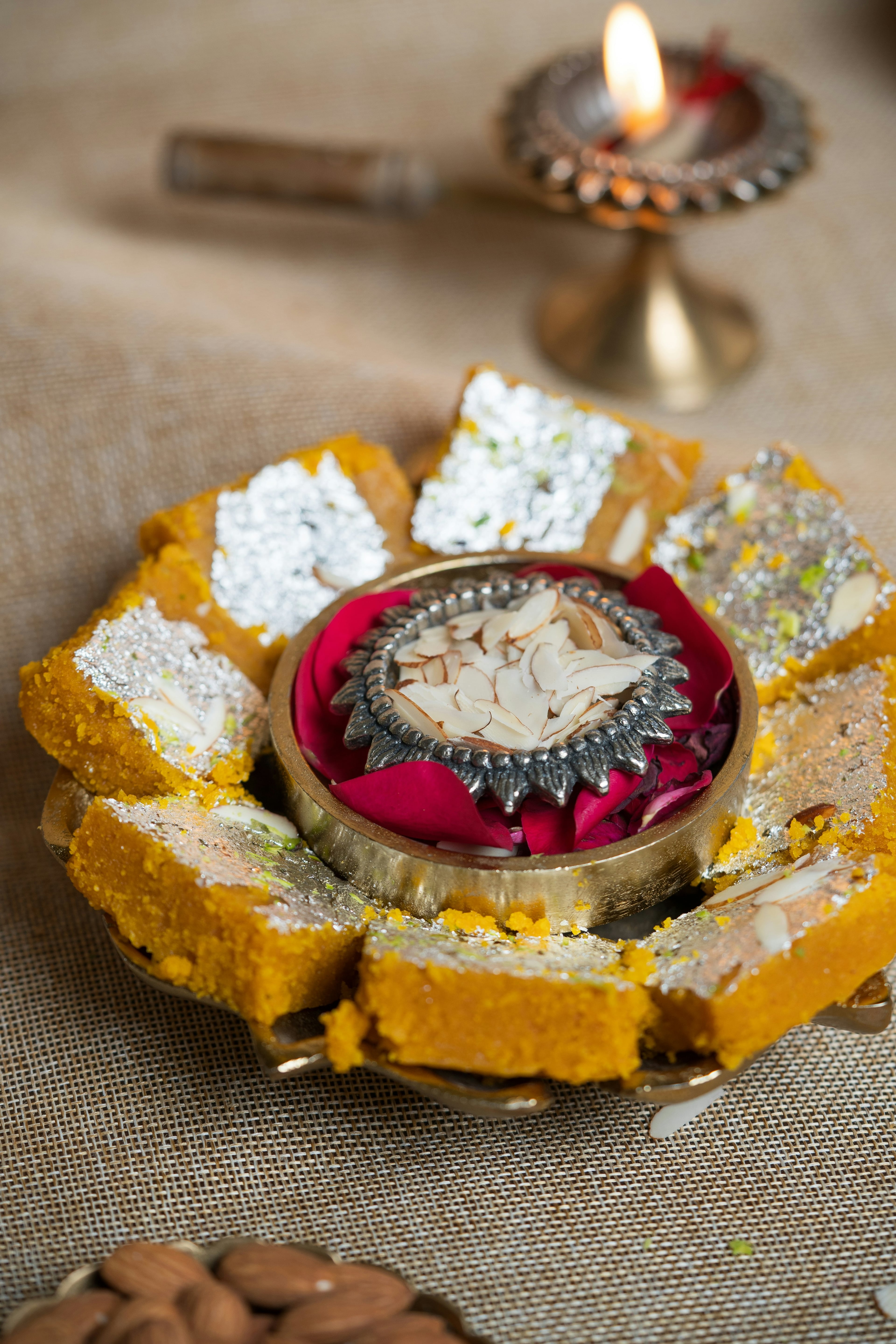
Can you serve Jain food in Morocco? Yes. A wedding in Marrakech can follow Jain rules strictly, with no root vegetables, no honey and meals before sunset, for three hundred guests, in a kitchen set aside for it. And Jain is only one of the tables an Indian wedding needs: Punjabi, Gujarati, Marwari, South Indian and Bengali families each bring their own. This guide explains what we serve, who cooks it, and what has to come from home. For how we run the wedding kitchen itself, see The Table.
At a glance
- Pure vegetarian by default, in every venue: no meat, no fish, no egg.
- Strict Jain on request: no root vegetables, no honey, served before sunset.
- Every regional cuisine: Punjabi, Gujarati, Marwari, South Indian, Bengali, Maharashtrian, street food and mithai.
- Who cooks: a chef from India, London or Dubai, an Indian kitchen in Marrakech, or the venue’s brigade under an Indian chef.
- Indian ingredients are ordered at least two months before the wedding.
Every Indian cuisine, at one wedding
Families rarely eat one cuisine only. A Gujarati bride and a Punjabi groom, a Tamil family with guests from London and Dubai: the menu follows the family, ceremony by ceremony. These are the dishes families ask us for most often, and what they mean in Morocco.
- Punjabi
- Tandoori breads, paneer tikka, dal makhani, chole; sarson da saag with makki di roti in winter
- Tandoors are sold in Morocco; paneer is made on site.
- Gujarati
- The thali, dhokla, khandvi, undhiyu in winter, shrikhand
- Often pure veg and Jain: daylight meals, mocktail bars.
- Marwari & Rajasthani
- Dal baati churma, gatte ki sabzi, ker sangri
- Usually without onion or garlic; dried ker and sangri come from India.
- South Indian
- A banana-leaf meal (sadya in Kerala, virundhu in Tamil Nadu), dosa, idli, sambar, rasam, payasam
- The Muhurtham is often at dawn, so the wedding meal can be a breakfast.
- Bengali
- Luchi, cholar dal, shukto, mishti doi, rosogolla
- A vegetarian Bengali menu, like every table we plan.
- Maharashtrian
- Puran poli, masale bhat, and modak for the Ganesh Puja
- Served on the day of the puja, at the hour your pandit sets.
- Street food
- Pani puri, chaat, pav bhaji, jalebi fried to order
- Live counters for the Mehendi afternoon or the Sangeet night.
- Indo-Chinese
- Hakka noodles, vegetable Manchurian
- Cooked in the same pure-veg kitchen.
- Mithai
- Kaju katli, ladoo, barfi; rasmalai and rabri
- Dry sweets can travel; milk sweets are made on site.
| Cuisine | Dishes families ask for | In Morocco |
|---|---|---|
| Punjabi | Tandoori breads, paneer tikka, dal makhani, chole; sarson da saag with makki di roti in winter | Tandoors are sold in Morocco; paneer is made on site. |
| Gujarati | The thali, dhokla, khandvi, undhiyu in winter, shrikhand | Often pure veg and Jain: daylight meals, mocktail bars. |
| Marwari & Rajasthani | Dal baati churma, gatte ki sabzi, ker sangri | Usually without onion or garlic; dried ker and sangri come from India. |
| South Indian | A banana-leaf meal (sadya in Kerala, virundhu in Tamil Nadu), dosa, idli, sambar, rasam, payasam | The Muhurtham is often at dawn, so the wedding meal can be a breakfast. |
| Bengali | Luchi, cholar dal, shukto, mishti doi, rosogolla | A vegetarian Bengali menu, like every table we plan. |
| Maharashtrian | Puran poli, masale bhat, and modak for the Ganesh Puja | Served on the day of the puja, at the hour your pandit sets. |
| Street food | Pani puri, chaat, pav bhaji, jalebi fried to order | Live counters for the Mehendi afternoon or the Sangeet night. |
| Indo-Chinese | Hakka noodles, vegetable Manchurian | Cooked in the same pure-veg kitchen. |
| Mithai | Kaju katli, ladoo, barfi; rasmalai and rabri | Dry sweets can travel; milk sweets are made on site. |
Jain food in Morocco: what we guarantee
Jain food is the strictest table at an Indian wedding, and the one families worry about most abroad. In Morocco, it is cooked in a dedicated kitchen, by a team that knows the rules, and labelled dish by dish.
- No root vegetables: no onion, garlic, potato, carrot, beetroot or fresh ginger. No honey, no mushrooms, no alcohol in any dish.
- Before sunset for families who keep chauvihar: in Marrakech in December, around 6.30 pm. The service plan follows the sunset of each day.
- A kitchen set aside: dedicated utensils, boards, frying oil and work station, cleaned before the team starts.
- Filtered or boiled water, nothing from the day before, yoghurt set the same day.
- Paneer made on site, curdled with lemon or vinegar, never with animal rennet.
- On excursions, a Jain basket prepared by the same kitchen; honey-free welcome gifts in every room.
Families keep Jain rules in different ways. Before the menu is written, we ask each household what it follows, from root vegetables to chauvihar, and the kitchen works from that list.
No onion, no garlic: Swaminarayan and satvik tables
Many Gujarati families, Swaminarayan followers among them, eat no onion and no garlic; satvik kitchens avoid them too. These dishes come from the same pure-veg kitchen and are labelled on every buffet and every thali, so that each guest knows what is on the plate.
Who cooks your wedding food
Many luxury venues in Marrakech work only with their own caterer. The usual arrangement is therefore a guest Indian chef or caterer who cooks in the venue’s kitchen, under its food-safety approval, with its brigade. In practice, three options:
- A chef or caterer from India, London or Dubai, who travels with a team.
- An Indian kitchen based in Marrakech. One confirmed to us in writing, on 12 October 2026, that it can cater strict Jain food end to end for 300 guests.
- The venue’s own brigade, under the supervision of an Indian chef.
A 100% vegetarian caterer in London also confirmed to us in writing, the same day, that it cooks Jain and chauvihar menus. We choose with you and the venue, and the choice is written into the contract.
Ingredients: what we find in Morocco, what comes from home
We could not confirm any dedicated Indian importer or Indian grocery in Morocco. Fresh vegetables, fruit, milk and flour are bought locally, and cumin, turmeric and coriander are easy to find. Asafoetida (hing), kasuri methi, amchur, besan, dried ker and sangri come from India, the UK or Dubai.
Since 1 January 2025, every foreign food supplier must be registered with ONSSA, Morocco’s food-safety office, on its ATLAS platform, and validation can take up to 60 days. Dairy products, sauces and pickles also need a health certificate from the country of origin. That is why we order at least two months before the wedding, and why paneer and ghee are made on site from local milk and butter.
Moroccan-Indian fusion
The two cuisines share saffron, cumin, coriander and slow cooking. A few fusion dishes from our menus:
- A vegetarian red lentil harira with garam masala
- Smoked aubergine zaalouk beside dal makhani
- Squash tagine with ras el hanout and cardamom
- Saffron and pistachio kulfi, rose lassi
- Mint tea and masala chai, poured side by side
Questions families ask about the food
Is Morocco vegetarian friendly?
Is all food in Marrakech halal?
Can our family maharaj or halwai cook?
Will alcohol be served?
Can we taste the menu before the wedding?
Sources
- ONSSA, order n° 466-23 on foreign food suppliers and the ATLAS platform: official text (PDF)
- ONSSA, order n° 2768-12 on the food-safety approval of caterers with kitchens: official text (PDF, in French)
- Jain dietary rules, an overview: Jain vegetarianism
- Written confirmations from two caterers, 12 October 2026, kept on file.
Written by Sehra Morocco. Last reviewed: . Rules on food imports change; we check them before every wedding.
Tell us about your celebration.
By e-mail or video call. We reply within 48 hours.