Ouarzazate and Aït Ben Haddou from Marrakech: the earthen ksar, the gateway to the south and a night on the road
On the far side of the High Atlas, the light changes and the houses turn to earth. Aït Ben Haddou, a fortified village climbing a hillside above a river, has stood on the caravan road for centuries; Ouarzazate, a few kilometres away, is the town where every road to the Sahara begins. Here is how to reach them, what to see, and why they deserve a night rather than a dash.
Reviewed 12 November 2026 · Updated 23 November 2026 · Sources at the end
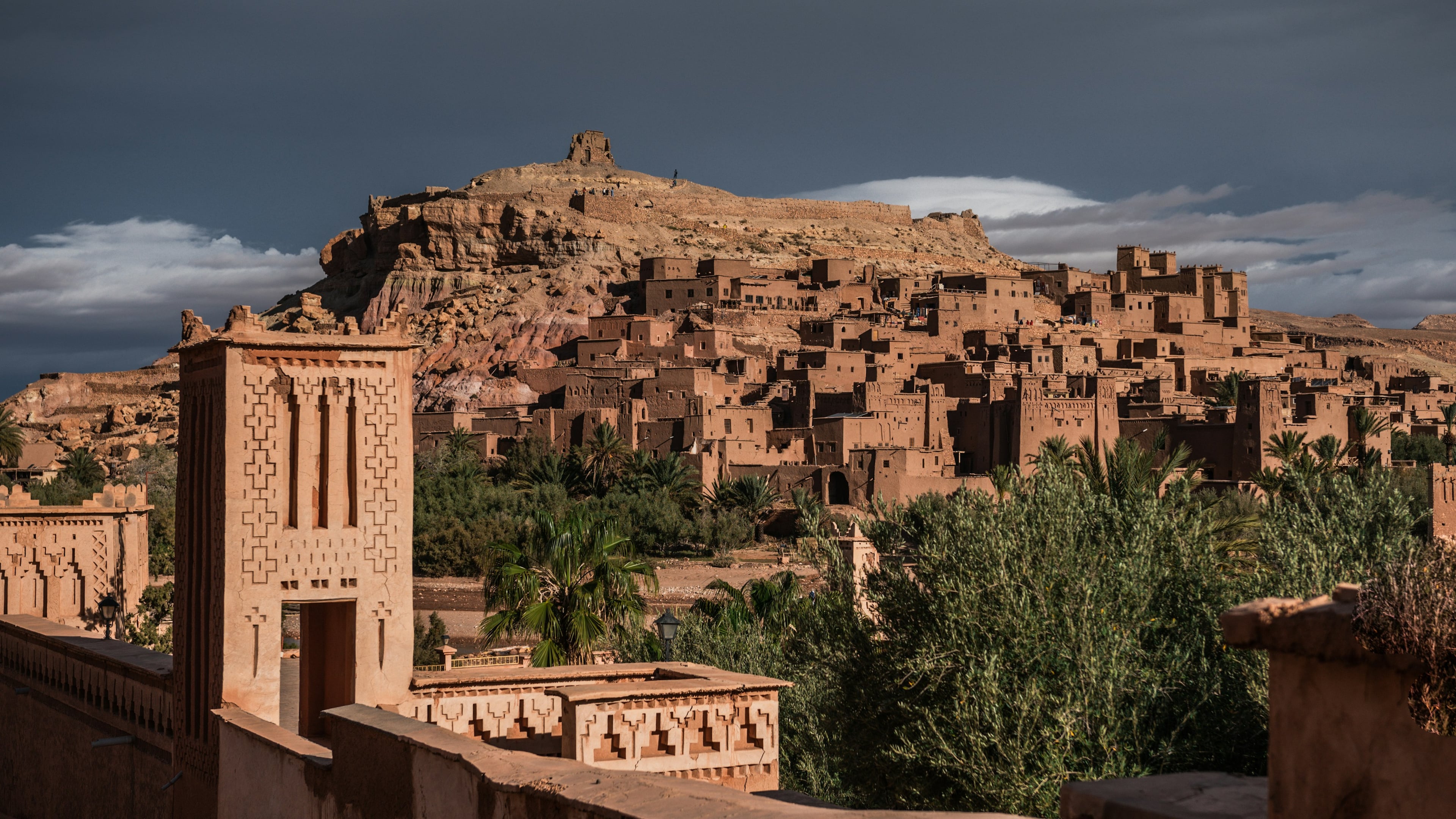
Ouarzazate lies about 195 km from Marrakech, beyond the Tizi n’Tichka pass: nearly four hours at the wheel without a stop, with the UNESCO-listed ksar of Aït Ben Haddou some 30 km before the town. A day trip is possible but means close to seven hours of driving; a night between the two turns a long day into one of the finest stages of a journey south. Ouarzazate and Aït Ben Haddou are, in other words, a stop on the road rather than a destination of their own: the first night out of Marrakech on the way to the Merzouga dunes or the Drâa valley, or the last one on the way back.
This guide sets out what the ksar is and how to visit it with every generation, what Ouarzazate itself offers, from its kasbah to its film studios, the palm grove of Skoura, the road over the High Atlas and the flights, how many nights to give the region, the weather month by month and the question of meals. Sehra Morocco plans tailor-made journeys across Morocco for families and groups from India and beyond. The facts below come from official and public sources and from the information published by guides and guesthouses in the region, all listed at the end; the advice that follows from them is ours.
Ouarzazate and Aït Ben Haddou, at a glance
The essentials, checked on 12 November 2026:
- Where
- South of the High Atlas, in Ouarzazate province; the ksar of Aït Ben Haddou stands about 30 km north-west of Ouarzazate, beside the Ounila river
- Heritage
- Aït Ben Haddou: a UNESCO World Heritage site since 1987
- By road from Marrakech
- About 195 km to Ouarzazate over the Tizi n’Tichka pass, at some 2,200 metres: nearly four hours without stops; about 170 km and three hours and twenty minutes to Aït Ben Haddou
- By air
- Ouarzazate airport (OZZ), about 2 km from the town: Royal Air Maroc from Casablanca, Ryanair from Barcelona and Marseille; no flight from Marrakech
- Nights
- One at least, two with the Skoura palm grove, in our view
- Best months
- March to May and September to November; from December to February, nights of 2 to 5 °C on average
- At the table
- Vegetarian when asked for in advance; Jain on request
Flight schedules, road conditions and opening arrangements change: check them again before you book.
Aït Ben Haddou: the earthen ksar on the caravan road
A ksar is a fortified village, and Aït Ben Haddou is the one the world knows. Its houses, granaries and towers rise in tiers up a hillside beside the Ounila river, built entirely of rammed earth, adobe, clay brick and wood, the materials of the pre-Saharan south. A mosque, a caravanserai, several kasbahs and a marabout’s shrine stand among the houses, and at the summit lie the remains of a large fortified granary, the agadir, where the village once kept its harvest safe.
The site owes its importance to its place on one of the main trans-Saharan trade routes, the caravan road that climbed from the south to the Tizi n’Tichka and down to Marrakech. It has been fortified since the Almoravid period, in the eleventh century, though none of the buildings seen today is thought to be older than the seventeenth. UNESCO inscribed the ksar on its World Heritage List in 1987.
Today, only a few families still live inside the walls; most of the villagers live in the modern village across the river, from farming and tourism. A footbridge, completed in 2011, links the two banks. The ksar has been extensively restored in modern times, helped by its fame on screen and its UNESCO listing, and is managed by a local committee. The earthquake of September 2023, which the UK government says killed almost 3,000 people in Morocco, cracked some of its buildings: ask locally which lanes are open on the day.
Visiting with grandparents and children
Aït Ben Haddou is a walk, not a drive-through. From the modern village, the footbridge crosses the Ounila, and from there the earthen lanes climb the hillside to the granary at the top. The climb repays the effort with the view over the river, the palms and the stony plain, but it is not for everyone. A family can divide the visit: the grandparents along the river bank and the lower lanes, where the walls are at their most photogenic, while the younger ones climb to the summit.
Time matters as much as the route. Leaving Marrakech in the morning, a day trip cannot reach the ksar much before late morning, when the light is flat and, from May to September, the heat already strong. Sleeping nearby gives you the hours a day trip cannot: the early morning and the late afternoon, when the earth walls turn from ochre to copper and the lanes are quiet. Wear shoes with a good grip, and carry water.
On screen: from Lawrence of Arabia to Game of Thrones
Many travellers have seen Aït Ben Haddou before they arrive. The ksar has served as a film set since Lawrence of Arabia in 1962, and the list runs through The Man Who Would Be King, The Jewel of the Nile, The Living Daylights, Gladiator, Kingdom of Heaven and Prince of Persia, to scenes of the series Game of Thrones. Teenagers who come for the dragons tend to leave with a taste for earthen architecture.
Ouarzazate, the gateway to the south
Ouarzazate, at 1,151 metres above the sea, is the regional town of the south: some 79,000 inhabitants in 2024, and every road to the Sahara running through it. Its nickname is the door of the desert. It grew in the French period as a garrison town, an administrative centre and a customs post, and the El Mansour Eddahbi reservoir, east of the town, was built in 1971 to supply it and to regulate the Drâa. Morocco’s tourist office suggests three days for the region, and Ouarzazate makes a comfortable base for them.
The Taourirt kasbah
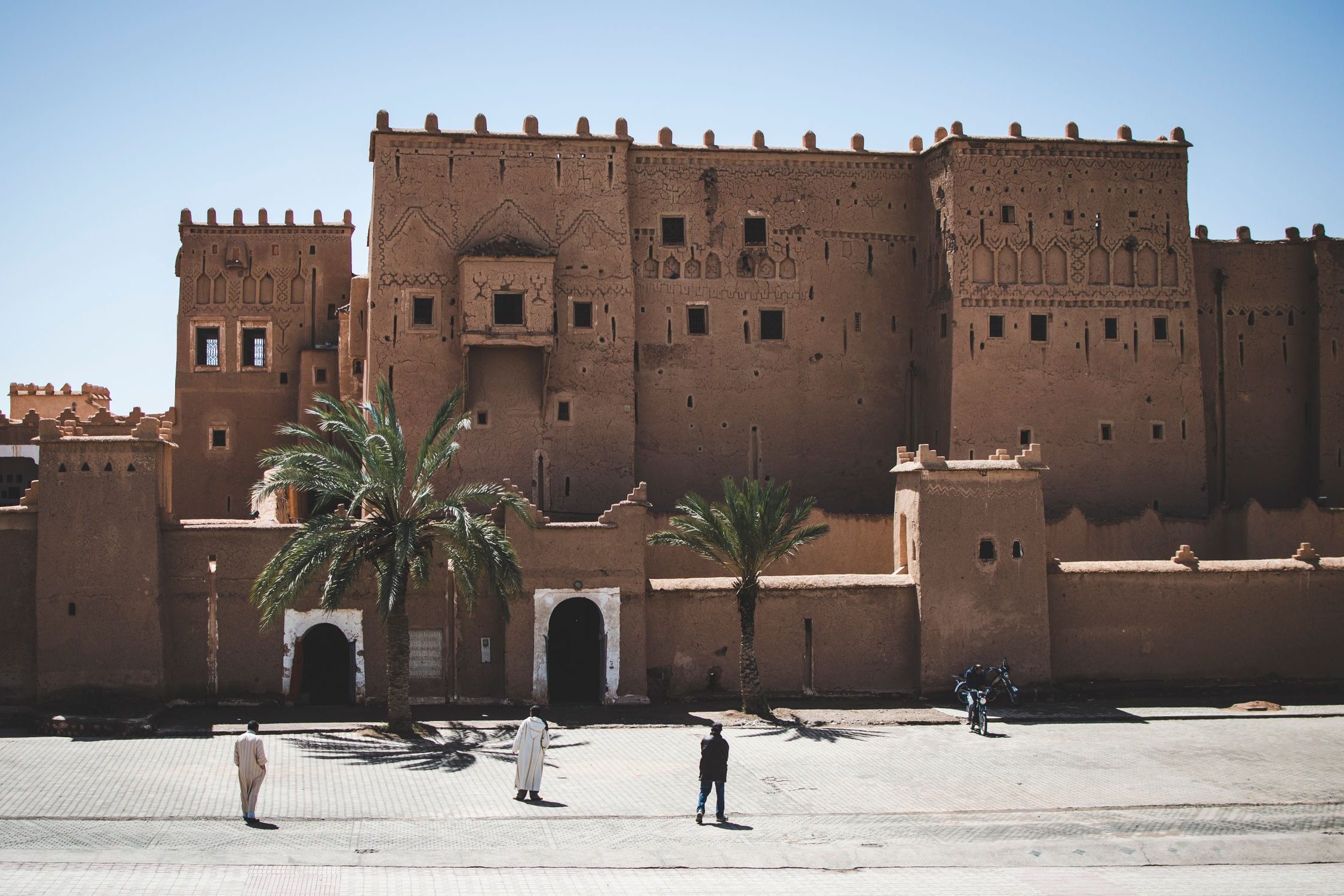
In the heart of the town stands the Taourirt kasbah, a fortified residence of rammed earth with large corner towers. Oral tradition says a local family first built it in the seventeenth century; the Glaoui family took it over and enlarged it in the nineteenth, when one of its members, Thami El Glaoui, became pasha of Marrakech. The town bought it in 1972, and a small part was restored in the 1990s with UNESCO’s help and opened to visitors. Inside, some rooms keep painted decoration and ceilings of woven reed, and families still live in the parts that were never restored. It too was damaged in the earthquake of 2023: check which rooms are open before you go.
The film studios
Film is one of Ouarzazate’s industries, and Morocco’s tourist office calls the region the Hollywood of Africa: David Lean, Ridley Scott, Martin Scorsese and Alejandro González Iñárritu have all filmed here. On the edge of the town, a studio about 5 km to the west runs guided tours among its sets, and the tourist office lists a cinema museum among the town’s sights. For children, an hour among plaster temples and painted palaces is often the most talked-about stop of the day.
Skoura: the palm grove and its kasbahs
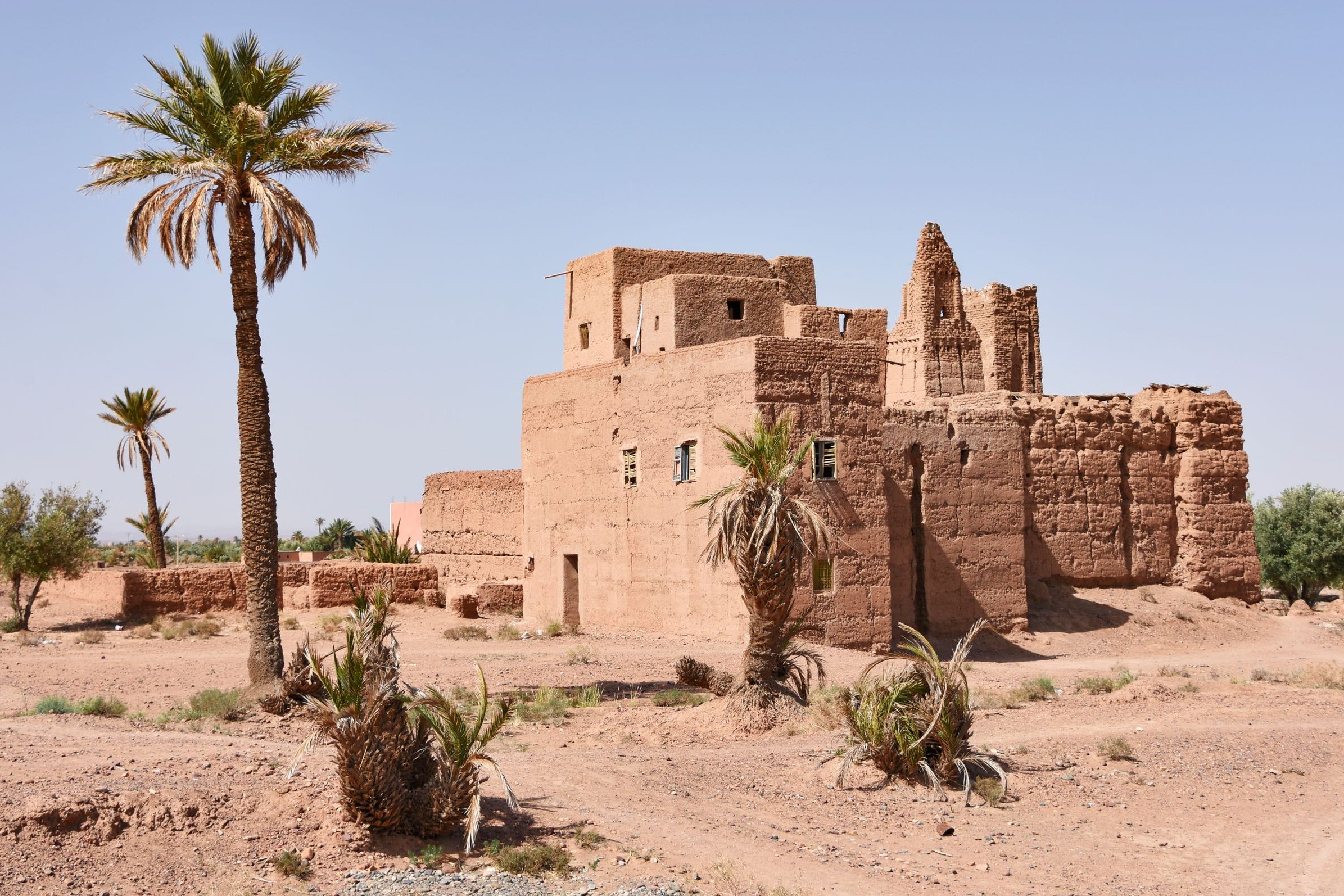
About 40 km east of Ouarzazate, some forty minutes by road, the oasis of Skoura spreads its palm groves around a scatter of earthen kasbahs. Its best-known, the Kasbah Amridil, began as a seventeenth-century ksar, to which a towering kasbah was added at the end of the nineteenth; it once appeared on the Moroccan 50-dirham note, and part of it now serves as a museum of traditional architecture, with its tools, an olive press, a bread oven and an old well. The family that owns it still lives in one wing.
The palm grove is best seen on foot, with a local guide, along its shaded paths. Local guides in Skoura offer half-day walks through the palm grove with a visit to the kasbah, and full days with lunch in a family home, where an entirely vegetarian menu can be prepared on request. Workshops in pottery and in baking the local bread, henna, and rides on mules or bicycles, including electric ones, complete the list. Guiding is in English or French, depending on who is available, so ask in advance; for a group of ten or more, ask for two guides. For a family, Skoura is the quiet counterpoint to the ksar: half a day of shade and green after the stone and earth of the morning.
What to do around Ouarzazate and Skoura
The kasbahs are the reason to come; the outings around them are the reason to stay a second night. These are the activities local providers run in the region; durations are indicative.
By quad: to Aït Ben Haddou or the Fint oasis
Quads leave from Ouarzazate for an hour or two, or for three to four hours as far as Aït Ben Haddou or the Fint oasis, or for a full day. Drivers must be at least 16, no licence is needed, and a passenger can ride behind.
A cooking class for the family, in Skoura
Beyond the walks, workshops and rides described above, a cooking class in Skoura has a children’s version, so that every generation can take part.
Hammam and massage
After the road or the quad, the hammams of Ouarzazate offer the steam bath with black soap, a scrub and a wrap of ghassoul clay, from half an hour, and massages with argan oil, of half an hour to an hour.
Getting there from Marrakech: the road over the Tizi n’Tichka
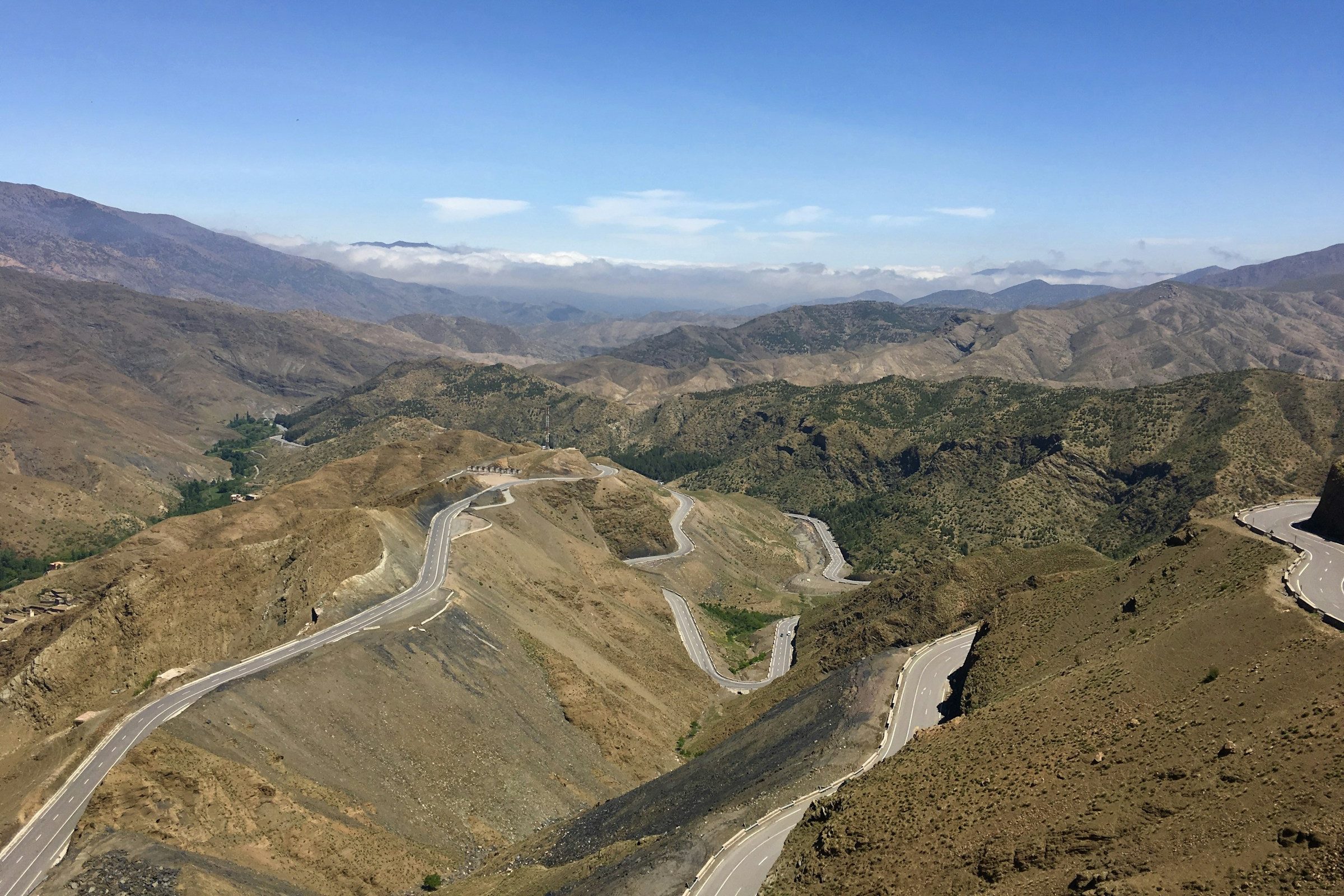
Calculated on OpenStreetMap, the drive from Marrakech to Ouarzazate covers about 195 km and nearly four hours without stops; Morocco’s tourist office gives 194 km and three hours and three-quarters. The road is the N9, which the French army built in 1936 along the old caravan trail. About 104 km and nearly two hours out of Marrakech, it crosses the Tizi n’Tichka, the highest major mountain pass in North Africa: some 2,200 metres, for an old figure of 2,260 metres is still widely quoted, while a GPS measurement gave 2,205. From the pass, the road comes down to the turning for Aït Ben Haddou, about 170 km and three hours and twenty minutes from Marrakech.
Those times are for a car that never stops. With a minibus or a coach, photographs on the pass, tea and lunch, the crossing fills most of a day; for the High Atlas villages and valleys closer to Marrakech, see our guide to the Atlas Mountains from Marrakech. In winter, the pass sets the pace: snow can often fall on it from November to March. The UK government notes that mountain roads can be especially hazardous in poor weather and that poor lighting makes driving at night dangerous. Cross by day, ask your driver to check the conditions the evening before, and keep a spare half-day in a winter plan.
The Telouet detour
Beyond the pass, a smaller road leaves the N9 for Telouet, the old seat of the Glaoui family on the caravan route, about 127 km and some two and a half hours from Marrakech. Its palace, begun in 1860 and built over some five years by craftsmen brought from across Morocco, is now owned by the village council; most of it is in ruins, but a suite of upper reception rooms was restored for visitors, and the 2023 earthquake damaged even those. From Telouet, a smaller road runs down to Aït Ben Haddou, about 47 km and an hour and a quarter further. It makes a fine way in for travellers with time and a taste for history; ask the driver about the state of the road before choosing it.
By air
Ouarzazate airport (OZZ) lies about 2 km from the town. Royal Air Maroc lists Ouarzazate, and Zagora, in its domestic network, served from Casablanca, a route that suits travellers who reach Morocco through Casablanca, as some journeys from India do: the connections are set out in flights from India and the airport for Marrakech. On 12 November 2026, Ryanair’s timetable showed flights between Ouarzazate and Barcelona and Marseille, twice a week each through the winter, mostly on Saturdays and Mondays, and on other days from the end of March. There is no flight between Marrakech and Ouarzazate: from Marrakech, the road is the only way.
A day trip, one night or two?
Ouarzazate and Aït Ben Haddou can be seen in a day from Marrakech, but at the cost of close to seven hours on the road for a few hours on foot. For most families, a night changes everything. Counted from Marrakech, there are three sensible shapes:
- One night, on the way south. Leave Marrakech in the morning, cross the pass, and reach Aït Ben Haddou for the late afternoon; sleep near the ksar or in Ouarzazate, see the Taourirt kasbah in the morning, and drive on. It is the classic first stage towards the dunes.
- Two nights, with Skoura. Add a day for the studios and the palm grove of Skoura, and the region becomes a stay in its own right, at the gentle pace that suits grandparents.
- One night on the way back. Coming from the desert, a night in or near Ouarzazate breaks the long road to Marrakech and leaves the pass for the next morning, in daylight.
Onward: to the dunes, or down the Drâa
From Ouarzazate, two roads lead on into the south. Eastward, the road of the kasbahs runs to Boumalne Dadès, about 112 km and two hours away, and on by the Todra gorges to the dunes of the Erg Chebbi, some 360 km and six and a half hours from Ouarzazate without stops: the stages, the nights and the flight back are set out in our guide to the Merzouga desert from Marrakech. Southward, the road runs to Agdz, about 67 km and an hour and a quarter away, at the head of the Drâa valley: the Drâa is Morocco’s longest river, and its upper course runs through six stretches of oases and palm groves; Zagora, about 158 km and three hours from Ouarzazate, is the gateway to the dunes of the far south. On the way east, see the Dadès valley and the Todra Gorge; to the south, Zagora and the Drâa valley; to the west, Taroudant and the Souss.
When to go: the Ouarzazate weather, month by month
Morocco’s tourist office names March to May and September to November as the best times to visit, with very hot summers and winters of mild days and cool evenings. The long-term averages for Ouarzazate, where the World Meteorological Organization publishes Morocco’s official figures, bear this out. Little rain falls in any month, on three to five days on average.
Ouarzazate’s averages, month by month
- October
- 28 °C by day · 13 °C at night
- Warm days, mild nights: one of the best months
- November
- 22 °C by day · 7 °C at night
- Soft days, cool nights; snow possible on the pass from now
- December
- 18 °C by day · 3 °C at night
- Mild days, cold nights
- January
- 17 °C by day · 2 °C at night
- The coldest nights of the year
- February
- 19 °C by day · 5 °C at night
- Cold nights; Ramadan expected from around 8 February 2027
- March
- 23 °C by day · 8 °C at night
- Spring returns; snow still possible on the pass
- April
- 27 °C by day · 12 °C at night
- Warm days, comfortable nights: one of the best months
- May
- 31 °C by day · 16 °C at night
- Hot afternoons
- June
- 36 °C by day · 20 °C at night
- Very hot
- July
- 39 °C by day · 23 °C at night
- The hottest month: visits early and late only
- August
- 38 °C by day · 22 °C at night
- Very hot
- September
- 33 °C by day · 18 °C at night
- Hot, easing as the month goes on
| Month | Average high | Average low | What to expect |
|---|---|---|---|
| October | 28 °C | 13 °C | Warm days, mild nights: one of the best months |
| November | 22 °C | 7 °C | Soft days, cool nights; snow possible on the pass from now |
| December | 18 °C | 3 °C | Mild days, cold nights |
| January | 17 °C | 2 °C | The coldest nights of the year |
| February | 19 °C | 5 °C | Cold nights; Ramadan expected from around 8 February 2027 |
| March | 23 °C | 8 °C | Spring returns; snow still possible on the pass |
| April | 27 °C | 12 °C | Warm days, comfortable nights: one of the best months |
| May | 31 °C | 16 °C | Hot afternoons |
| June | 36 °C | 20 °C | Very hot |
| July | 39 °C | 23 °C | The hottest month: visits early and late only |
| August | 38 °C | 22 °C | Very hot |
| September | 33 °C | 18 °C | Hot, easing as the month goes on |
Long-term averages for 1991–2020 at Ouarzazate, from Morocco’s Direction de la Météorologie Nationale, published by the World Meteorological Organization and rounded to the nearest degree. A given day can be colder or warmer than the average.
The altitude explains the nights. In January, Ouarzazate averages 2 °C at night, against about 6 °C in Marrakech and 8 °C in New Delhi, though its days, at 17 °C, are almost as mild as Marrakech’s. From December to February, pack a warm layer for the evening and the early morning at the ksar, and ask your hotel how it heats the rooms. From June to August, the averages climb to 36–39 °C by day: visit the ksar at the edges of the day, and keep the middle hours for the shade.
Ramadan, next expected from around 8 February to 9 March 2027, changes the rhythm of the day more than the sights themselves; keep long drives away from dusk. The dates and their sources are in the best months to visit Morocco from India, which also covers the rest of Morocco, region by region.
Vegetarian and Jain meals in the south
Guesthouses in and around Ouarzazate publish vegetarian meals on request, and some serve a single evening menu to a whole group: the kitchen needs to know before you arrive, not at the table. Vegetarian is therefore simple when asked for in advance, and Jain food is on request: set out the rules in writing when you book, from no onion, garlic or root vegetables to the hour of the meal, and see how to ask for a Jain meal as a traveller in Morocco. On the road over the pass, lunch is wherever the road allows: carry what the strictest eater in the party needs. One more question to ask when you book in the region: whether the house accepts young children, as some lodges in the region do not take young children.
Five questions to plan your stop
- Is this a stage or a stay? One night on the way to the desert, or two with Skoura and the studios.
- Who will climb? The lanes of the ksar rise to the granary: decide in advance who goes to the top and who stays by the river.
- Which month? Spring and autumn for comfort; warm layers from December to February; the edges of the day in summer.
- By the N9, or by Telouet? The main road for speed and comfort, the Telouet detour for history, if the road is in good condition.
- Who will cook? Vegetarian, and Jain on request, agreed in writing before you book.
So, are Ouarzazate and Aït Ben Haddou worth a night from Marrakech?
Yes. Seen in a day, they are a long drive with a famous view in the middle; given a night, they become the moment the journey south truly begins: the ksar in the late light, the Taourirt kasbah in the morning, the shade of Skoura if you can spare the day, and the pass behind you in daylight. One night is enough for a stage on the road to the dunes, two for a family that wants to slow down.
For the days in the city before you set off, see things to do in Marrakech with grandparents and children. Planning the road south for your family or your group? Write to us with your dates, the ages in your party and the nights you can give the south, and we will answer by e-mail or video call.
Questions travellers ask about Ouarzazate and Aït Ben Haddou
Can you visit Aït Ben Haddou as a day trip from Marrakech?
How far is Ouarzazate from Marrakech?
How high is the Tizi n’Tichka pass, and is it safe in winter?
Is Aït Ben Haddou suitable for elderly parents?
Does Ouarzazate have an airport?
Which films were shot at Aït Ben Haddou?
Should you sleep in Ouarzazate or at Aït Ben Haddou?
Editorial note
This guide draws on Morocco’s national tourist office; the World Meteorological Organization, for the long-term averages of Morocco’s Direction de la Météorologie Nationale at Ouarzazate and Marrakech (1991–2020) and of the India Meteorological Department at New Delhi (1901–2000); the UK government’s travel advice for Morocco; the published timetable and route list of Ryanair and the network of Royal Air Maroc; and Wikipedia, for the history and geography of Aït Ben Haddou (including its UNESCO inscription in 1987 and its film history), Ouarzazate, the Taourirt kasbah, the Tizi n’Tichka, Telouet, Skoura, the Kasbah Amridil, the Drâa, Ouarzazate airport and a film studio near the town. Road distances and driving times were calculated with the OSRM route planner on OpenStreetMap data. Details of what guides and guesthouses offer come from information published by guides and guesthouses in the region. The dates of Ramadan follow our guide to the seasons. All were read on 12 November 2026. The dates of Ramadan were checked again on 23 November 2026.
Activity durations and ages come from information provided by local activity providers in 2026; check them when you book.
Flight schedules, road conditions and the opening of earthen monuments damaged in 2023 change, sometimes without notice: check them before you book. Apart from airlines and public bodies, no business is named, and none is recommended. Sehra Morocco plans tailor-made journeys in Morocco; this guide describes no journey of its own.
- Moroccan National Tourist Office: Ouarzazate, Zagora and Tinghir, the Hollywood of Africa
- World Meteorological Organization, World Weather Information Service: Ouarzazate, Marrakech and New Delhi
- GOV.UK, Morocco travel advice: safety and security
- Ryanair, timetable (Ouarzazate – Barcelona and Ouarzazate – Marseille, winter 2026–2027 and spring 2027); Royal Air Maroc, our network
- Wikipedia: Aït Benhaddou, Ouarzazate, Taourirt Kasbah, Tizi n’Tichka, Telouet, Skoura, Kasbah Amridil, Draa River and Ouarzazate Airport
- Road distances and driving times: OSRM on OpenStreetMap data, calculated on 12 November 2026, without stops
- Information published by guides and guesthouses in the Ouarzazate region.
Written by Sehra Morocco. Last reviewed: . Text last updated: .
Tell us about your trip.
By e-mail or video call. We reply within two working days.