The Dadès valley and gorges: the valley of roses, the kasbahs and the road through the rock
East of Ouarzazate, a river turns the stony south green: first fields hedged with roses, then earthen kasbahs, then red cliffs that close in until the road has to climb out in hairpin bends. Here is how to follow the Dadès, when the roses bloom, and why it deserves a night, or two.
Reviewed 12 November 2026 · Sources at the end
The Dadès valley runs along the road from Ouarzazate to Tinghir, from the rose town of Kelaat M’Gouna, about an hour and a half east of Ouarzazate, to Boumalne Dadès, where the river comes down out of its gorges. It is the natural night on the road between Ouarzazate and the dunes of Merzouga; come in May for the roses, and give it two nights if you want to walk. The Dadès valley is, in other words, less a single sight than a journey upstream: from the gardens of the lower valley to the rock of the gorges, a few kilometres apart and a world away.
This guide follows the river from Kelaat M’Gouna to the hairpin road beyond Aït Oudinar, then sets out the rose season, the kasbahs, the easy walks, where the valley fits on the road to the desert, the seasons and the meals. Sehra Morocco plans tailor-made journeys across Morocco for families and groups from India and beyond; the facts come from official and public sources listed at the end, and the advice is ours.
The Dadès valley, at a glance
The essentials, checked on 12 November 2026:
- Where
- South of the High Atlas, in Tinghir province, on the road between Ouarzazate and Tinghir; the gorges climb north from Boumalne Dadès
- Height
- Kelaat M’Gouna about 1,425 m, Boumalne Dadès about 1,560 m, the floor of the gorges about 1,800 m
- From Ouarzazate
- About 91 km and an hour and a half to Kelaat M’Gouna; about 112 km and two hours to Boumalne Dadès
- From Marrakech
- About 306 km to Boumalne Dadès, over the Tizi n’Tichka: some five and three-quarter hours without stops
- On to the dunes
- About 243 km and four and a half hours from Boumalne Dadès to Merzouga, without stops
- The roses
- The Damask rose; a rose festival at Kelaat M’Gouna each May, lasting about three days
- Nights
- One on the road between Ouarzazate and the desert; two to walk, in our view
- At the table
- Vegetarian when asked for in advance; Jain on request
Road times are for a car that never stops, calculated on OpenStreetMap data; with a minibus, photographs and lunch, every stage takes longer.
Following the Dadès upstream
The Dadès rises in the High Atlas and flows south-west; with the Imini it becomes the Drâa, which runs on towards the edge of the Sahara. For the traveller, its valley comes in three movements, each a short drive from the next: the gardens around Kelaat M’Gouna, the market town of Boumalne Dadès, and the gorges that open behind it. Morocco’s national tourist office lists Kelaat M’Gouna and the Dadès valley among the five most popular places of the region around Ouarzazate, and puts the Dadès about two hours from the town.
Kelaat M’Gouna, in the valley of roses
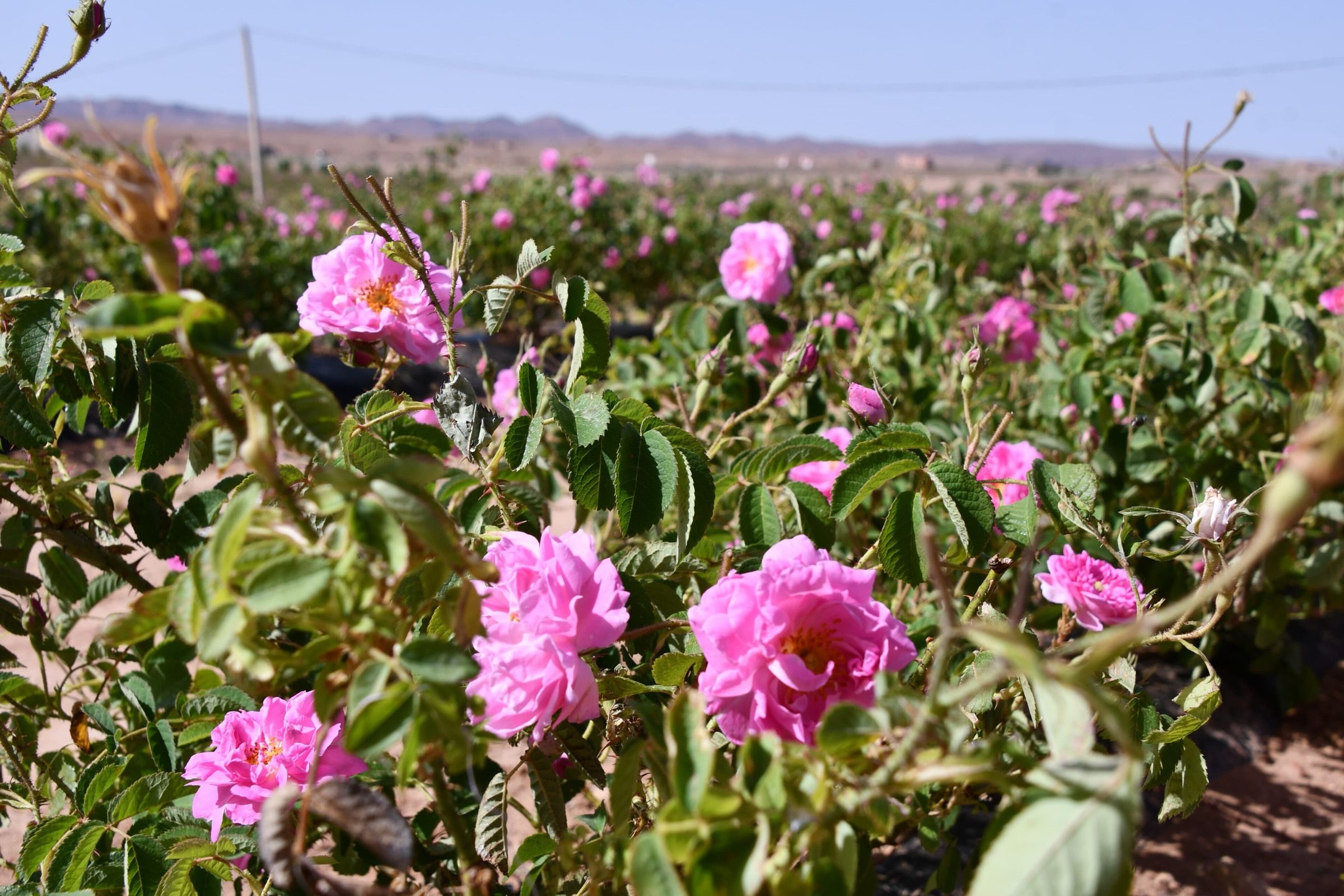
Kelaat M’Gouna, at about 1,425 metres, is the town of the roses: so much so that the valley around it is known as the valley of roses. The tourist office describes pink blooms running for miles near the town, and rose gardens along the road; the plant is the Damask rose, Rosa damascena. A distillery in the town turns the petals into rose water, and the tourist office suggests a visit to see how it is made; in the shops, the harvest lives on all year, as rose water, oil and cosmetics.
Boumalne Dadès, where the valley turns north
About 22 km further east, less than half an hour by road, Boumalne Dadès stands at about 1,560 metres on the edge of a stony plateau, where the upper valley opens onto the main road. Its weekly market is held on Wednesdays, and the town is the hinge of the region: east lies Tinghir, west lies Ouarzazate, and north, a narrow road follows the river into the gorges.
Into the gorges: the ‘monkey fingers’
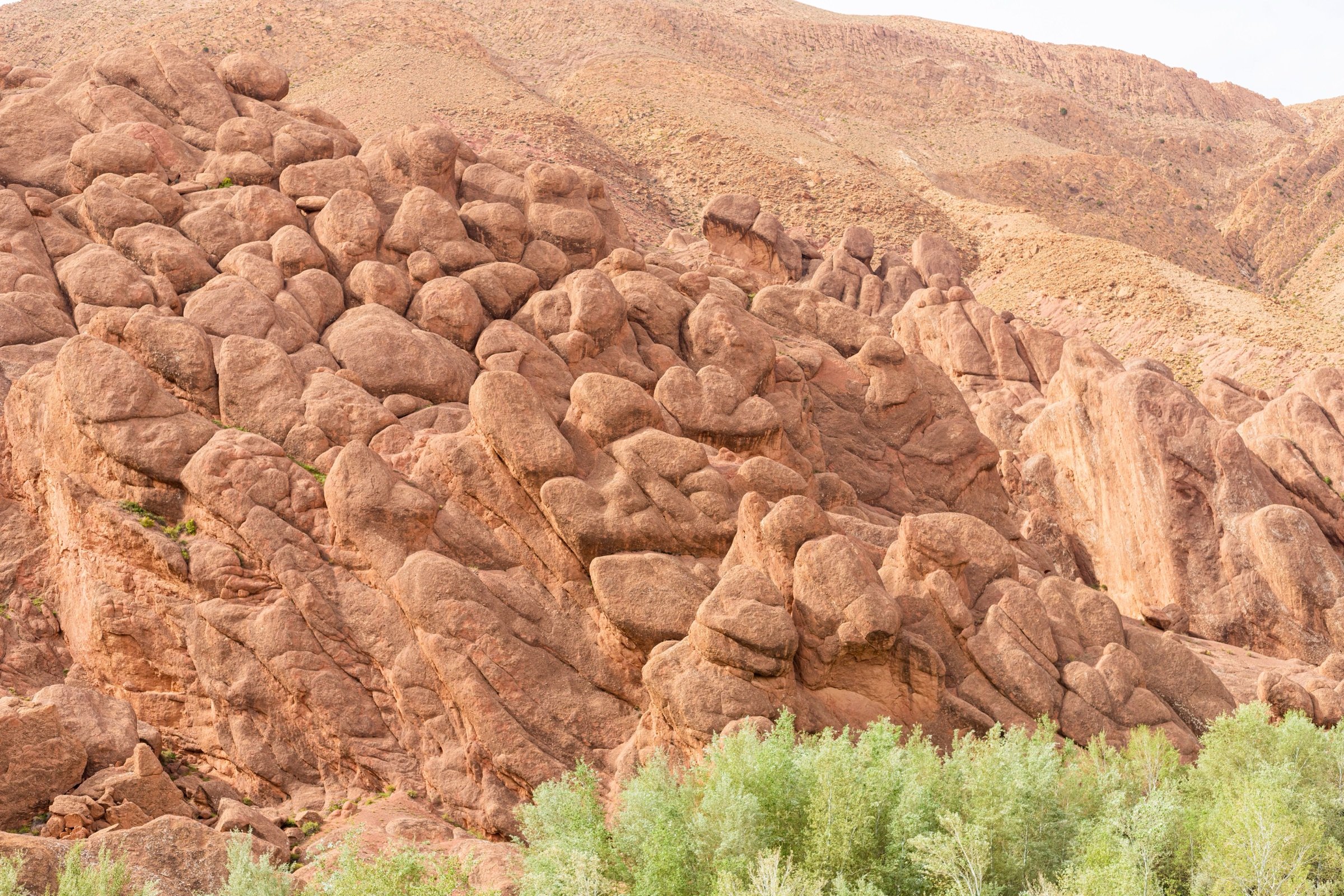
North of Boumalne, the valley narrows and the colours change. The walls of the gorges rise 200 to 500 metres above a floor at about 1,800 metres, and the rock is sedimentary, sandstone and limestone laid down when this land lay under the sea, then lifted with the Atlas and carved by the river and its floods. That history explains the strangest sight of the valley: rounded, folded formations of red rock, nicknamed the ‘monkey fingers’ and, by some, the ‘brain of the Atlas’. Children see animals in them; elders see the patience of water. Along the road, kasbahs and villages stand on the green strip of fields and almond and palm trees between the cliffs.
The hairpin road above Aït Oudinar
About 26 km from Boumalne, at the village of Aït Oudinar, the valley floor ends: just beyond it the road leaves the gorge and climbs in a stack of hairpin bends: the picture of the Dadès on every postcard, and the subject of the national tourist office’s own videos of the valley. The best view is from above, looking down on the bends. The tarmac carries on to Msemrir, about 60 km and an hour and a quarter from Boumalne, through a quieter, higher valley; most travellers turn back at the bends.
Two practical notes. The road is narrow and the bends are tight: ask your transport company whether a full-size coach can take them, or whether the group should switch to minibuses at Boumalne. And the UK government’s advice warns of hazardous mountain roads in bad weather and of the dangers of driving after dark: plan the gorges for daylight.
The rose season, and the festival in May
The roses set the calendar of the valley. They bloom in spring, and the harvest ends with a festival in Kelaat M’Gouna each May. Morocco’s tourist office describes about three days of dancing, feasting and Amazigh song, with contests and the crowning of a Miss Rose. Press reports of the most recent edition describe a carnival along the main avenue, with decorated vehicles, folk troupes and musicians in traditional dress, and a fair of essential oils, cosmetics and the products of the oases.
For a family, the season brings three practical questions:
- Festival or harvest? The festival is the crowd and the music; the weeks of picking before it are the quieter sight, with the roses in flower. If you prefer the roses to the parade, come a little earlier in the season.
- Are the dates known? They change from year to year: plan around May, check the dates in the spring, and fix the night in Kelaat M’Gouna once they are published.
- Where to sleep? The festival draws crowds to a small town; a night in Boumalne, less than half an hour away, keeps the evening calm.
The kasbahs of the valley
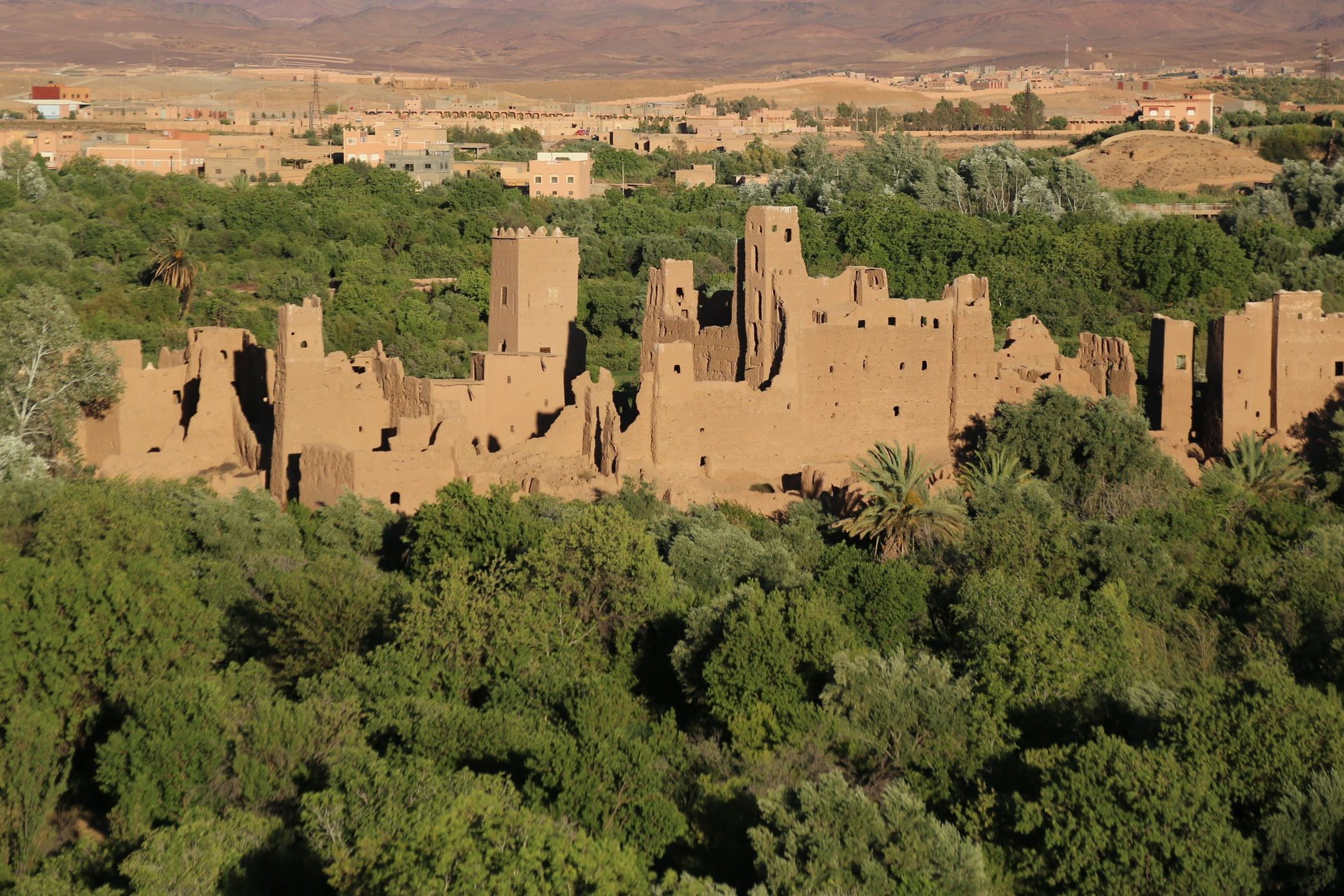
The national tourist office calls the road from Ouarzazate to Tinghir the road of the thousand kasbahs, and the Dadès is where the name feels least exaggerated. Earthen kasbahs and fortified villages, the ksour, stand on the edge of the fields all along the valley, some still lived in, some crumbling back into the earth they were built from, a few restored as guesthouses. The finest views are often from the road, in the low light of late afternoon, when the walls turn the colour of the cliffs behind them. If you would like to step inside one, ask your guide which families welcome visitors; it is a home before it is a monument.
For a kasbah that is open as a monument, and for the earthen ksar of Aït Ben Haddou, a UNESCO World Heritage site, see our guide to Ouarzazate and Aït Ben Haddou.
Easy walks, for every generation
The Dadès rewards those who leave the car. The tourist office suggests walking in the gorges, and the valley offers walks of every length, most of them gentle:
- Along the valley floor. Between the fields, the roses and the almond trees, from one village to the next. Flat or nearly so, these walks suit grandparents and children alike, best in the morning.
- Among the rock formations. With a local guide, a walk into the folds of the ‘monkey fingers’; the ground is uneven and climbs, so good shoes matter as much as fitness.
- A day with mules. Guesthouses in the valley can arrange, when you book, a day’s walk with mules to carry the bags and the tired, or a night’s bivouac under the stars.
- For the children. Mountain bikes or a short 4x4 outing can sometimes be arranged the same way; ask at booking.
- For serious walkers. The tourist office points to trekking in the Jbel Saghro, to the south, and to the climb of the M’Goun, in the High Atlas, to the north: expeditions of their own.
For anything beyond a stroll, take a professional guide, as the UK government’s advice recommends in the Atlas; it also cautions that adventure-activity providers may not follow UK safety standards, so ask about equipment and cover, and check your own insurance.
A night on the road between Ouarzazate and Merzouga
Most travellers meet the Dadès on the way to the desert, and that is how it fits best. The drive from Marrakech to the dunes of Merzouga is too long for one day, and the valley lies close to its middle. Our guide to the Merzouga desert from Marrakech sets out the whole journey and the flight back from Errachidia; here are the stages seen from the valley, calculated without stops:
- Marrakech to Ouarzazate: about 195 km over the Tizi n’Tichka, nearly four hours, with Aït Ben Haddou on the way.
- Ouarzazate to Kelaat M’Gouna: about 91 km and an hour and a half, past the palm grove of Skoura.
- Kelaat M’Gouna to Boumalne Dadès: about 22 km and under half an hour.
- Boumalne to Aït Oudinar and the foot of the hairpin bends: about 26 km and forty minutes each way.
- Boumalne Dadès to Merzouga: about 243 km and four and a half hours, by Tinghir and Erfoud.
On those figures, two rhythms work. One night: leave Ouarzazate in the morning, lunch in Kelaat M’Gouna, drive up the gorges in the afternoon, sleep in the valley, and reach the dunes the next afternoon. Two nights: add a whole day for a walk, the roses in season and a slower morning, which suits grandparents and young children far better than a night that is only a bed. On the way back from the desert, the valley is just as good a pause, leaving the Tichka for the following day.
An hour east of Boumalne, Tinghir and the narrow walls of the Todra have their own guide: the Todra gorge and Tinghir. And for a longer loop through the south, by the palm groves of the Drâa, see our guide to Zagora and the Drâa valley.
When to go: the Dadès through the year
The World Meteorological Organization publishes no long-term averages for the valley itself. The nearest station with published figures is at Ouarzazate, about two hours to the west, and its averages, the same as in our Ouarzazate guide, give the shape of the year. Bear in mind that the valley lies higher, from about 1,425 metres at Kelaat M’Gouna to about 1,800 metres in the gorges: expect its nights to be cooler than these figures, especially in winter.
- The rose season (April and May)
- 27 to 31 °C by day · 12 to 16 °C at night
- The roses, the festival in May, green fields: the valley at its best, and at its busiest
- Autumn (September to November)
- 33 down to 22 °C by day · 18 down to 7 °C at night
- Clear light and long walks; the nights cool quickly by November
- Winter (December to February)
- 17 to 19 °C by day · 2 to 5 °C at night
- Sunny days, cold nights, higher still in the gorges: pack warm layers
- Early spring (March)
- 23 °C by day · 8 °C at night
- Mild days before the roses; a quiet month on the road
- Summer (June to August)
- 36 to 39 °C by day · 20 to 23 °C at night
- Hot in the valley; walks only in the first and last hours of light
| When | Average high | Average low | In the valley |
|---|---|---|---|
| The rose season (April and May) | 27 to 31 °C | 12 to 16 °C | The roses, the festival in May, green fields: the valley at its best, and at its busiest |
| Autumn (September to November) | 33 down to 22 °C | 18 down to 7 °C | Clear light and long walks; the nights cool quickly by November |
| Winter (December to February) | 17 to 19 °C | 2 to 5 °C | Sunny days, cold nights, higher still in the gorges: pack warm layers |
| Early spring (March) | 23 °C | 8 °C | Mild days before the roses; a quiet month on the road |
| Summer (June to August) | 36 to 39 °C | 20 to 23 °C | Hot in the valley; walks only in the first and last hours of light |
Long-term averages for 1991–2020 at Ouarzazate, from Morocco’s Direction de la Météorologie Nationale, published by the World Meteorological Organization and rounded to the nearest degree. The valley is higher than Ouarzazate, and a given night can be colder than the average.
The roses make spring the obvious choice, and autumn the wise second: clear days, comfortable walks and fewer visitors. Winter is beautiful and quiet, with cold nights in the gorges; summer asks for early starts. For the seasons of the whole country, and how they meet India’s holidays, see the best months to visit Morocco from India.
Vegetarian and Jain meals in the valley
In the Dadès, dinner is usually where you sleep, cooked in the guesthouse or hotel kitchen, and that makes a vegetarian table simple when it is asked for in advance. Jain food is on request, not a given: say what your party avoids when you book, and see how to ask for a Jain meal as a traveller in Morocco. Between towns the stretches are long, so keep fruit and dry snacks in the vehicle.
So, is the Dadès valley worth a night?
Yes, and more than the one it is usually given. The Dadès valley turns the long road to the desert into a journey worth taking for itself: the roses of Kelaat M’Gouna in May, the kasbahs in the evening light, the ‘monkey fingers’ and the hairpin bends of the gorges, and walks gentle enough for every generation. One night breaks the road; two let you live in the valley for a day.
Arriving from India? The flight, the visa and the money are covered in our guide to the journey from India; the first stage of the road is described in Ouarzazate and Aït Ben Haddou. Planning the south for your family or your group? Write to us with your dates, the ages in your party and the nights you can give the road, and we will answer by e-mail or video call.
Questions travellers ask about the Dadès valley
Where is the Dadès valley?
How far is the Dadès valley from Marrakech?
When is the rose festival in Kelaat M’Gouna?
What are the ‘monkey fingers’ of the Dadès gorges?
Can grandparents and young children enjoy the gorges?
Should you sleep in Boumalne Dadès or in the gorges?
Editorial note
This guide draws on Morocco’s national tourist office, for the region, the road of the kasbahs, the valley of roses, the rose festival and the rose-water distillery; Hespress, for the 2026 rose festival; the World Meteorological Organization, for the long-term averages of Morocco’s Direction de la Météorologie Nationale at Ouarzazate (1991–2020); the UK government’s travel advice for Morocco; and Wikipedia, for the geography of the Dadès gorges, Kelaat M’Gouna and Boumalne Dadès, including heights, rocks and the weekly market. Road distances and driving times were calculated with the OSRM route planner on OpenStreetMap data, which also gives the position of the hairpin bends. All were read on 12 November 2026.
What guesthouses in the valley arrange comes from information provided by local providers in 2026; check it when you book.
Festival dates, road conditions and local arrangements change, sometimes without notice: check them before you book. Apart from public bodies, no business is named, and none is recommended. Sehra Morocco plans tailor-made journeys in Morocco; this guide describes no journey of its own.
- Moroccan National Tourist Office: Ouarzazate, Zagora and Tinghir, the Hollywood of Africa, shop in the oasis of ochre lights, Ouarzazate, a world of amusement, a paradise of sand and stone, the road of the 1000 kasbahs, adventure in the valleys (2016) and stop and take time for the Rose Festival (2015)
- Hespress, Kelâat M’gouna : le Carnaval des roses célèbre traditions et patrimoine (in French), 10 May 2026
- World Meteorological Organization, World Weather Information Service: Ouarzazate
- GOV.UK, Morocco travel advice: safety and security
- Wikipedia: Dadès Gorges, Gorges du Dadès (in French), Kalaat M’Gouna, Kelaat-M’Gouna (in French), Boumalne Dades and Boumalne-Dadès (in French)
- Road distances and driving times: OSRM on OpenStreetMap data, calculated on 12 November 2026, without stops
Written by Sehra Morocco. Last reviewed: .
Tell us about your trip.
By e-mail or video call. We reply within two working days.