Meknès and Volubilis: the sultan’s city, the Roman ruins and the holy town between them
A seventeenth-century sultan made Meknès his capital, and took some of its marble from a Roman town half an hour away. Between the two, a holy town climbs its hillside. Here is how to see all three without rushing, and why Meknès deserves a night of its own.
Reviewed 12 November 2026 · Sources at the end
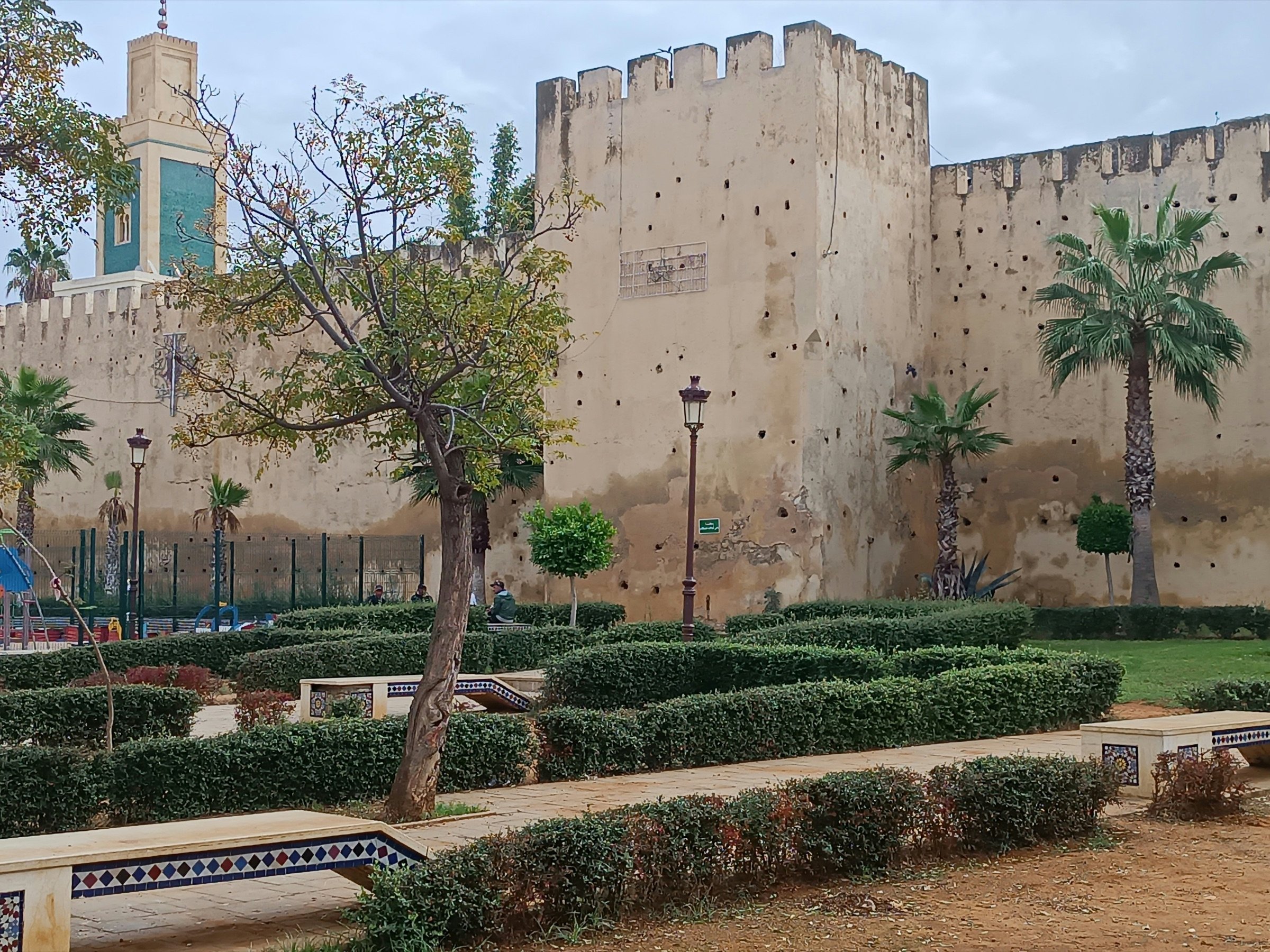
Give Meknès and Volubilis one night, not a hurried afternoon: arrive in Meknès by train from Rabat or Fès, walk to Bab Mansour and the Place El Hedim in the evening, reach the Roman ruins of Volubilis when they open the next morning, climb into Moulay Idriss Zerhoun, and return to the granaries and the mausoleum of Moulay Ismaïl in the afternoon. Meknès and Volubilis are two World Heritage sites some 30 km apart, one a royal city of the 1600s, the other a Roman town abandoned for nearly a thousand years. Seen together, with the holy town between them, they tell two thousand years of Moroccan history in two days.
This guide answers what a day trip from Fès leaves open: whether Meknès is worth a night, in which order to see the sites, and how to cope with the heat at Volubilis. Sehra Morocco plans tailor-made journeys across Morocco for families and groups from India and from around the world. The facts come from UNESCO, Morocco’s tourist office, Meknès’s own tourist board and other public sources, listed at the end; the advice that follows from them is ours.
Meknès and Volubilis, at a glance
The essentials, checked on 12 November 2026:
- Where
- On the Saïss plain of northern Morocco, between the Middle Atlas and the Zerhoun hills: about 70 km west of Fès and 140 km east of Rabat by road
- World Heritage
- The Historic City of Meknès, inscribed by UNESCO in 1996; the Archaeological Site of Volubilis, inscribed in 1997
- Volubilis
- About 30 km north of Meknès, some 35 minutes by road; Moulay Idriss is 4 km further
- By train
- About 40 minutes from Fès and 2 hours from Rabat, with trains about every hour; about 3 hours from Casablanca
- Nights
- One, between Rabat and Fès, to see both at an easy pace; a day trip from Fès is possible but full
- Best months
- March to May and September to November; at Volubilis, from May to September, go early in the day
- Opening hours
- Volubilis every day from 8.30 am; the Heri es-Souani granaries close at midday; the Dar Jamaï museum is closed on Tuesdays
- At the table
- Vegetarian when asked for in advance; Jain on request
Train times, opening hours and road conditions change: check them again before you book.
Does Meknès deserve a night?
Seen as the afternoon half of a day trip from Fès, Meknès can feel like a gate glimpsed from a car window. The tourist office’s own advice is to allow two days, and the clock explains why. Volubilis opens in the morning and is best seen early; the granaries of Meknès close at midday; the Place El Hedim comes alive only at dusk. A day from Fès can hold all three, but never each at its best hour. And since Meknès sits on the railway between the Atlantic and Fès, a night there is a pause, not a detour. Three shapes of visit work:
- The day trip from Fès. Ruins and holy town first, then the imperial city, and home for dinner: comfortable from October to April, long and hot from May to September. It is the outing sketched in our guide to things to do in Fès.
- One night in Meknès, on the way. Arrive from Rabat or Tangier in the afternoon, see the sites in the order below, and take the train on to Fès, about 40 minutes away. Our choice for most families.
- Two nights, at an easy pace. The tourist office’s two days, with time for the medina, the music museum of Dar Jamaï, or a morning in the Middle Atlas around Ifrane.
The imperial city of Moulay Ismaïl
Meknès began in 1061 as an Almoravid stronghold and took its name from the Meknassa, a great Berber tribe. Its moment came under Moulay Ismaïl, sultan from 1672 to 1727, who chose it as his capital. When UNESCO inscribed the city in 1996 it called it the first great work of the Alaouite dynasty, and listed around twenty-five mosques, ten hammams, palaces and vast granaries behind ramparts that rise to 15 metres and open through nine monumental gates, in a Hispano-Moorish style that blends Islamic and European ideas of the seventeenth century.
Two cities stand side by side, each behind its walls: the compact medina, and the sultan’s kasbah, a world of long corridors between high blind walls, gardens and open ground, several times larger than the old town. See it by car between monuments, and on foot at each one.
Bab Mansour and the Place El Hedim
Morocco’s tourist office calls Bab Mansour one of the masterpieces of Hispano-Moorish art. Completed in 1732 by the sultan’s son Moulay Abdallah, it is named after its designer, Mansour al-’Alj. Its facade is a lattice of polychrome zellige, and its marble columns are of Roman origin, most probably carried from Volubilis: the first thread between the two sites. The gate is usually closed, opening only for occasional exhibitions, so admire it from the square.
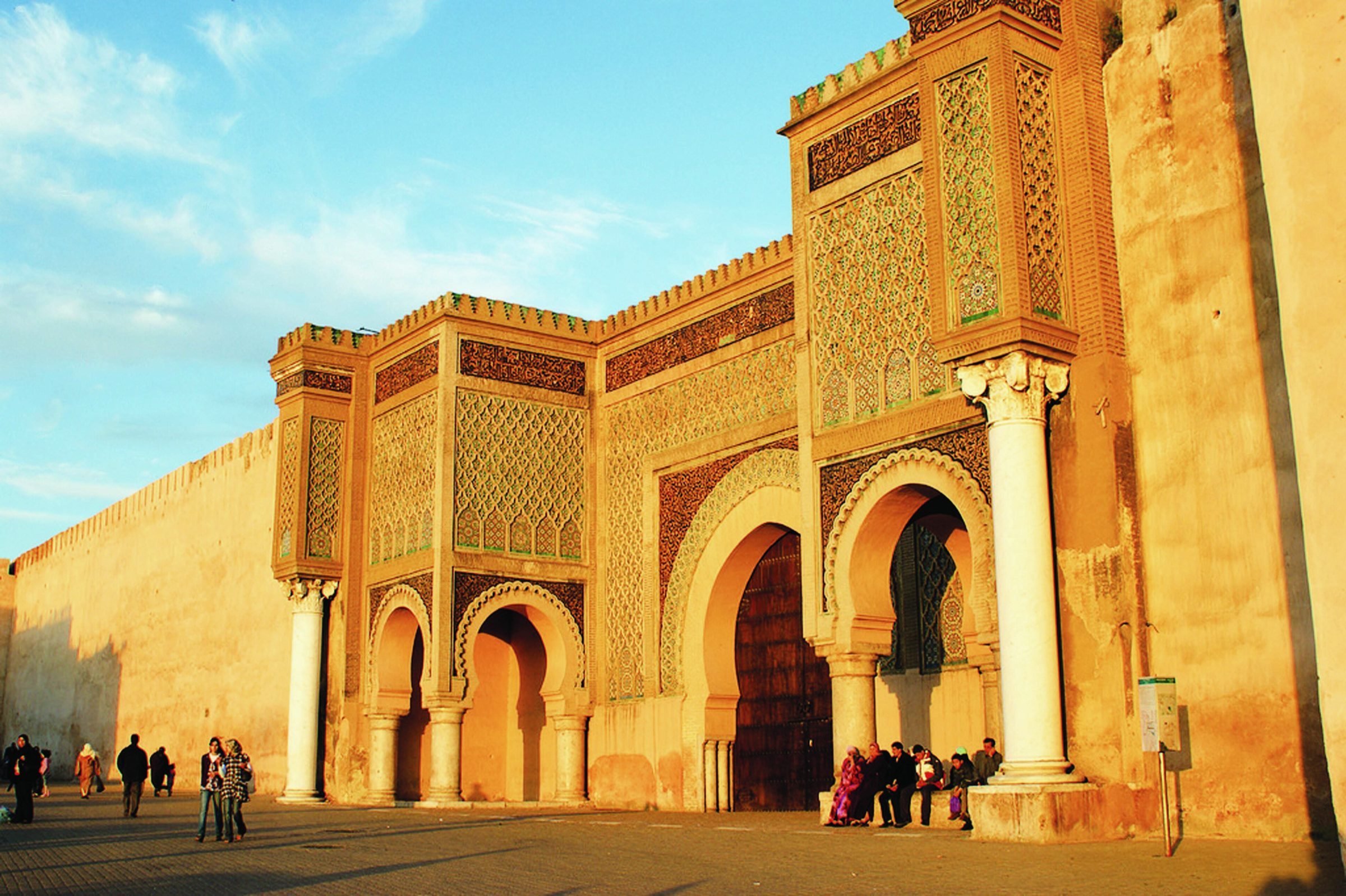
That square, the Place El Hedim, takes its name from the rubble of the houses the sultan cleared to build his palaces. It joins the medina to the imperial city, with a covered market on one side. By day it is wide and open; at dusk storytellers, musicians and street performers gather, and Meknès’s tourist board promises an atmosphere far from the everyday. Come back to it in the evening.
Heri es-Souani and the Agdal basin
Moulay Ismaïl built a granary large enough to see his capital through a long siege. Heri es-Souani measures about 182 by 104 metres, divided by twenty-two rows of thick arches; its vaults fell in the earthquake of 1755, leaving a forest of earthen arches open to the sky. Beside it, the House of Water raised water from deep wells with horse-turned wheels to feed the Agdal basin, a reservoir some 319 metres long and 149 metres wide. The granaries are often called the royal stables; the stables were in fact a different building further south, of which very little survives. Meknès’s tourist board lists the granaries as open in the morning and again in the afternoon, closed at midday: plan around it.
The mausoleum of Moulay Ismaïl
The sultan lies inside his former kasbah, in a mausoleum first built in 1703 and altered between 1727 and 1729. It is one of the few religious monuments in Morocco open to non-Muslims. Visitors take off their shoes, cross courtyards of zellige and horseshoe arches, and look from the antechamber into the tomb chamber, with its marble tombstones and two long-case clocks sent by Louis XIV of France; the chamber itself is reserved for Muslims. The local tourist board lists daily opening hours, but this is a place of prayer: confirm on the day that it is open, and cover arms and legs.
In the medina: a madrasa and a museum of music
The medina keeps its own Bou Inania madrasa, built around 1336 under the Marinid sultan Abu al-Hasan and open to visitors, not to be confused with its namesake in Fès. Nearby, the palace of Dar Jamaï, built in 1882 for a grand vizier, reopened in March 2022 as Morocco’s national museum of music: more than a hundred instruments around an Andalusian garden, where elders can sit between rooms. It is closed on Tuesdays.
Volubilis: a Roman town in the olive country
Volubilis stands at the foot of Jebel Zerhoun, above a fertile plain. Founded in the third century BC as a Mauretanian capital, it passed into the Roman orbit; UNESCO, which inscribed it in 1997, ranks it among the richest sites of its period in North Africa. The walled town covers 42 hectares, inside a rampart of 168–169 AD, and lay abandoned for nearly a thousand years. In the late eighth century it sheltered Idris I, who founded the Idrisid dynasty, and later it was quarried by Moulay Ismaïl for Meknès and hit by the earthquake of 1755.
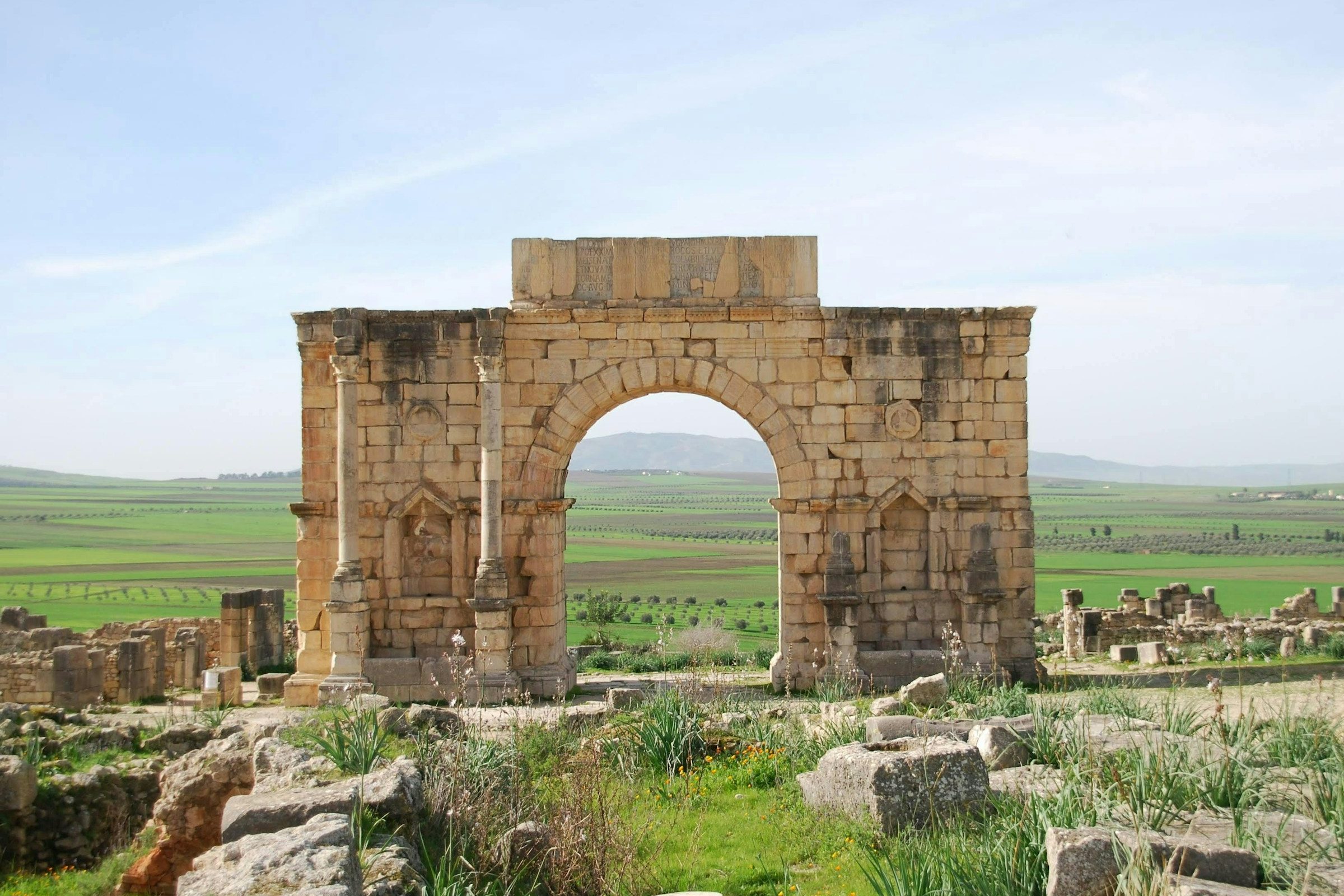
What makes it unforgettable is that so much stays where it was found. Many mosaics remain in the houses named after them: Orpheus charming the animals in the House of Orpheus, the labours of Hercules and the four seasons, Bacchus and Ariadne in the House of the Knight, the humorous acrobat of the House of the Athlete. Along the main street stand the triumphal arch raised in 217 for the emperor Caracalla, the basilica and the capitol. Olive oil made the town rich, and one of its fifty-eight pressing complexes has been restored with a replica Roman press, a good stop for children. The finest bronzes went to Rabat, and are best seen with Rabat’s museums, the Kasbah and the Hassan Tower.
Heat and shade: how to time Volubilis
Volubilis is an open-air site of 42 hectares on a slope, and the part of the day that asks most of the body. Meknès’s tourist board gives it as open every day of the year from 8.30 am, closing in the late afternoon, earlier in winter than in summer. From May to September, when highs at Fès, the nearest city with published averages, run from 26 to 35 °C, arrive at opening time with hats, sun cream and water for everyone, and keep indoor visits for the afternoon. From November to March, the risk is rain: keep a dry day for the ruins. We would give the site two hours with a guide, and the UK government’s advice is to ask to see the official badge.
Moulay Idriss Zerhoun, the holy town on two hills
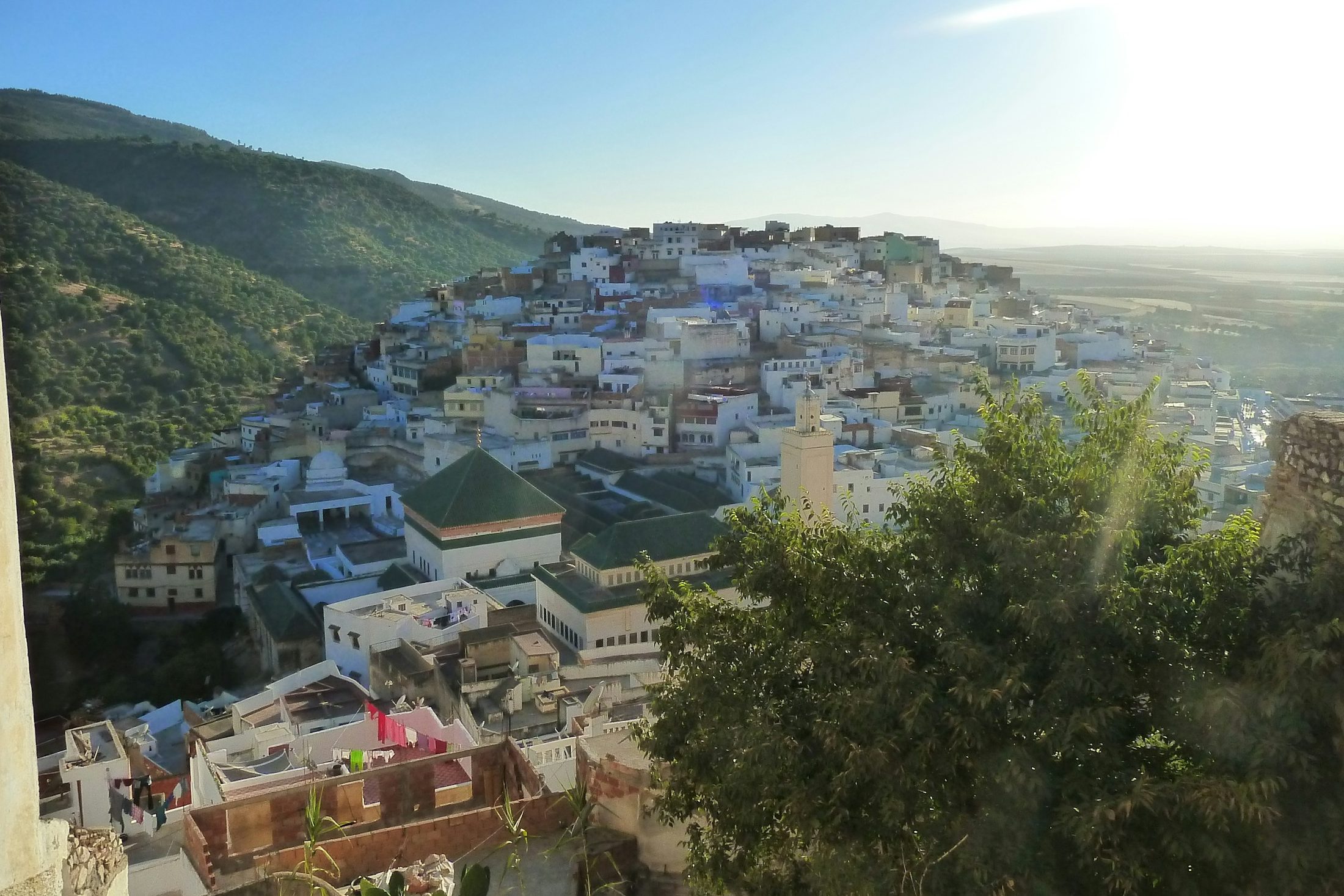
Four kilometres from the ruins, Moulay Idriss Zerhoun spreads over two hills at the base of Mount Zerhoun, with the green-tiled roof of a shrine between them. Here lies Idris I, who reached Volubilis in the late eighth century; Moulay Ismaïl rebuilt his mausoleum on a grander scale between 1719 and 1721. The town was closed to non-Muslims until 1912, they could not stay the night until 2005, and the shrine itself remains closed to them. Every August a moussem, a religious festival, gathers pilgrims around the tomb.
For visitors, Moulay Idriss is a view rather than a monument. From the top of the Khiber, the higher hill, you look down on the religious quarter and the whole town; on the way, the minaret of the Sentissi mosque, built in 1939, is said to be the only cylindrical one in Morocco. The lanes are steep: for elders, a car to the upper town and a gentle walk down beats the climb.
The order of the day
The published opening hours, not the map, decide the order. For a night in Meknès, we suggest:
- Evening of arrival: Bab Mansour and El Hedim. The gate in the late light, the square as it fills, dinner in the medina.
- Early morning: Volubilis. At the gates when they open, about 35 minutes from Meknès, for two hours among the mosaics.
- Late morning: Moulay Idriss. Seven minutes further, the view from the Khiber, then lunch.
- Afternoon: the imperial city. Heri es-Souani and the Agdal basin once they reopen after midday, then the mausoleum of Moulay Ismaïl; on any day but Tuesday, Dar Jamaï.
On a day trip from Fès, keep the same logic: Volubilis first, about an hour and a half by road from the Fès medina, Moulay Idriss next, Meknès in the afternoon, an hour from Fès for the drive home.
With grandparents and children
Meknès is gentler on the legs than Fès: its great sights are wide spaces rather than steep lanes, and a car can bring the party close to each. The effort lies in the distances inside the kasbah, the sun at Volubilis and the slopes of Moulay Idriss. Use a car between monuments, see the ruins early with a licensed guide who keeps to the main houses, and tell children beforehand that some shrines are for Muslims only. The UK government suggests that women travellers consider loose clothing covering the arms, legs and chest, which also suits the mausoleum. For the rest of a first family journey, see things to do in Marrakech with grandparents and children.
Getting to Meknès
By train, with ONCF
Meknès lies on the classic railway from Fès to Rabat, Casablanca and Marrakech. Published journey planners give about 40 minutes from Fès and about two hours from Rabat, with trains about every hour, and about three hours from Casablanca. From Tangier, an Al Boraq high-speed train to Kenitra and a change onto a classic Al Atlas train take about 2 hours 40; a direct classic train, about 3 hours 40. Al Atlas trains carry a single first-class carriage, which can sell out, and ONCF opens bookings three months ahead: book early for a family. The train makes Meknès an easy stop between Rabat, the garden capital on the Atlantic and Fès.
By road and by air
Calculated on OpenStreetMap without stops, from the Place El Hedim: about 70 km and an hour from Fès, 140 km and 1 hour 40 from Rabat, 260 km and three hours from Casablanca’s airport, 470 km and 5 hours 20 from Marrakech. The nearest airport, Fès–Saïss, is about 75 km and an hour away; travellers from India usually land in Casablanca, as set out in flights from India and the airports of Morocco. Ifrane lies about 65 km to the south-east, an hour to an hour and a half by road: see Ifrane and the Middle Atlas.
When to go: the weather, month by month
For Meknès the tourist office points to spring and autumn, March to May and September to November, and describes summers as very hot and winter days as mild with cool evenings. The World Meteorological Organization publishes no long-term averages for Meknès itself, so the table below gives those of Fès, about 70 km east on the same plain; read them as a close guide, not as Meknès’s own figures. The notes say when to be at Volubilis.
Averages at Fès, the nearest station, month by month
- January
- 16 °C by day · 4 °C at night · rain on 8 days
- Cool ruins, cold evenings: any hour suits Volubilis
- February
- 17 °C by day · 4 °C at night · rain on 9 days
- Wet: keep a dry day for the ruins
- March
- 20 °C by day · 7 °C at night · rain on 9 days
- Milder days, still showers
- April
- 22 °C by day · 8 °C at night · rain on 9 days
- Mild: the whole day works; one of the best months
- May
- 26 °C by day · 12 °C at night · rain on 6 days
- Warm: Volubilis in the morning; one of the best months
- June
- 31 °C by day · 15 °C at night · rain on 3 days
- Hot afternoons: ruins at opening time
- July
- 35 °C by day · 18 °C at night · rain on 2 days
- The hottest: ruins first thing, Meknès late
- August
- 35 °C by day · 18 °C at night · rain on 2 days
- As hot as July; the Moulay Idriss pilgrimage
- September
- 30 °C by day · 16 °C at night · rain on 4 days
- Still hot by day: morning at the ruins
- October
- 26 °C by day · 13 °C at night · rain on 7 days
- One of the kindest months
- November
- 20 °C by day · 8 °C at night · rain on 8 days
- Soft light, cool evenings, some rain
- December
- 17 °C by day · 5 °C at night · rain on 9 days
- Short days: start early, finish in Meknès
| Month | Average high | Average low | Rainy days | For Volubilis |
|---|---|---|---|---|
| January | 16 °C | 4 °C | 8 | Cool ruins, cold evenings: any hour suits Volubilis |
| February | 17 °C | 4 °C | 9 | Wet: keep a dry day for the ruins |
| March | 20 °C | 7 °C | 9 | Milder days, still showers |
| April | 22 °C | 8 °C | 9 | Mild: the whole day works; one of the best months |
| May | 26 °C | 12 °C | 6 | Warm: Volubilis in the morning; one of the best months |
| June | 31 °C | 15 °C | 3 | Hot afternoons: ruins at opening time |
| July | 35 °C | 18 °C | 2 | The hottest: ruins first thing, Meknès late |
| August | 35 °C | 18 °C | 2 | As hot as July; the Moulay Idriss pilgrimage |
| September | 30 °C | 16 °C | 4 | Still hot by day: morning at the ruins |
| October | 26 °C | 13 °C | 7 | One of the kindest months |
| November | 20 °C | 8 °C | 8 | Soft light, cool evenings, some rain |
| December | 17 °C | 5 °C | 9 | Short days: start early, finish in Meknès |
Long-term averages for 1991–2020 at Fès, from Morocco’s Direction de la Météorologie Nationale, published by the World Meteorological Organization and rounded to the nearest degree; rainy days are days with measurable rain. A given day can be colder or warmer than the average.
April, May and October are the easiest months for the whole circuit. Ramadan is expected to begin in February 2027; what it changes for travellers is in the best months to visit Morocco from India.
Beyond the monuments: gardens on the plain
Meknès is often called Morocco’s capital of agriculture, and the Saïss plain around it is known for its olives, fruit and vegetables. Gardens on the plain can be visited, and a gardening workshop, in which each guest plants something to take home, gives children a quiet moment after the ruins.
Vegetarian food is simple around Meknès when asked for in advance, and Jain food is on request. Because the day starts early at Volubilis, mention it before you set out, not at lunch; the practical details are in how to ask for a Jain meal as a traveller in Morocco.
So, are Meknès and Volubilis worth it?
Yes, and worth more than an afternoon. Within thirty kilometres, Meknès and Volubilis give a Roman town still floored with its mosaics, the holy town of the founder of the Idrisid dynasty, and the royal city of a sultan who borrowed the marble of the one to build the other. Give them a night: Bab Mansour and El Hedim in the evening, Volubilis at opening time, Moulay Idriss from its hilltop, the granaries and the mausoleum in the afternoon. Choose spring or autumn, take the train between Rabat and Fès, and let the sun set the order of the day.
Meknès is the natural stop before Fès, Morocco’s oldest imperial capital; for the rest of the country, see our travel experiences across Morocco. Planning Meknès and Volubilis for your family or your group? Write to us with your dates, the ages in your party and the route you have in mind, and we will answer by e-mail or video call.
Questions travellers ask about Meknès and Volubilis
Is Meknès worth visiting?
Can you see Meknès and Volubilis in one day from Fès?
How far is Volubilis from Meknès?
Can non-Muslims visit the mausoleum of Moulay Ismaïl?
When is Volubilis open, and is it too hot in summer?
How do you get to Meknès by train?
Editorial note
This guide draws on UNESCO, for the Historic City of Meknès and the Archaeological Site of Volubilis; Morocco’s national tourist office, for Meknès; the regional tourist board of Meknès, for opening hours and the Place El Hedim; Morocco’s Fondation Nationale des Musées, for the Dar Jamaï museum; the World Meteorological Organization, for the long-term averages of Morocco’s Direction de la Météorologie Nationale at Fès (1991–2020), as none are published for Meknès; the UK government’s travel advice for Morocco; train journey times published by Seat61 and Rome2rio, as ONCF’s own website could not be reached on 12 November 2026; and Wikipedia, for Bab Mansour, Heri es-Souani and the Agdal basin, the mausoleum of Moulay Ismaïl, the medina of Meknès, Volubilis and Moulay Idriss Zerhoun. Road distances and driving times were calculated with the OSRM route planner on OpenStreetMap data. Train times are approximate and should be confirmed with ONCF before you book. All sources were read on 12 November 2026.
Activity durations and ages come from information provided by local activity providers in 2026; check them when you book.
Timetables, opening hours and road conditions change, sometimes without notice: check them before you book. Apart from public bodies and a railway, no business is named, and none is recommended. Sehra Morocco plans tailor-made journeys in Morocco; this guide describes no journey of its own.
- UNESCO World Heritage Centre: Historic City of Meknes (inscribed 1996) and Archaeological Site of Volubilis (1997)
- Moroccan National Tourist Office: Meknes
- Conseil Préfectoral du Tourisme de Meknès: Volubilis, Heri Souani et Dar El Ma, le tombeau de Moulay Ismaïl and Place Lahdim
- Fondation Nationale des Musées: Dar Jamaï, Musée National de la Musique
- World Meteorological Organization, World Weather Information Service: Fès
- GOV.UK, Morocco travel advice: safety and security
- Train journey times: Seat61, train travel in Morocco (Tangier, Al Boraq and Al Atlas, booking period) and Rome2rio (Fès, Rabat and Casablanca to Meknès)
- Wikipedia: Bab Mansour, Heri es-Souani, Mausoleum of Moulay Ismail (and the French article on visitor access), Meknes, Volubilis and Moulay Idriss Zerhoun
- Road distances and driving times: OSRM on OpenStreetMap data, calculated on 12 November 2026, without stops
Written by Sehra Morocco. Last reviewed: .
Tell us about your trip.
By e-mail or video call. We reply within two working days.