Things to do in Fès: the medina, the madrasas and the craftsmen of Morocco’s oldest imperial capital
Fès was a capital eleven centuries before Rabat became one, and its old city still works: tanners at their vats, coppersmiths in their square, the Qarawiyyin still a place of prayer and learning. It is a place to walk slowly, with a good guide; here is what to see, how to arrive, and how long to stay.
Reviewed 12 November 2026 · Sources at the end
Give Fès two nights at least, and three if you can: walk the medina of Fès el-Bali with a licensed guide, step into the madrasas of Bou Inania and Al-Attarine, look down on the Chouara tannery, watch the craftsmen at work, and keep a day for the Roman ruins of Volubilis and the imperial city of Meknès. Those are the things to do in Fès that no other Moroccan city can offer, and they ask for little more than comfortable shoes and an unhurried pace. The city is easy to reach: by train from Casablanca, Rabat or Tangier, by air to Fès–Saïss, or by road from Marrakech or the desert.
This guide sets out what to see in the old city and around it, how to walk the medina with grandparents and children, how to get there, how many nights to allow, the weather month by month and the day trips worth taking. Sehra Morocco plans tailor-made journeys across Morocco for families and groups from India and from around the world. The facts below come from UNESCO, Morocco’s national tourist office and other public sources, listed at the end; the practical advice that follows from them is ours.
Fès, at a glance
The essentials, checked on 12 November 2026:
- Where
- Inland northern Morocco, on the edge of the Saïss plain below the Middle Atlas: about 530 km north-east of Marrakech and 300 km east of Casablanca by road
- The medina
- Fès el-Bali and Fès el-Jdid, together a UNESCO World Heritage site since 1981; the lanes of Fès el-Bali are closed to cars
- By train
- About 3 hours 50 from Casablanca, 3 hours from Rabat, 3 hours 25 from Tangier with a change at Kenitra, 6 hours 30 from Marrakech
- By air
- Fès–Saïss airport, about 15 km south of the medina; from Marrakech, Ryanair flies four times a week this winter, in about an hour
- Nights
- Two at least, three to do it justice, four with a day at Meknès and Volubilis
- Best months
- March to May and September to November; winter is cool and wet, July and August hot
- Getting around
- On foot inside the walls; luggage goes in by handcart from the nearest car park
- At the table
- Vegetarian when asked for in advance; Jain on request
Train and flight timetables, opening days and road conditions change: check them again before you book.
The medina of Fès el-Bali: a city on foot
Fès was founded by the Idrisid dynasty between 789 and 808, as two walled quarters on either side of a river, the Oued Fès. It reached its height in the thirteenth and fourteenth centuries under the Marinids, when it replaced Marrakech as the capital of the kingdom, and most of the madrasas, inns, palaces, mosques and fountains of the old city date from that age. The capital moved to Rabat in 1912, but UNESCO, which inscribed the medina on its World Heritage List in 1981, still calls Fès the cultural and spiritual centre of Morocco, and one of the most extensive and best conserved historic towns of the Arab-Muslim world.
Two things make it unlike any other city you will visit. The first is that it has no cars: the medina is one of the largest and oldest pedestrian areas in the world, and everything inside the walls of Fès el-Bali moves on foot or by handcart. The second is that it still works. Morocco’s tourist office suggests entering by Bab Boujloud, on the western side; from there two long streets, the Tala’a Kebira and the Tala’a Seghira, run down the valley towards the Qarawiyyin, past mosques, madrasas, souks and the doors of houses.
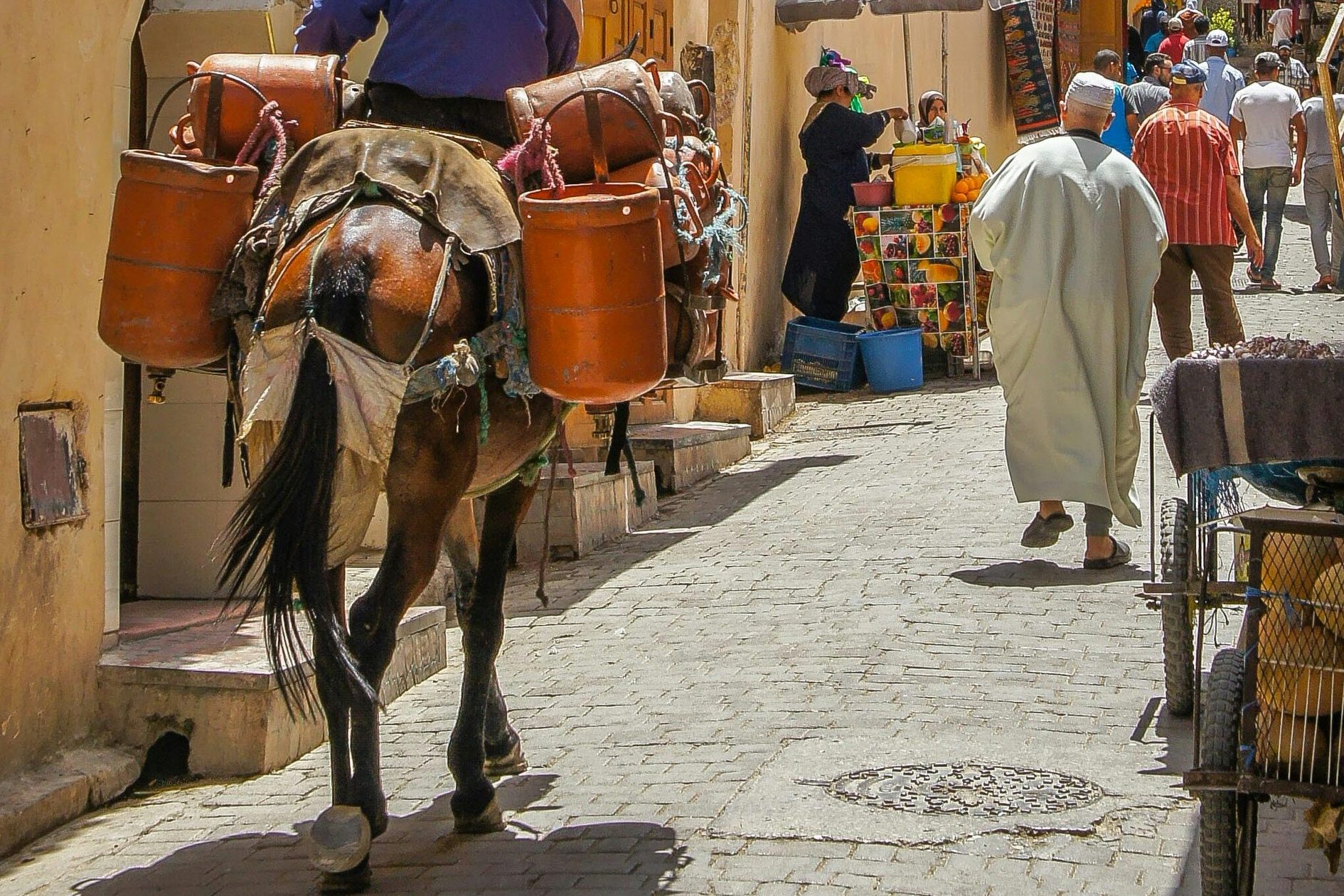
Nobody should attempt the medina alone on a first visit. Take a licensed guide, and check the official badge: the UK government warns that people posing as official guides harass visitors, and that genuine guides carry a badge and the permission of the local authority. A half-day walk of three or four hours, or a full day with a break, is the usual shape of a guided visit. For a family, a guide of your own is worth more than a place in a larger group.
The Qarawiyyin and the madrasas
Learning built the reputation of Fès, and the buildings that housed it are the jewels of the medina. We suggest them early in the day, before the lanes are at their busiest.
The Qarawiyyin: a mosque, a university, a library
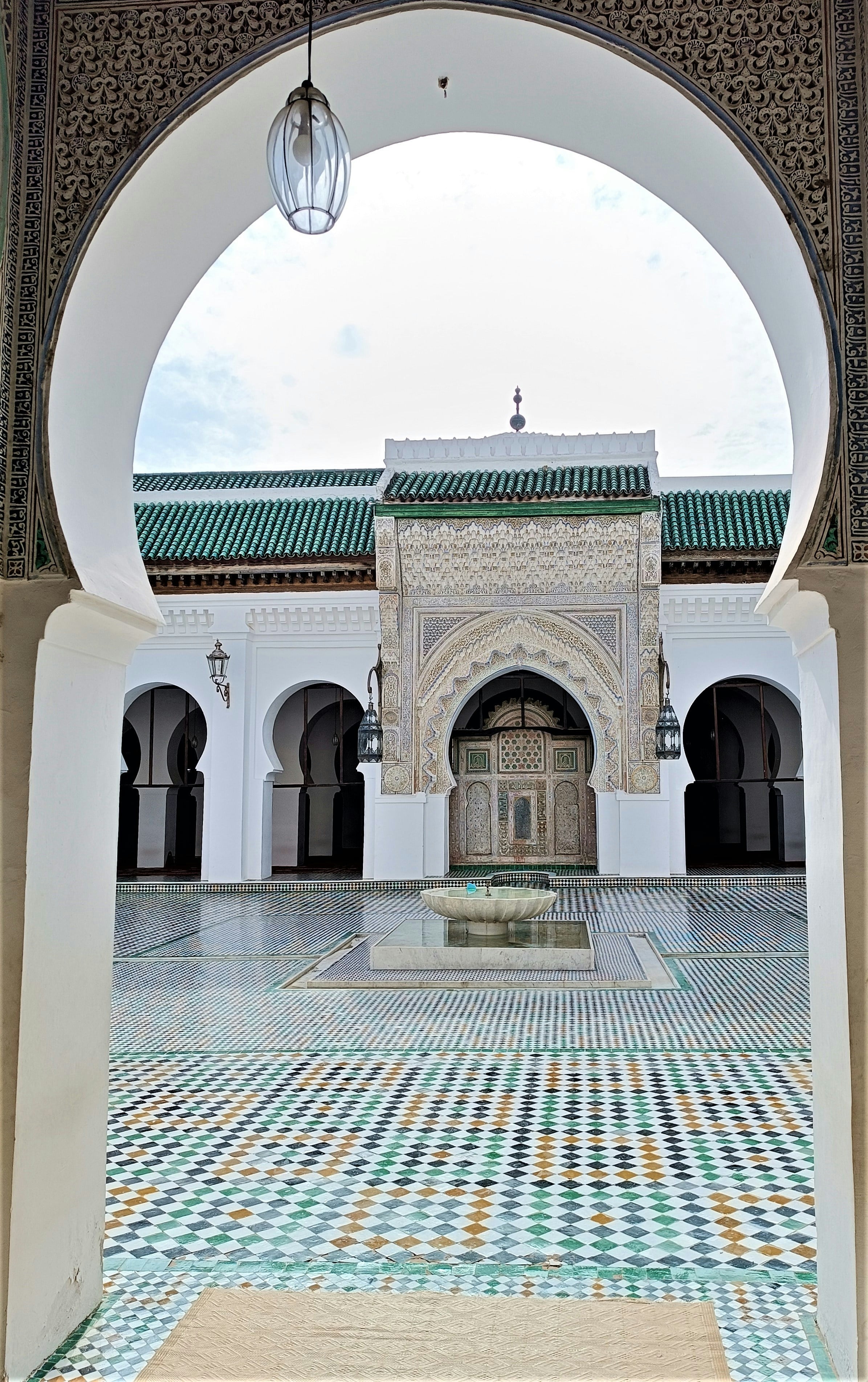
Founded as a mosque between 857 and 859, by tradition by Fatima al-Fihri, the daughter of a merchant, the Qarawiyyin became one of the great centres of learning of the Islamic world. UNESCO and Guinness World Records cite it as the oldest continually operating institution of higher learning in the world, and it joined Morocco’s state university system in 1963. Its library was founded by the Marinid sultan Abu Inan in 1349. The mosque remains a place of worship: visitors look into its courtyard, and its carved wooden screen, from the gate.
Bou Inania: a madrasa that was also a mosque
Built between 1350 and 1355 for the same Abu Inan, who gave it his name, Bou Inania is the only madrasa in Morocco that also served as a congregational mosque, with Friday sermons and a minaret of its own. Its prayer hall is off-limits to non-Muslim visitors, but it can be seen from the courtyard. Opposite the entrance, the facade of a house called Dar al-Magana holds a water clock completed in 1357; it no longer works, and how exactly it worked is still not fully understood. Do not confuse it with the Bou Inania madrasa of Meknès, a different building on the day trip described below.
Al-Attarine: the madrasa of the perfumers
The smaller Al-Attarine madrasa, built between 1323 and 1325 under the sultan Abu Sa’id Uthman II, takes its name from the souk of the spice and perfume sellers at its door, close to the Qarawiyyin. It is open as a historic site, and it is the place to understand the decoration of Fès in a single glance: zellige mosaic on the floor and the lower walls, carved stucco and calligraphy above, and carved cedar crowning the courtyard. Nearby, on the Place Seffarine, the Saffarin madrasa, finished in 1271, was the first the Marinids built.
The Chouara tannery, and how to see it
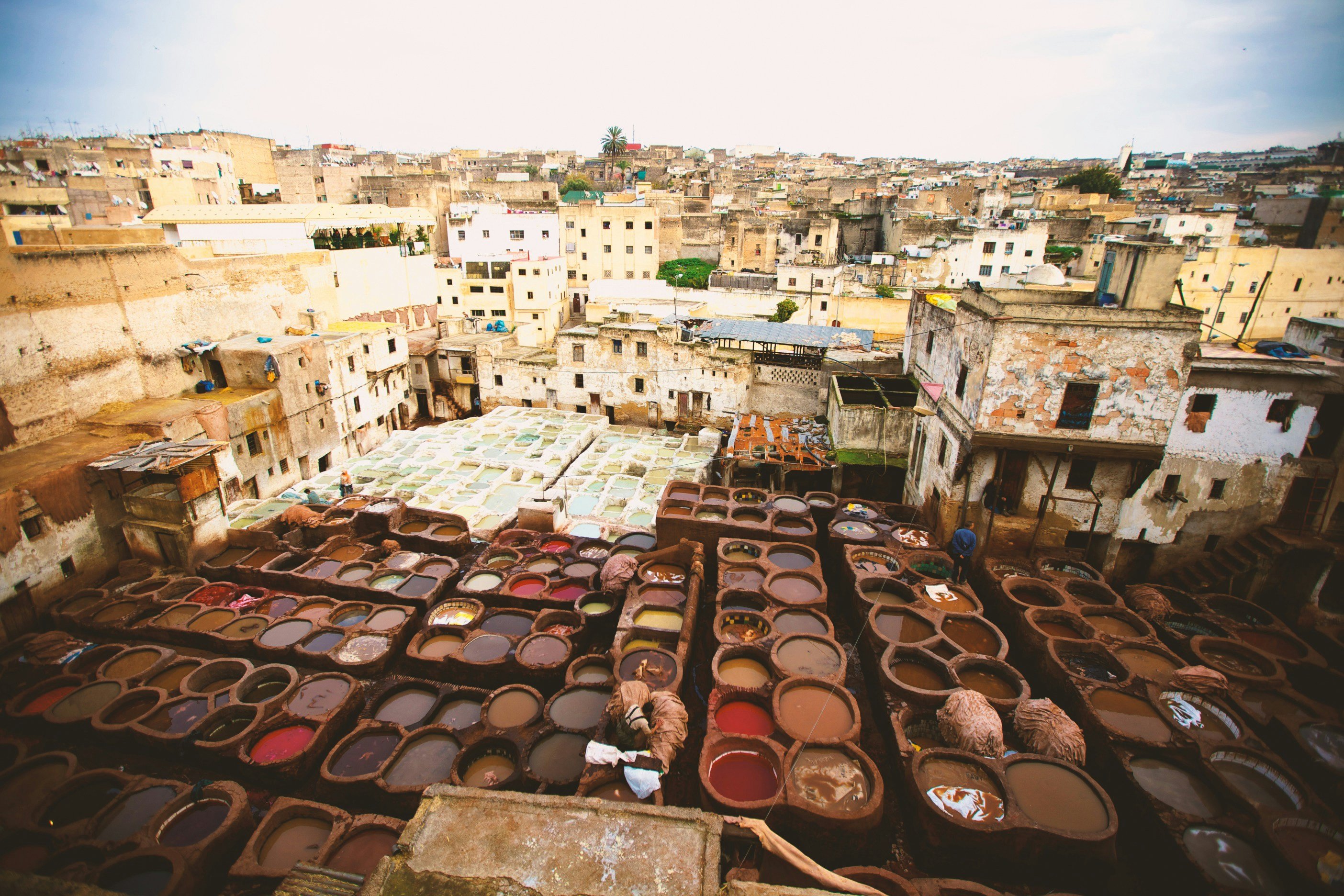
The Chouara tannery is the image everyone brings home from Fès: a honeycomb of round stone vats along the river in Fès el-Bali, each filled with a different colour. Local tradition links it to the founding of the city; its true age is uncertain. The work is still done by hand. The hides are softened for two to three days in vats of quicklime, salt, water and pigeon droppings, then dyed with poppy for red, indigo for blue and henna for orange, and the tannery was restored, and kept in place, when the river was rehabilitated this century.
Visitors watch from the terraces of the leather shops around it. Three pieces of advice for a family: warn everyone about the smell, which is strong; let the guide choose the terrace, since some are easier to reach than others; and remember that the visit carries no obligation to buy. The UK government notes that scams are common, and that inferior goods are sometimes substituted for those bought, so take any purchase with you rather than having it sent.
The craftsmen of Fès
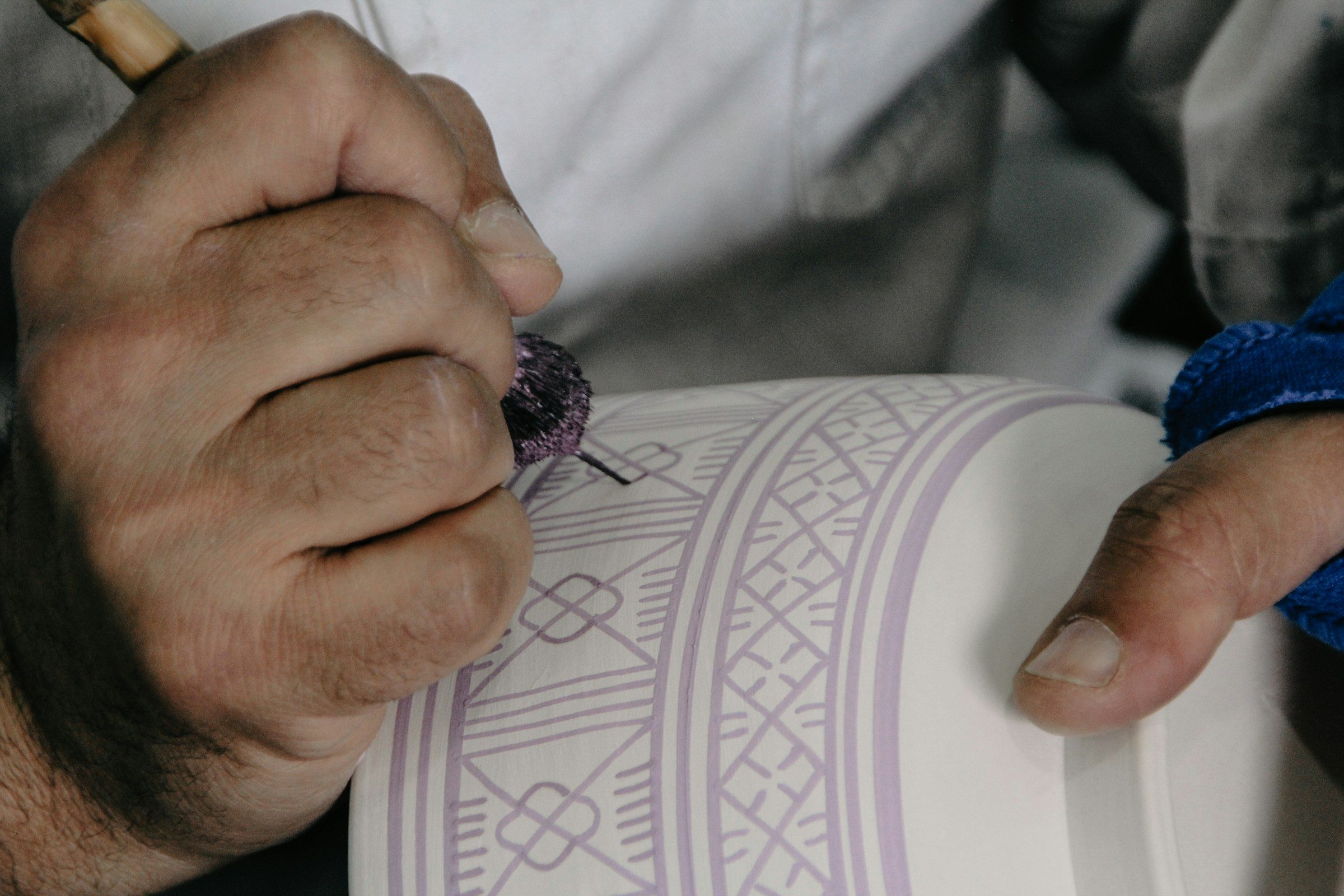
The medina is above all a city of crafts, organised by trade. On the Place Seffarine, coppersmiths still work in the square that bears their name. Around the Place Nejjarine, the carpenters’ souk surrounds a caravanserai completed in 1711, restored between 1990 and 1996 and reopened in 1998 as a museum of the arts and crafts of wood, with a nineteenth-century public fountain in front of it. UNESCO links the medina to three living traditions on its intangible heritage lists: Arabic calligraphy, the engraving of gold, silver and copper, and malhun, a sung poetry.
For the arts of Islam as a whole, the Al Batha museum, in the former Batha palace, reopened in February 2025 after restoration work begun in 2019. Its collections run from Quranic manuscripts to carpets, ceramics and metalwork, and an Andalusian garden, shaded by a great holm oak, covers more than half the site: a good place for grandparents to sit while the others explore. It is closed on Tuesdays.
To work with your hands rather than watch, Fès has cooking, bread and calligraphy classes: they are described in the hands-on section below.
Fès el-Jdid, the Mellah and the view from above
West of the old city lies Fès el-Jdid, the “new Fès”, founded in 1276 by the Marinid sultan Abu Yusuf Ya’qub as a royal citadel. The Royal Palace, Dar al-Makhzen, takes up some 80 hectares of it and is still used on occasion by the King; its gates on the Place des Alaouites, made under King Hassan II in the late 1960s and early 1970s, are known for their craftsmanship. Beside them lies the Mellah, the former Jewish quarter, created in the Marinid period and the first of its kind in Morocco. Between Fès el-Jdid and Bab Boujloud, the gardens of Jnan Sbil, which the tourist office counts among the essentials of Fès, give a green pause between two walks.
Fès is best understood from above. On the hill north of the medina, the ruined Marinid tombs, generally dated to the fourteenth century, are a lookout over the whole old city, popular at the end of the day, and a fine place to hear the call to prayer rise from its mosques; Borj Nord, a sixteenth-century fortress, stands close by. For anyone who will not walk far, drivers in Fès offer a tour of the ramparts by car: the walls and the views, without the climb.
Hands-on in Fès: kitchens, bread, calligraphy and the hills
Fès is a city to learn in, not only to look at. Alongside the guided walks, these are the experiences available in and around the medina; durations are indicative.
A cooking class, with or without the souk
The classic morning begins with a visit to the food souk and ends at the table after about four hours; a shorter class of about two hours stays in the kitchen. Classes are private or shared, from two guests to a group of about thirty. The bread and pastry class lasts two and a half hours, with a longer version of three and a half, and includes baking in the communal oven. Tell the school of any diet in advance; Jain food is on request.
The Sephardic kitchen of the Mellah
Some kitchens teach Sephardic Moroccan cooking, in a private session of about four and a half hours with a vegetarian alternative: a different taste of the city’s history.
Calligraphy
Calligraphy classes are held for two people or more at a time: a quiet counterpoint to the Arabic script UNESCO lists among the traditions of the medina.
A food tour of the medina
Guided food tours lead through the medina for one or two guests, for small parties of three to six, and for groups of seven or more. Ask for the length and the stops, and say so if the party eats vegetarian.
Above the city: a walk on Mount Zalagh
A private guided walk on Mount Zalagh, for two to six guests, is a change of air after the lanes of the medina. It can be cancelled up to 36 hours ahead if the weather turns.
Hammam and spa
Some riads have their own hammam and spa: the traditional bath, scrubs and massages, and treatments with orange blossom, a scent of Fès.
Walking the medina with grandparents and children
Fès is the Moroccan city that asks the most of the legs, and also the one where a little planning changes everything. The old city fills a valley, and its main streets follow the slope: east of the Chrabliyine mosque, the Tala’a Kebira descends steeply towards the Qarawiyyin. Five habits make the day easier:
- Walk downhill. Enter at the top, near Bab Boujloud, walk down towards the Qarawiyyin and the tanneries, and agree beforehand where the car will meet you at the end, so that no one climbs back.
- Keep the walk to a half-day. Three or four hours with a guide is plenty for elders and young children; leave the afternoon for the riad, a museum garden or a viewpoint by car.
- Let the luggage travel separately. Riads in the medina usually have porters bring bags in by handcart from the nearest car park: ask about it when you book, and about late arrivals.
- Ask for the right room. Riads are built around courtyards on several floors, and many rooms are reached by steep stairs, with few on the ground floor and often no lift: name the guests who need a ground-floor room.
- Prepare the children. Lanes are narrow and busy, handcarts come through, and the tannery smells strongly; agree on a meeting point, and explain beforehand that some mosques and shrines are for Muslims only.
On dress, the UK government suggests that women travellers consider loose-fitting clothing that covers the arms, legs and chest, and notes that clothing outside local norms may cause more offence during Ramadan. Its advice also lists the medinas among the places where pickpocketing occurs: keep phones and wallets out of sight in the crowds. For the rest of what families should know before a first journey to Morocco, see things to do in Marrakech with grandparents and children.
How to get to Fès
Fès is the best-connected city of the north. Most journeys arrive by train or by air, and leave by road towards the mountains or the desert.
By train, with ONCF
Morocco’s national railway, ONCF, links Fès with the Atlantic cities. From Casablanca, the train takes about 3 hours 50, with departures about every hour; from Rabat, about three hours. From Tangier there are two ways: an Al Boraq high-speed train to Kenitra and a change there onto a classic Al Atlas train, about 3 hours 25 in all, or a direct train over the classic line, about 4 hours 15. From Marrakech, direct trains take about six and a half hours. Al Boraq itself does not reach Fès. Each Al Atlas train has a single first-class carriage, which can sell out, and tickets go on sale three months ahead: book early for a family travelling together. The station stands in the Ville Nouvelle, the modern town, outside the medina walls. On the line, see things to do in Rabat and things to do in Tangier.
By air: Fès–Saïss
Fès–Saïss airport lies about 15 km south of the medina, some twenty minutes by road. On 12 November 2026, Ryanair’s timetable showed four flights a week from Marrakech to Fès this winter, on Mondays, Thursdays, Saturdays and Sundays, of about an hour; Royal Air Maroc lists Fès in its domestic network. Travellers from India usually land in Casablanca and continue by train or by air: the connections are set out in flights from India and the airports of Morocco.
By road: from Marrakech, the north or the desert
Calculated on OpenStreetMap, Fès lies about 530 km and six hours’ driving from Marrakech without stops; about 320 km and 3 hours 40 from Casablanca’s airport; about 285 km and 4 hours 30 from Tangier. From the dunes of Merzouga, the road climbs north through the Middle Atlas, about 460 km and some eight hours at the wheel: the desert and Fès make a natural pair, set out in the Merzouga desert, from the road to the nights in the dunes. In winter, ask about the mountain passes before setting out.
How many nights in Fès?
Morocco’s tourist office suggests allowing three days, and we agree. One night means seeing the medina at a run, the day after a long journey; two give a full day inside the walls; three leave room for Fès el-Jdid, a workshop and an evening at the Marinid tombs. Counted from arrival, that gives three shapes of stay:
- Two nights, the essentials. A morning in the medina with a guide, the tannery and the madrasas; an afternoon at the Al Batha museum or Fès el-Jdid; the view from the Marinid tombs.
- Three nights, at an easy pace. The same, spread over two days, with a cooking or calligraphy class and a slow afternoon in the riad.
- Four nights, with Meknès and Volubilis. A full day out to the Roman ruins, the holy town of Moulay Idriss and the imperial city of Meknès, back in Fès for dinner.
Day trips from Fès: Meknès, Volubilis and Chefchaouen
Volubilis and Moulay Idriss
Volubilis, about an hour and a half from Fès according to the tourist office, was the capital of the kingdom of Mauretania, founded in the third century BC, before it became an outpost of the Roman Empire. Its 42 hectares, inscribed by UNESCO in 1997, hold one of the richest sites of the period in North Africa: a triumphal arch, a capitol, houses floored with mosaics, all within a Roman rampart built in 168–169 AD. Volubilis later became, briefly, the capital of Idris I, founder of the Idrisid dynasty, who is buried in the hill town of Moulay Idriss nearby. His shrine is closed to non-Muslims, and the town is the scene of a pilgrimage every August.
Meknès, the city of Moulay Ismaïl
Meknès, about an hour from Fès, was a military settlement of the Almoravids before the sultan Moulay Ismaïl, who reigned from 1672 to 1727, made it his capital. UNESCO, which inscribed it in 1996, describes ramparts up to 15 metres high pierced by nine monumental gates, and the tourist office singles out Bab Mansour, on the El Hedime square, as a masterpiece of Hispano-Moorish art, together with the sultan’s royal stables and granaries. A full day takes in Volubilis and Moulay Idriss in the morning, Meknès after lunch, and Fès again by evening. For a night there and the best order of visits, see our guide to Meknès and Volubilis, and for the cedar forests to the south, Ifrane and the Middle Atlas.
Chefchaouen, better with a night
The blue town of the Rif lies about 190 km north-west of Fès, three and a half to four hours by road. A day trip is possible, but it leaves seven or eight hours in the car for a few hours in the lanes; a night there, on the way to Tangier or back to Fès, makes the better plan. What to do once there is in things to do in Chefchaouen, the blue town of the Rif. Closer to Fès, Ifrane, in the Middle Atlas, is about an hour and a quarter away by road.
When to go: the Fès weather, month by month
Fès lies inland, and its seasons are sharper than those of the coast: Morocco’s tourist office recommends March to May and September to November, with very hot summers, mild winter days and cool evenings. The long-term averages published by the World Meteorological Organization give the detail.
Fès’s averages, month by month
- September
- 30 °C by day · 16 °C at night · rain on 4 days
- Warm, drying out: one of the kindest months
- October
- 26 °C by day · 13 °C at night · rain on 7 days
- Soft days; the autumn rains return
- November
- 20 °C by day · 8 °C at night · rain on 8 days
- Cool evenings, rain on a quarter of the days
- December
- 17 °C by day · 5 °C at night · rain on 9 days
- Cold nights, frequent rain
- January
- 16 °C by day · 4 °C at night · rain on 8 days
- The coldest month: warm layers for the evenings
- February
- 17 °C by day · 4 °C at night · rain on 9 days
- Cold and wet; Ramadan expected from about 8 February 2027
- March
- 20 °C by day · 7 °C at night · rain on 9 days
- Milder days, still wet
- April
- 22 °C by day · 8 °C at night · rain on 9 days
- Mild days, cool nights, showers
- May
- 26 °C by day · 12 °C at night · rain on 6 days
- Warm and drier: one of the kindest months
- June
- 31 °C by day · 15 °C at night · rain on 3 days
- Hot afternoons
- July
- 35 °C by day · 18 °C at night · rain on 2 days
- The hottest months: the medina in the morning only
- August
- 35 °C by day · 18 °C at night · rain on 2 days
- Very hot and dry
| Month | Average high | Average low | Rainy days | What to expect |
|---|---|---|---|---|
| September | 30 °C | 16 °C | 4 | Warm, drying out: one of the kindest months |
| October | 26 °C | 13 °C | 7 | Soft days; the autumn rains return |
| November | 20 °C | 8 °C | 8 | Cool evenings, rain on a quarter of the days |
| December | 17 °C | 5 °C | 9 | Cold nights, frequent rain |
| January | 16 °C | 4 °C | 8 | The coldest month: warm layers for the evenings |
| February | 17 °C | 4 °C | 9 | Cold and wet; Ramadan expected from about 8 February 2027 |
| March | 20 °C | 7 °C | 9 | Milder days, still wet |
| April | 22 °C | 8 °C | 9 | Mild days, cool nights, showers |
| May | 26 °C | 12 °C | 6 | Warm and drier: one of the kindest months |
| June | 31 °C | 15 °C | 3 | Hot afternoons |
| July | 35 °C | 18 °C | 2 | The hottest months: the medina in the morning only |
| August | 35 °C | 18 °C | 2 | Very hot and dry |
Long-term averages for 1991–2020 at Fès, from Morocco’s Direction de la Météorologie Nationale, published by the World Meteorological Organization and rounded to the nearest degree; rainy days are days with measurable rain. A given day can be colder or warmer than the average.
For a first visit, aim for May or September, when the table shows mild to warm days and little rain. From November to April, rain falls on eight or nine days a month and January nights average 4 °C: pack an umbrella and a warm layer, and ask how your room is heated. In July and August, with highs of 35 °C, the medina is for the morning and the shade of the courtyard for the afternoon.
Ramadan, expected to begin around 8 February 2027, changes the rhythm of the city rather than closing it; the dates and what they mean for travellers are in the best months to visit Morocco from India. Music lovers should check the dates of the Fès Festival of World Sacred Music, which the tourist office counts among the main events of the city’s cultural calendar.
Vegetarian and Jain food in Fès
Fès is proud of its kitchen, and the tourist office calls its gastronomy one of the best in the world. It is kinder to vegetarians than its reputation for pastilla suggests: vegetable tagines and couscous are part of the everyday repertoire. Riads in the medina that cook for their guests serve vegetarian dishes at their table, and ask to be told of any diet in advance; cooking classes offer vegetarian alternatives too.
Vegetarian is therefore simple when asked for in advance, and Jain food is on request: set the rules out in writing before you book, from no onion, garlic or root vegetables to no egg, and ask for the hour of dinner as well as the dishes. The words to use, with a list in French to show the kitchen, are in how to ask for a Jain meal as a traveller in Morocco.
What we plan for you in Fès
Sehra Morocco plans journeys that include Fès for families and groups, and works with travel agencies on them: see how we work with travel agencies. If you are planning your own stay, the choices that matter most are where to sleep (inside the medina or outside the walls), who will guide you, and how the days are paced for the oldest and youngest in the party.
So, what are the best things to do in Fès?
Walk the medina of Fès el-Bali with a licensed guide, downhill and unhurried; step into the courtyards of Al-Attarine and Bou Inania, and look into the Qarawiyyin from its gate; watch the Chouara tannery from a terrace; find the coppersmiths and the woodworkers; rest in the garden of the Al Batha museum; and end the day at the Marinid tombs, above the whole city. Give it three nights, add a day for Volubilis and Meknès, and choose spring or autumn.
The rest is preparation: a train from Casablanca or a flight to Fès–Saïss, a ground-floor room for those who need one, a porter for the bags, and the kitchen told in advance. Flying in from India? Start with the journey from India, from flights to dirhams; for the rest of the country, see our travel experiences across Morocco.
Planning Fès for your family or your group? Write to us with your dates, the ages in your party and the nights you can give Fès, and we will answer by e-mail or video call.
Questions travellers ask about Fès
How many days do you need in Fès?
Is Fès worth visiting?
How do you get from Marrakech to Fès?
Can you visit the Qarawiyyin Mosque?
Is the Fès medina suitable for elderly parents and children?
Can you visit Chefchaouen as a day trip from Fès?
What is the best time to visit Fès?
Editorial note
This guide draws on UNESCO, for the Medina of Fez, the Archaeological Site of Volubilis and the Historic City of Meknes; Morocco’s national tourist office, for Fès and Meknès; the World Meteorological Organization, for the long-term averages of Morocco’s Direction de la Météorologie Nationale at Fès (1991–2020); Morocco’s Fondation Nationale des Musées, for the Al Batha museum; the UK government’s travel advice for Morocco; the published timetable of Ryanair and the network of Royal Air Maroc; train journey times published by Seat61 and Rome2rio, as ONCF’s own website could not be reached on 12 November 2026; and Wikipedia, for the history of the Qarawiyyin, the madrasas, the Chouara tannery, the Nejjarine caravanserai, Fès el-Jdid, the Marinid tombs, the streets of the medina and Moulay Idriss. Road distances and driving times were calculated with the OSRM route planner on OpenStreetMap data. Train times are approximate and should be confirmed with ONCF before you book. All sources were read on 12 November 2026.
Activity durations and ages come from information provided by local activity providers in 2026; check them when you book.
Timetables, opening days and road conditions change, sometimes without notice: check them before you book. Apart from public bodies, an airline and a railway, no business is named, and none is recommended. Sehra Morocco plans tailor-made journeys in Morocco; this guide describes no journey of its own.
- UNESCO World Heritage Centre: Medina of Fez (inscribed 1981), Archaeological Site of Volubilis (1997) and Historic City of Meknes (1996)
- Moroccan National Tourist Office: Fez, the imperial pearl and Meknes
- World Meteorological Organization, World Weather Information Service: Fès
- Fondation Nationale des Musées: Musée Al Batha des Arts de l’Islam
- GOV.UK, Morocco travel advice: safety and security, updated 19 August 2026
- Ryanair, timetable (Marrakech – Fès, winter 2026–2027); Royal Air Maroc, our network
- Train journey times: Seat61, train travel in Morocco (Tangier, Al Boraq and Al Atlas, booking period) and Rome2rio (Casablanca, Rabat and Marrakech to Fès)
- Wikipedia: University of al-Qarawiyyin, Bou Inania Madrasa, Al-Attarine Madrasa, Saffarin Madrasa, Chouara Tannery, Funduq al-Najjarin, Fes Jdid, Marinid Tombs, Tala’a Kebira, Fez and Moulay Idriss Zerhoun
- Road distances and driving times: OSRM on OpenStreetMap data, calculated on 12 November 2026, without stops
Written by Sehra Morocco. Last reviewed: .
Tell us about your trip.
By e-mail or video call. We reply within two working days.