Things to do in Tangier: the Kasbah, Cap Spartel and the city on the Strait
Tangier looks across the water at Europe and has always lived from the comings and goings of its harbour: Phoenician traders, Portuguese and English garrisons, the consulates of Europe, painters and writers. Here is what to see between the Kasbah and the cape, how to arrive by high-speed train or by ferry, and how many nights to give the gateway to the north.
Reviewed 12 November 2026 · Sources at the end
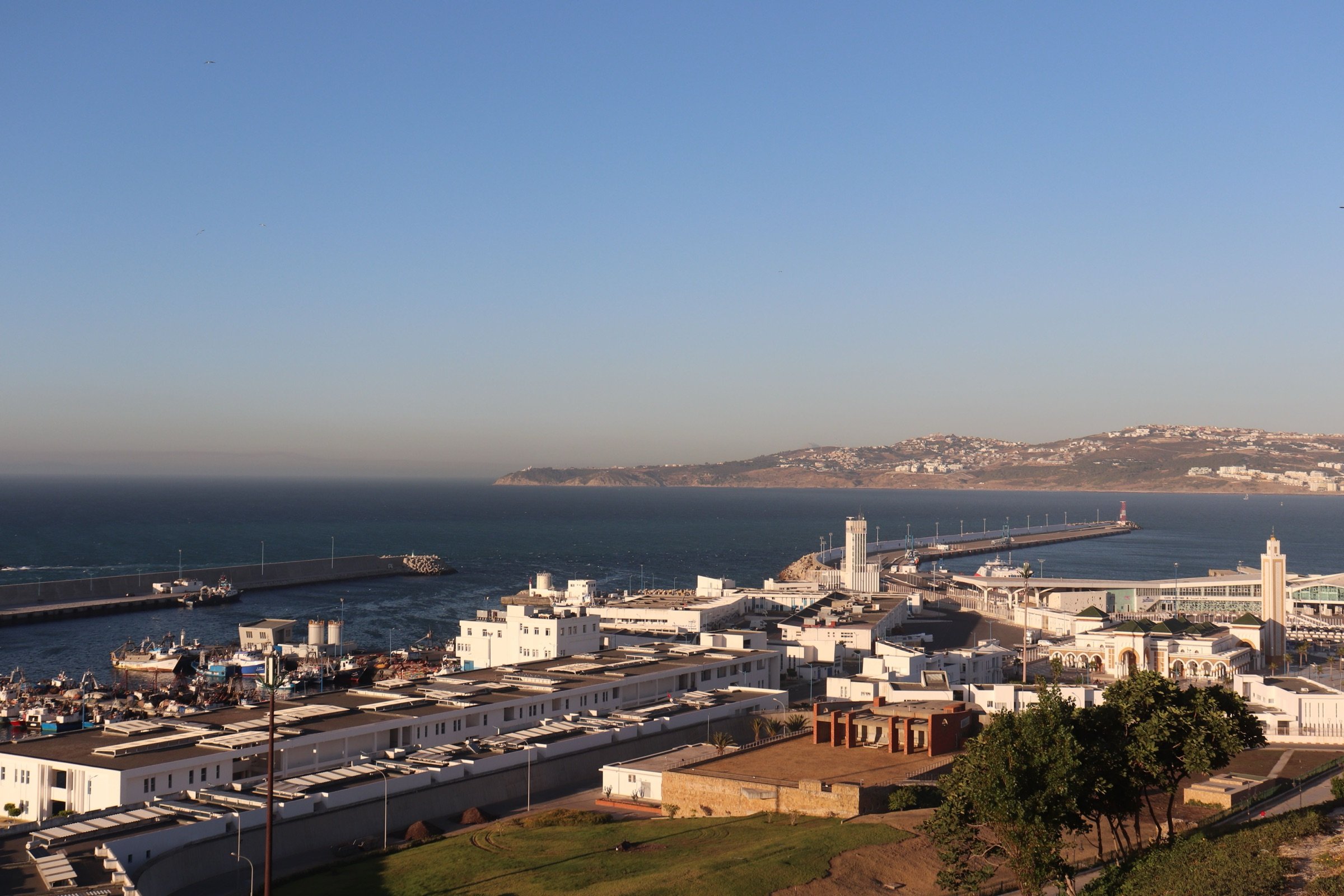
The best things to do in Tangier fit into two days: climb through the medina from the Grand Socco to the Kasbah and its museum, stop at the old American Legation, then drive out to Cap Spartel, where the Atlantic meets the Mediterranean, and down to the Caves of Hercules. Add a third day for Asilah or Tétouan, and the city becomes the natural base for the north of Morocco. It is also one of the few Moroccan cities you can reach from Europe without flying: Al Boraq high-speed trains arrive from Rabat in about 1 hour 20 and from Casablanca in about 2 hours 10, and ferries cross from Tarifa in about an hour.
Sehra Morocco plans tailor-made journeys across Morocco for travellers from India and from everywhere else. The facts in this guide come from official and public sources, listed at the end; the advice drawn from them is ours.
Tangier, at a glance
The essentials, checked on 12 November 2026:
- Where
- On the Strait of Gibraltar, at the north-western tip of Africa, where the Mediterranean meets the Atlantic
- By train
- Al Boraq high-speed trains: about 1 hour 20 from Rabat and 2 hours 10 from Casablanca, roughly every hour
- By sea
- From Tarifa, about an hour, into the port in town; from Algeciras, 50 minutes to an hour and a half, into Tanger Med, 52 km east
- By air
- Ibn Batouta airport, about 15 km south-west of the centre, in Royal Air Maroc’s network
- Nights
- Two for the city and the cape (the tourist office suggests two days); three or four with Asilah and Tétouan
- Day trips
- Asilah, about 45 minutes; Tétouan, about an hour; Chefchaouen, about two hours, better with a night
- Best months
- Spring and early autumn; the rain comes between October and February
- At the table
- Vegetarian when asked for in advance; Jain on request
Train and ferry times change with the timetable and the weather, and road times are without stops: check them again before you go.
A harbour between two seas
Tangier sits where Africa comes closest to Europe, between two hills at the end of its bay: the Kasbah on the western one, the medina tumbling down to the port, the newer city beyond. A few kilometres west, at Cap Spartel, the Atlantic ends: the longitude of its lighthouse is recognised as the western limit of the Mediterranean. The Romans called the city Tingis, and the tangerine is named after it.
From Tingis to the international city
Few Moroccan cities have changed hands so often. Tangier began as a Phoenician trading post, certainly by the eighth century BCE, and became a Roman colony. Its most famous son was born here in 1304: Ibn Battuta, who left at twenty for Mecca and spent three decades travelling across Africa and Asia. He reached Delhi, where Sultan Muhammad bin Tughluq made him a judge, the first thread between Tangier and India; a tomb said to be his stands in the medina.
The Portuguese took the city in 1471; England held it from 1662 and destroyed the town and its harbour before leaving in 1684. In 1777, Sultan Mohammed ben Abdallah made Tangier the meeting point between the Moroccan court and the European powers, and the consulates moved in; the same year, Morocco became the first nation to recognise the independence of the United States.
Under a convention signed in Paris in 1923, the city became an international zone from 1925, governed jointly by European powers and, after 1945, the United States, with a role for the Sultan. It drew diplomats, businessmen, spies, painters and writers: Delacroix had come in 1832, Matisse stayed several times, and after them came Paul Bowles, Tennessee Williams and the Beat writers. On 9 April 1947, Sultan Mohammed V gave his Tangier Speech, and the city’s great square still bears the date. The zone ended with independence in 1956.
Things to do in Tangier: the Kasbah and the medina
Morocco’s tourist office names five essentials for Tangier: the Great Mosque, the Kasbah, Cap Spartel, the Caves of Hercules and the gardens of the Mendoubia. Three of them lie within a short walk of each other, in and around the old city.
The Grand Socco and the gardens of the Mendoubia
The Grand Socco, officially the Place du 9 Avril 1947, is the round square where the medina meets the newer city: once a market outside the walls, today a fountain among palm trees and benches. On one side, an arch opens onto the gardens of the Mendoubia, around a palace that now holds a museum of Morocco’s resistance to colonial rule; on another, the Rue de la Kasbah climbs towards the citadel.
The medina, the Petit Socco and the American Legation
Downhill from the Grand Socco, the lanes lead to the Petit Socco, the small square at the heart of the lower medina. Around it, mosques, synagogues and churches stand within a few streets of each other: the Great Mosque, several old synagogues, one of them now a Jewish museum, and the Church of the Immaculate Conception.
A little further, the American Legation is the city’s most surprising museum. Given to the United States by the Sultan in 1821, it was the first American public property abroad and is still the only National Historic Landmark of the United States outside its own territory. The Moorish-style house holds paintings and a wing given to Paul Bowles, and makes a quiet hour in the middle of the medina.
The Kasbah and its museum of Mediterranean cultures
At the top of the medina, behind high walls, the Kasbah watches over the Strait. Its palace, Dar el Makhzen, stands where the Portuguese governors and then the English Upper Castle stood, and was built after 1684. It now houses the Musée la Kasbah des Cultures Méditerranéennes, run by Morocco’s national museums foundation, with archaeological and ethnographic collections laid out through the palace’s own rooms. A former prison of the Kasbah has become a space for contemporary art. With grandparents, ask the driver to set you down as close to the Kasbah as the streets allow, and let the lanes carry you downhill to the two Soccos.
Check the opening days before you go: the foundation’s page lists the museum as open daily but also as closed on Tuesdays. Its sister museum, the Villa Harris, faces the sea outside the medina, hung with two centuries of painting in Morocco, from the heirs of Delacroix to the first Moroccan modernists.
Cap Spartel and the Caves of Hercules
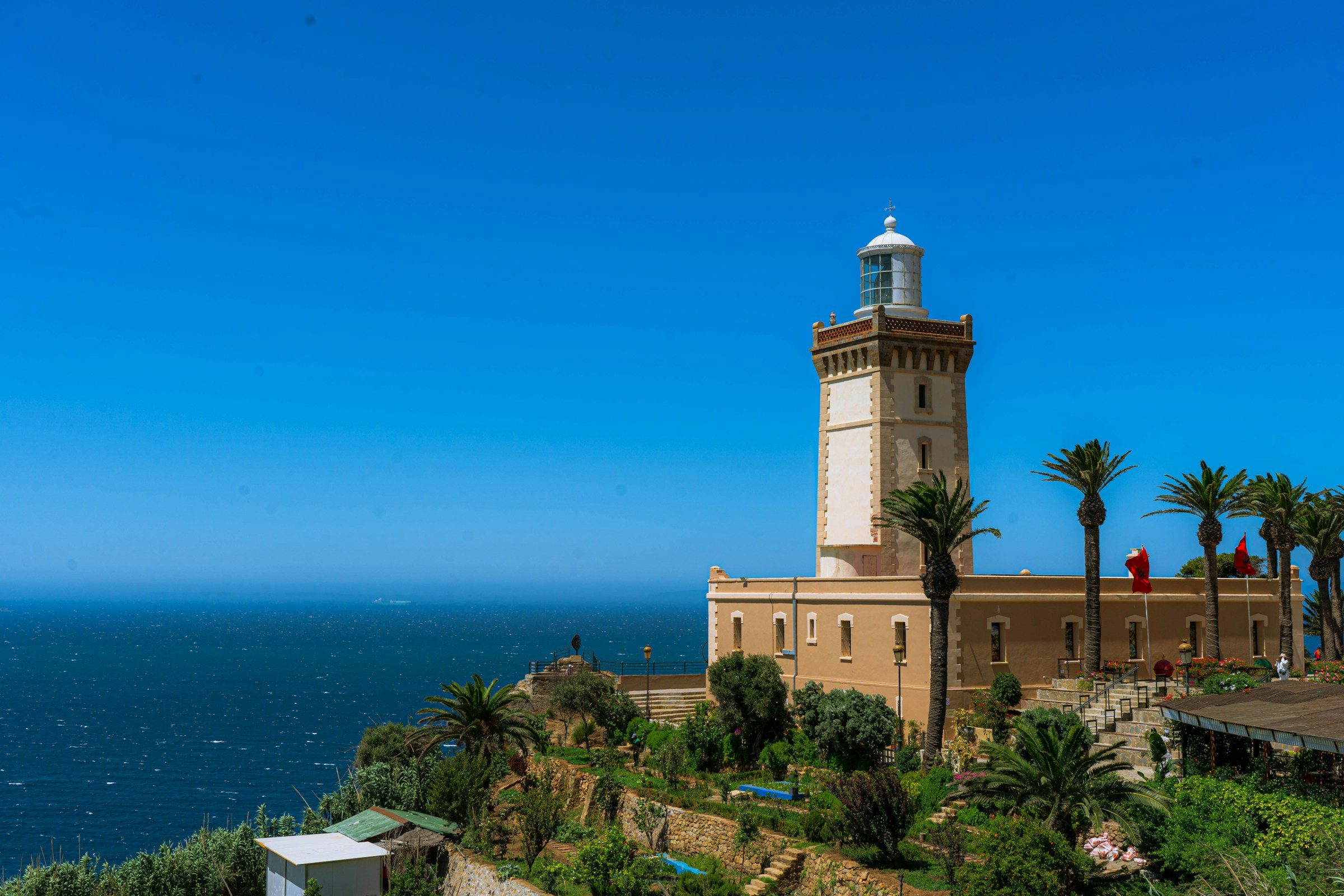
Some 15 km west of the medina, about twenty minutes by road, the land ends at Cap Spartel, the north-western corner of Africa (not its northernmost point, as is often said). Its lighthouse, built in 1864 under Sultan Muhammad IV, was long kept by a consortium of foreign powers. The site, restored in 2020 and 2021, has a maritime museum and a botanical garden, and visitors can climb the lighthouse for the view over the Strait.
A short drive south, along the Atlantic shore, the Caves of Hercules open onto the ocean. Part natural, part enlarged by people who cut millstones from the rock, they were inhabited in the Neolithic. Their opening onto the sea is said to trace the shape of Africa. Legend says that Hercules slept here before seeking the golden apples of the Hesperides, and split the mountain to open the Strait, leaving the two Pillars of Hercules on either shore. The caves have been open to visitors since 1920 and were renovated in 2015.
Beaches line this coast, but the UK government warns that many Moroccan beaches have little or no lifeguard cover, with strong currents and unexpected waves: keep children to supervised beaches and calm days.
How to get to Tangier: train, ferry or plane
By Al Boraq from Casablanca and Rabat
Since November 2018, Al Boraq, Africa’s first high-speed train, has linked Tangier with Rabat and Casablanca, at up to 320 km/h between Tangier and Kenitra. Published timetables give about 1 hour 20 from Rabat Agdal and about 2 hours 10 from Casa Voyageurs, with departures roughly every hour through the day, in first or second class, every seat reserved. Tanger Ville station lies about 4 km from the medina: a five-minute taxi ride, or half an hour on foot.
From Marrakech, the day train means a change at Casablanca, for about five hours and a quarter in all; an overnight train with shared couchettes runs direct. From Fès, the quickest route is a classic train to Kenitra and Al Boraq from there, about 3 hours 25. Rabat and Casablanca have their own guides: things to do in Rabat and things to do in Casablanca.
By ferry from Spain
For travellers already in Andalusia, two routes cross the Strait:
- Tarifa to Tangier. Fast ferries take about an hour and dock at the port in the city itself, within walking distance of the medina. It is the more beautiful arrival.
- Algeciras to Tanger Med. Ships take about an hour and a half, fast ferries about 50 minutes, to Tanger Med, a modern port 52 km east of Tangier: about an hour by road to the city. The ships have open decks, with a view of the Rock of Gibraltar as they leave.
There is a time difference between Spain and Morocco, passport formalities may take place on board, and ferries often run late: check the local time of arrival, listen for the announcements, and avoid a tight train connection. Travellers who need a visa for Morocco should hold it before boarding; see the Morocco visa for Indian passport holders.
By air
Ibn Batouta airport lies about 15 km south-west of the centre, half an hour by road, and Royal Air Maroc is its largest airline. From India, the flights, and which Moroccan airport to choose, are set out in the journey to Morocco from India. A family landing in Casablanca can take Al Boraq north from Casa Voyageurs.
How many nights in Tangier?
Morocco’s tourist office suggests allowing two days: two nights for the city alone. Three questions decide the rest:
- Is Tangier a stop or a base? As a stop between Spain and the south, or between Casablanca and Chefchaouen, two nights give a day in the old city and half a day at the cape. As a base for the north, four nights let you add Asilah and Tétouan without changing hotels.
- Who walks, and how far? With grandparents, spread the steep old city over two mornings and keep the afternoons for the cape and the museums.
- What comes next? If the journey continues to Chefchaouen and Fès, Tangier is the natural start, two hours from the blue town. If it continues south to Rabat, Casablanca or Marrakech, end with Tangier and leave by train.
Day trips from Tangier: Asilah, Tétouan and Chefchaouen
Asilah, the white town on the Atlantic
About 45 minutes south along the coast, Asilah is a small fortified town whose Portuguese ramparts, built after 1471, still stand intact. Its medina has been restored and whitewashed, and every summer since 1978 its cultural festival, held in August, has invited artists to paint new murals on the walls of the houses. It is the gentlest day out from Tangier: a walk on the ramparts above the ocean, a lunch of fish, and for those who want it, an hour in a hammam, where sessions of 60 or 90 minutes are usual.
Tétouan, a medina listed by UNESCO
About an hour east, on the Mediterranean side, Tétouan was rebuilt at the end of the fifteenth century by refugees from Granada, led by Ali al-Mandri, and grew with the Muslim and Jewish families who left Andalusia after 1492. It is still called the daughter of Granada, and some families are said to keep the keys of their old Andalusian homes. The medina has been inscribed on UNESCO’s World Heritage List since 1997, and the city joined UNESCO’s network of Creative Cities for crafts and folk art in 2017. From 1913 to 1956, it was the capital of the Spanish protectorate. Go with a licensed guide: the medina is large and lived in, and a guide makes sense of it.
On to Chefchaouen, in the Rif
The blue town of the Rif lies about 110 km away, two hours by road. It can be done in a day, but four hours in a car for a few hours in its lanes is a poor bargain. Give it a night, or two, on the way south to Fès: see things to do in Chefchaouen, the blue town of the Rif, and, for the next stop, things to do in Fès.
On horseback, underwater and at the stove
Around the city, the hills, the beaches and the waters of the Strait offer a different kind of day, and several outings suit a family.
- A ride in the hills or on the beach. Horse rides of about an hour and a half leave from the outskirts of Tangier, either through the hills of Mnar or along a beach. They are open to all levels, led by an instructor, with a helmet provided; riders must be at least 8 years old and weigh no more than 115 kg. Departures are private and small, a few riders at a time, so a larger group rides in turns.
- A first dive in the Strait. East of Tangier, towards Belyounech at the foot of Jebel Musa, often named as the African Pillar of Hercules, the Mediterranean shore has dive sites some 70 km from the city. An introductory dive lasts about two hours, no deeper than 12 metres, with equipment and an instructor; it is open from age 10, after a medical questionnaire. Non-divers can join a guided snorkelling outing of about an hour and a half. Diving runs all year, and June to September is the most comfortable season.
- A cooking class. A half-day class of about four hours ends with the meal you have cooked. A vegetarian menu is offered, and dishes can often be adapted if you ask in advance.
- A licensed guide for the city. Guided walks usually take a half-day of three to four hours, or a full day of six to seven; beyond twenty people, several licensed guides share the group.
For what else Morocco offers, from the desert to the Atlantic, see our journeys across Morocco.
When to go: Tangier’s weather, month by month
Morocco’s tourist office names April to June, then September and October, as the mild months, and warns that winter can be rainy. The averages of the World Meteorological Organization agree. The sea keeps the city mild all year: no month averages above 30 °C by day or below 8 °C at night. The difference between the seasons is the rain: from October to February, it falls on nine to eleven days a month, while June, July and August are almost dry.
Tangier’s averages, month by month
- January
- 17 °C by day · 8 °C at night · rain on 10 days
- Mild by day, cool at night; a coat for the evening
- February
- 17 °C by day · 9 °C at night · rain on 10 days
- Showers come and go; museums and the medina between them
- March
- 19 °C by day · 10 °C at night · rain on 9 days
- The hills turn green; still a month for an umbrella
- April
- 21 °C by day · 12 °C at night · rain on 9 days
- Spring on the Strait: one of the best months
- May
- 24 °C by day · 14 °C at night · rain on 7 days
- Soft and bright: one of the best months
- June
- 27 °C by day · 17 °C at night · rain on 3 days
- Dry and warm, before the summer crowds: one of the best months
- July
- 29 °C by day · 19 °C at night · rain on 1 day
- Dry and warm, cooled by the sea; the beaches fill
- August
- 30 °C by day · 20 °C at night · rain on 1 day
- The warmest month; Asilah’s arts festival
- September
- 27 °C by day · 19 °C at night · rain on 4 days
- Warm sea air, quieter streets: one of the best months
- October
- 25 °C by day · 16 °C at night · rain on 9 days
- Mild; the first autumn rains arrive
- November
- 20 °C by day · 12 °C at night · rain on 10 days
- The wettest month of the year, on average
- December
- 18 °C by day · 10 °C at night · rain on 11 days
- Mild and often wet; the most rainy days
| Month | Average high | Average low | Days of rain | What to expect |
|---|---|---|---|---|
| January | 17 °C | 8 °C | 10 | Mild by day, cool at night; a coat for the evening |
| February | 17 °C | 9 °C | 10 | Showers come and go; museums and the medina between them |
| March | 19 °C | 10 °C | 9 | The hills turn green; still a month for an umbrella |
| April | 21 °C | 12 °C | 9 | Spring on the Strait: one of the best months |
| May | 24 °C | 14 °C | 7 | Soft and bright: one of the best months |
| June | 27 °C | 17 °C | 3 | Dry and warm, before the summer crowds: one of the best months |
| July | 29 °C | 19 °C | 1 | Dry and warm, cooled by the sea; the beaches fill |
| August | 30 °C | 20 °C | 1 | The warmest month; Asilah’s arts festival |
| September | 27 °C | 19 °C | 4 | Warm sea air, quieter streets: one of the best months |
| October | 25 °C | 16 °C | 9 | Mild; the first autumn rains arrive |
| November | 20 °C | 12 °C | 10 | The wettest month of the year, on average |
| December | 18 °C | 10 °C | 11 | Mild and often wet; the most rainy days |
Long-term averages for 1991–2020 at Tangier, from Morocco’s Direction de la Météorologie Nationale, published by the World Meteorological Organization and rounded to the nearest degree.
That makes Tangier a good summer choice while Fès, inland, averages 35 °C by day in July and August. In winter, pack for rain and keep an indoor day for the museums. For Ramadan and for how Morocco’s seasons meet India’s holidays, see the best months to visit Morocco from India.
Vegetarian and Jain food in Tangier
On this coast the kitchen looks across the Strait too: in Asilah, the cooking is described as Ibero-Moroccan, rich in fish and seafood. For a vegetarian family, meals are easy to arrange when asked for in advance, and Jain food is on request: give each kitchen your rules before the day, not at the table. The wording to use is in how to ask for a Jain meal as a traveller in Morocco. On a day trip to the cape or to Tétouan, carry what the strictest eater in the party needs.
Good to know before you go
- Guides. The UK government warns that people posing as official tourist guides are common, and advises using only a guide with an official badge and the permission of the local authority.
- Pickpockets. Petty crime is common in historic quarters and on beaches: carry little cash and few valuables in the medina.
- Photographs. Always ask before photographing people, especially children; photography near sensitive political or military sites is illegal.
- Drugs. The UK government warns of severe penalties for any drug offence, cannabis included.
- Roads at night. Poor lighting makes night driving dangerous: drive to the cape, Asilah and Tétouan by day.
So, what are the best things to do in Tangier?
Those that make sense of its place on the map. Climb the medina to the Kasbah and look out over the Strait; spend an hour in the American Legation, where the story of the international city still hangs on the walls; stand at Cap Spartel, where one sea becomes another, and step down into the Caves of Hercules. Then use the city as a door: to Asilah’s white ramparts, to the Andalusian medina of Tétouan, to Chefchaouen and the Rif. Two nights for the city, three or four as a base, between April and June or in September and October: that is Tangier at its best.
Planning the north of Morocco for your family or your group? Write to us with your dates, the ages in your party and how you would like to arrive, and we will answer by e-mail or video call.
Questions travellers ask about Tangier
How many days do you need in Tangier?
How long is the train from Casablanca or Rabat to Tangier?
Can you take a ferry from Spain to Tangier?
What is there to see at Cap Spartel?
Can you visit Chefchaouen as a day trip from Tangier?
Is Tangier good for families with grandparents and children?
When is the best time to visit Tangier?
Editorial note
This guide draws on Morocco’s national tourist office; Morocco’s national museums foundation, for the Kasbah museum and the Villa Harris; the World Meteorological Organization, for the long-term averages of Morocco’s Direction de la Météorologie Nationale at Tangier (1991–2020); the UK government’s travel advice for Morocco; The Man in Seat 61, for train timetables and ferry crossings; and Wikipedia, for the history of Tangier and of the international zone, the American Legation, the Grand Socco, Cap Spartel, the Caves of Hercules, Ibn Battuta, Asilah, Tétouan, Belyounech and Al Boraq. The website of ONCF, Morocco’s railway, could not be reached on the day of writing: train times are approximate and should be confirmed with ONCF when you book. Road distances and driving times were calculated with the OSRM route planner on OpenStreetMap data. All were read on 12 November 2026.
Activity durations and ages come from information provided by local activity providers in 2026; check them when you book. Opening hours, timetables, sea conditions and road conditions change, sometimes without notice: check them before you go. Apart from an airline, a railway and public bodies, no business is named, and none is recommended. Sehra Morocco plans journeys in Morocco; this guide describes no journey of its own.
- Moroccan National Tourist Office: Tangier
- Fondation Nationale des Musées: Musée la Kasbah des Cultures Méditerranéennes and Villa Harris – Musée de Tanger
- World Meteorological Organization, World Weather Information Service: Tangier
- GOV.UK, Morocco travel advice: safety and security
- The Man in Seat 61: train travel in Morocco and ferries from Spain to Tangier
- Wikipedia: Tangier, Tangier International Zone, American Legation, Tangier, Grand Socco, Cape Spartel, Caves of Hercules, Ibn Battuta, Asilah, Tétouan, Belyounech and Al Boraq
- Road distances and driving times: OSRM on OpenStreetMap data, calculated on 12 November 2026 from the Grand Socco, without stops
Written by Sehra Morocco. Last reviewed: .
Tell us about your trip.
By e-mail or video call. We reply within two working days.