Things to do in Casablanca: the Hassan II Mosque, the Art Deco city and the trains onward
Many journeys to Morocco begin here, at the airport of the country’s largest city. Before the train or the road takes you on, Casablanca gives a day or two that no other Moroccan city can: a mosque built over the Atlantic that visitors may enter, boulevards of the 1930s, and a quarter where the old medina was reinvented a century ago.
Reviewed 12 November 2026 · Sources at the end
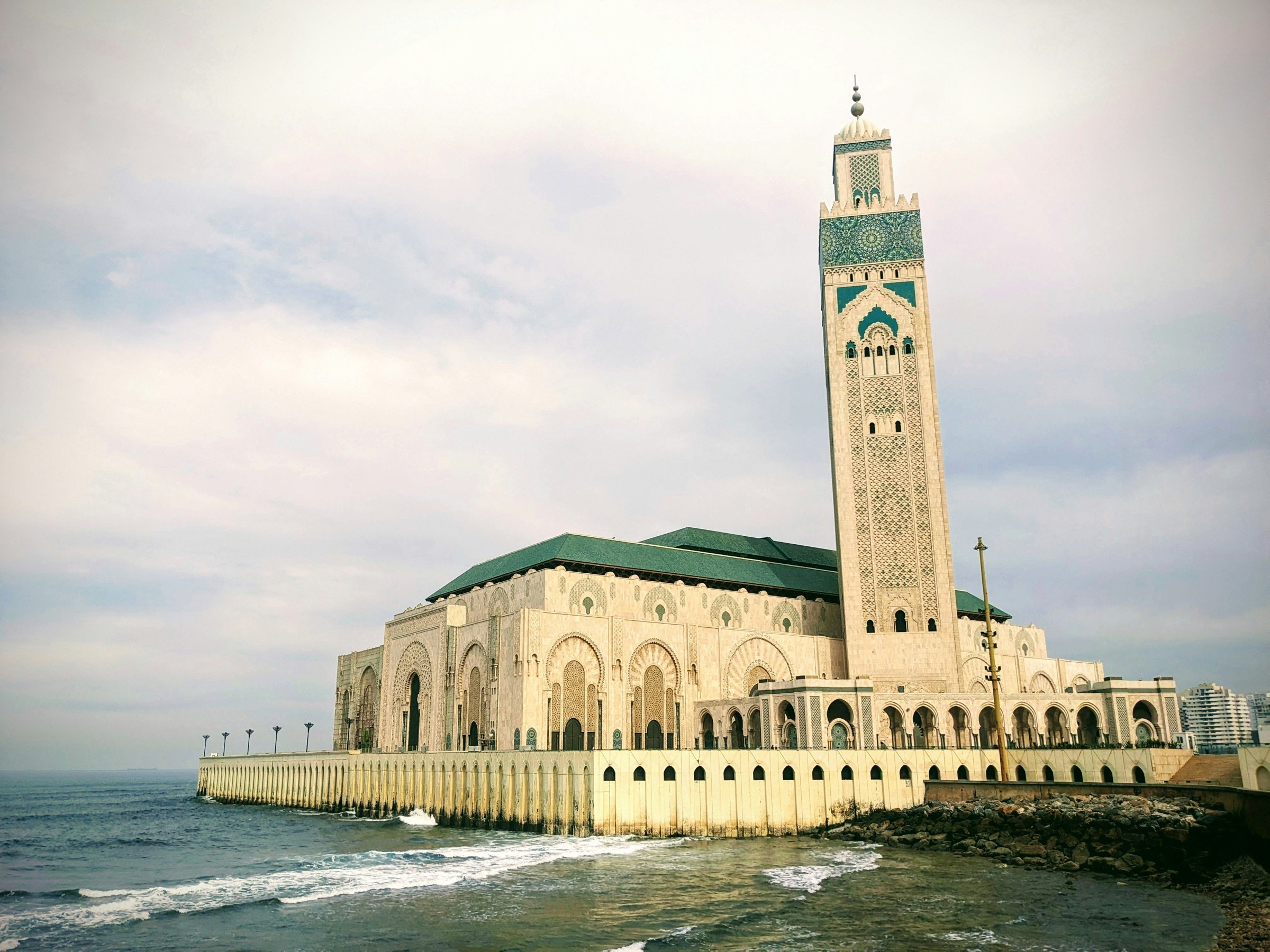
Give Casablanca one night, or two. The visit not to miss is the Hassan II Mosque, built partly over the ocean and open to visitors of every background on guided tours; around it, walk the Art Deco centre, the Habous quarter and the old medina, and end the day on the Corniche at Ain Diab. The things to do in Casablanca fill a day comfortably and two days at leisure, and the city’s real strength is what follows: from its stations, trains reach Rabat in about an hour, Tangier, Marrakech and Fès in a few, and the coast road runs south towards El Jadida and Essaouira.
Below: the arrival at Mohammed V airport, the mosque and how to visit it, the Art Deco city, the old medina, the Habous, the Corniche, how many nights to stay, the trains and roads onward, the weather, and meals. Sehra Morocco plans tailor-made journeys across Morocco for families, couples and groups from India and around the world. The facts come from the Foundation of the Hassan II Mosque, Morocco’s national tourist office, the World Meteorological Organization and the other sources listed at the end, read on 12 November 2026; the advice that follows from them is ours.
Casablanca, at a glance
The essentials, checked on 12 November 2026:
- Where
- Morocco’s economic hub, on the Atlantic coast, about 95 km by road from Rabat
- Airport
- Mohammed V (CMN), at Nouasseur, about 30 km south of the city: some half an hour by road, or the hourly airport train to Casa Voyageurs and Casa Port
- The visit not to miss
- The Hassan II Mosque, open to visitors on guided tours of the prayer hall, the minaret hall and the ablutions room
- Nights
- One to see the mosque and the centre after a long flight; two to add the Habous, the old medina and the Corniche
- Trains onward
- Rabat in about an hour; Tangier in about 2 hours 10 by Al Boraq; Marrakech in about 2 hours 40; Fès in about 3 hours 50
- Weather
- Mild all year: average highs from 18 °C in January to 27 °C in August; most rain from October to April
- At the table
- Vegetarian when asked for in advance; Jain on request
Tour hours, trains and timetables change: check them again before you book.
Arriving in Casablanca: the door most journeys come through
Mohammed V airport, code CMN, is Morocco’s busiest and the hub of Royal Air Maroc, which also lists flights from here to Dakhla and its lagoon, in the far south. It stands at Nouasseur, about 30 km south of the city. Some of the routes from India land here after a connection in the Gulf; which airlines fly which way, and how long the journey takes, are set out in our guide to flights from India and the journey to Morocco, and what to arrange before you leave in the Morocco visa for Indian passport holders.
From the airport, the road into the city takes about half an hour, traffic allowing. ONCF, Morocco’s national railway, also runs an airport train about every hour to Casa Voyageurs, the main station, in about 45 minutes, and on to Casa Port, the station by the harbour. With luggage, grandparents or a late arrival, a car booked in advance is the calmer choice; the UK government advises agreeing a taxi fare in advance or checking that the meter is running.
After a long-haul night, nobody needs to cross Morocco the same day. That is the first case for Casablanca: a bed close to the arrival, a morning at the mosque, and the onward journey rested.
The Hassan II Mosque, built over the ocean
The mosque was a vow. In the words of the foundation that runs it, King Hassan II wished to build a great mosque on the water, after the Qur’anic verse that speaks of the throne of God upon the water. He laid the first stone on 11 July 1986; the mosque was inaugurated on 30 August 1993, the day the Prophet’s birthday was celebrated that year, and its building was paid for by a national subscription. The French architect Michel Pinseau designed it, working with Morocco’s master craftsmen.
The figures given by the foundation are hard to take in until you stand beneath them. The prayer hall covers 20,000 square metres, 200 metres long by 100 wide, holds 25,000 worshippers, and has mezzanines for 5,000 women; its centre lies under a roof that opens to the sky. The esplanade around it, 30,000 square metres of arcades, fountains and zellige, can hold up to 80,000 people. The minaret rises some 200 metres, crowned by three golden spheres, and a laser beam with a range of 30 km points from it towards Mecca. Inside are carved and painted wooden ceilings, carved plaster, marble, onyx and Murano chandeliers, and a heated floor laid like a Moroccan carpet.
Visiting as a non-Muslim: the guided tour
The Foundation of the Hassan II Mosque opens the building to visitors from Morocco and abroad on paid guided tours. Each tour follows the same route: the prayer hall, the minaret hall, and the ablutions room beneath. Tours leave at set hours, in the morning and in the early afternoon, and there are fewer on Fridays, the day of the main weekly prayer. From mid-March to mid-September an extra afternoon tour is added, and during Ramadan the timetable changes. The foundation does not state the languages of the tours on its page: ask when you book, and check the hours on its own site before you go.
The rules are short and worth knowing before you arrive:
- Dress. Shoulders and chest covered, and clothing below the knee: no shorts and no sleeveless tops, for men and women alike.
- Shoes. They come off at the entrance and are carried with you, in a bag given out at the door.
- On the tour. Stay with the group and keep quiet; no food, drink or smoking; no video cameras or sound devices inside the mosque.
For a family, the visit works for every generation: the tour is on foot, indoors and out of the weather. Take the first tour of the morning if you are arriving from the airport that day, so that the afternoon stays free for rest. Before or after, the museum of the mosque, opened in October 2012, shows samples of the carved wood, zellige, marble, plaster and copper made by the craftsmen during the building, and the foundation presents it as an introduction to the visit. Then walk the esplanade towards the ocean.
The Art Deco city between the wars
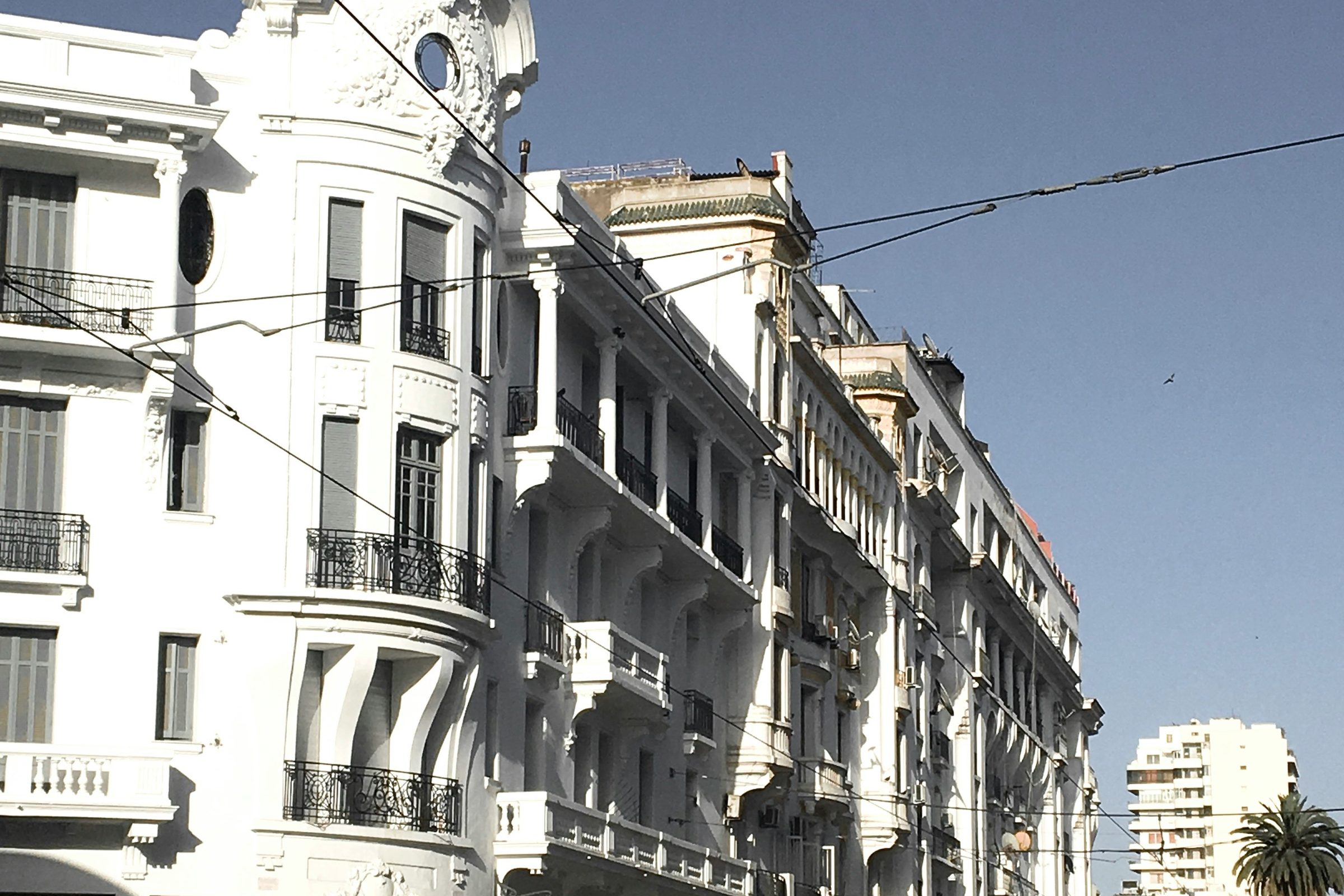
Much of Casablanca’s new town was built between the two world wars, and its centre still shows it. Morocco’s tourist office points to the broad avenues and squares of downtown, lined with Art Deco buildings. Around Mohammed V Square, the former administrative heart, stand buildings in the style architects called neo-Moorish, which joins Moroccan arches and tiles to the clean lines of Art Deco. The Central Market dates from 1917. On the edge of the Arab League Park stands the Sacred Heart church, a neo-Gothic building of 1930 to 1953 by Paul Tournon; the park, says the tourist office, offers shaded paths and a glass of mint tea.
The centre is best seen on foot, in the morning, looking up at the balconies, the ironwork and the carved façades rather than at the shops below. The tram makes the distances easy: its first line stops at Casa Voyageurs station and at United Nations Square. To understand what you are looking at, a guide helps; the UK government advises choosing one with an official badge and the permission of the local authority.
The old medina and the Sqala
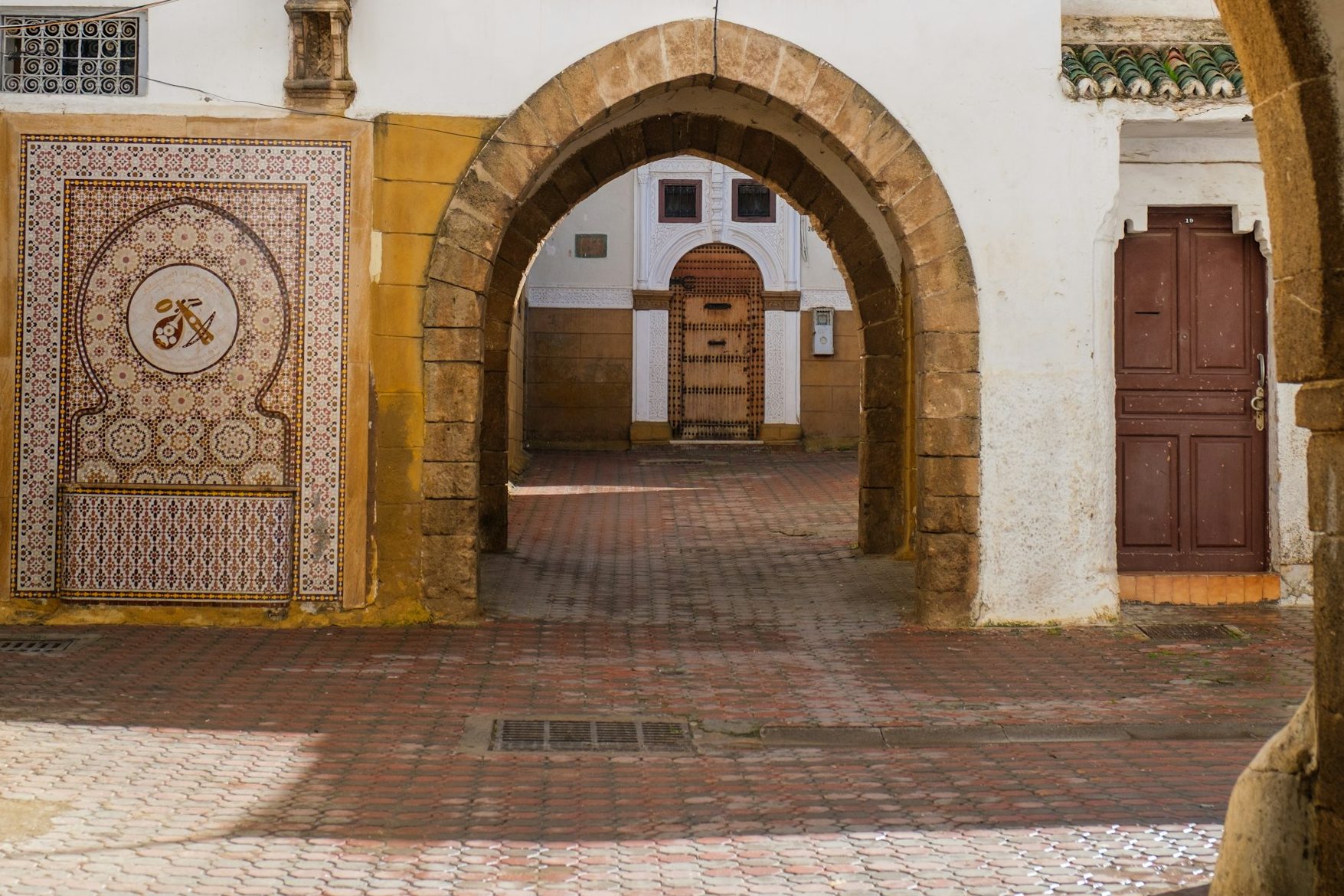
Near the port, the old medina is, as the tourist office says, the newest medina in the country. The earthquake of 1755 destroyed the old town; Sultan Mohammed ben Abdallah rebuilt it, and the Sqala, the fortified bastion of the eighteenth century that faces the harbour, dates from that rebuilding. Its architecture mixes Moroccan and European influences, and craftsmen still work in its lanes.
An hour in its lanes makes a gentle first taste of a Moroccan medina before Fès or Marrakech. As in every busy old quarter, the UK government notes that petty crime is common in tourist areas: keep bags closed and phones out of back pockets.
The Habous, a new medina of the 1910s
The Habous quarter, east of the modern centre, is one of Casablanca’s surprises: a medina planned from 1916, early in the French protectorate, by Henri Prost and his team, as a “new native town”, with a palace for the sultan. The land was given to the sultan by Haïm Bendahan, a Moroccan Jewish merchant, and the administration of religious endowments, the habous that give the quarter its name, still owns it.
The tourist office lists the Habous among the five places to see in Casablanca, and the Mahkama of the Pasha, the court building of 1941 and 1942, among the city’s sights. Walk the quarter for its two mosques, its bookshops of Moroccan and Arab publishers, and the coppersmiths whose trays and teapots, the tourist office notes, are chased with arabesques. The third tram line has a Habous stop.
The Corniche at Ain Diab
West of the mosque, about six kilometres from the centre, the Corniche of Ain Diab runs along the ocean: the tourist office describes a seaside strip of private beaches, cafés and restaurants, with jet-skis, windsurfing and deckchairs. The second tram line ends at Ain Diab. It is the place for a walk at the end of the day.
For swimming, be careful: the UK government’s advice is that lifeguard cover on Moroccan beaches is often limited or absent, and that currents and sudden waves are a risk. On the Corniche, keep children on the sand unless the sea is calm and the beach is supervised.
One night or two before moving on?
Morocco’s tourist office suggests two days for Casablanca. In our view, one night is enough for the mosque and the Art Deco centre, and a second is worth it if you want the Habous, the old medina and the Corniche at an easy pace. Four questions help to decide:
- When do you land? After a night flight, spend the first night in Casablanca and keep the mosque for the next morning, rather than taking a train with tired children.
- Which day of the week? Fridays have fewer mosque tours, and Ramadan has its own timetable: plan the visit for another day if you can.
- Who is travelling? Grandparents will enjoy the mosque, the museum and a slow walk through the Habous; teenagers, the Corniche and the tram.
- Where next? North to Rabat and Tangier, inland to Fès, south to Marrakech, or along the coast: the answer decides whether you leave by train or by road.
Leaving Casablanca: trains and roads onward
By train, with ONCF
Casa Voyageurs is the main station and the one where Al Boraq, Morocco’s high-speed train in service since November 2018, arrives from Tangier. Casa Port, by the harbour, is also on the airport line. Approximate journey times, from published timetables:
- Rabat
- About 1 hour
- Shuttle trains about every hour
- Tangier
- About 2 hours 10
- Al Boraq high-speed trains from Casa Voyageurs, roughly every hour, calling at Rabat
- Marrakech
- About 2 hours 40
- About every hour
- Fès
- About 3 hours 50
- About every hour, via Rabat and Meknès
- Mohammed V airport
- About 45 minutes
- The airport train, about every hour, from Casa Voyageurs
| To | Journey time | Notes |
|---|---|---|
| Rabat | About 1 hour | Shuttle trains about every hour |
| Tangier | About 2 hours 10 | Al Boraq high-speed trains from Casa Voyageurs, roughly every hour, calling at Rabat |
| Marrakech | About 2 hours 40 | About every hour |
| Fès | About 3 hours 50 | About every hour, via Rabat and Meknès |
| Mohammed V airport | About 45 minutes | The airport train, about every hour, from Casa Voyageurs |
Bookings open three months before departure, and first-class tickets come with a reserved seat, so they can sell out: for a family travelling together, book early. We could not read ONCF’s own timetable on 12 November 2026; confirm the times with ONCF before you plan around them.
Three journeys that start here
- North, to the imperial cities. An hour by train to Rabat, the capital, and its Kasbah of the Oudayas, then on to Tangier by Al Boraq, or inland to Fès and its medina.
- South, along the Atlantic. By road, about 100 km and an hour and a quarter to El Jadida, its Portuguese fortress and the lagoon of Oualidia, then down the coast to Essaouira and inland to Marrakech.
- Straight to Marrakech. About 2 hours 40 by train, or about 240 km and a little under three hours by road; what to do there with every generation is in things to do in Marrakech with grandparents and children.
By road, Rabat is about 95 km away, an hour and a quarter without stops. The UK government notes that poor lighting can make driving at night dangerous: travel by day.
Casablanca’s weather, month by month
The Atlantic keeps Casablanca mild. Morocco’s tourist office recommends April to June and September to October, and warns that winter can be rainy. The long-term averages bear it out: about 408 mm of rain a year, almost none from June to September, and July afternoons near 26 °C, where Marrakech reaches nearly 38 °C. A family landing in high summer will find Casablanca the gentlest first day in Morocco.
Average high and low, and rainy days
- January
- 18 / 9 °C · rain on 7 days
- The coolest month; a coat for the evenings
- February
- 18 / 10 °C · rain on 6 days
- Cool and showery
- March
- 20 / 12 °C · rain on 6 days
- Spring in the city; good for walking the centre
- April
- 21 / 13 °C · rain on 5 days
- One of the tourist office’s recommended months
- May
- 23 / 16 °C · rain on 2 days
- Dry and mild: ideal for walking
- June
- 25 / 19 °C · rain on 1 days
- Warm days, sea air in the evenings
- July
- 26 / 21 °C · rain on 0 days
- Dry, and far cooler than Marrakech
- August
- 27 / 21 °C · rain on 0 days
- The warmest month, rarely hot
- September
- 26 / 20 °C · rain on 2 days
- Warm and settled; recommended
- October
- 24 / 17 °C · rain on 5 days
- Mild; the rains return
- November
- 21 / 13 °C · rain on 7 days
- The wettest month by volume
- December
- 19 / 11 °C · rain on 7 days
- Mild days; showers likely
| Month | High / low | Rainy days | What to expect |
|---|---|---|---|
| January | 18 / 9 °C | 7 | The coolest month; a coat for the evenings |
| February | 18 / 10 °C | 6 | Cool and showery |
| March | 20 / 12 °C | 6 | Spring in the city; good for walking the centre |
| April | 21 / 13 °C | 5 | One of the tourist office’s recommended months |
| May | 23 / 16 °C | 2 | Dry and mild: ideal for walking |
| June | 25 / 19 °C | 1 | Warm days, sea air in the evenings |
| July | 26 / 21 °C | 0 | Dry, and far cooler than Marrakech |
| August | 27 / 21 °C | 0 | The warmest month, rarely hot |
| September | 26 / 20 °C | 2 | Warm and settled; recommended |
| October | 24 / 17 °C | 5 | Mild; the rains return |
| November | 21 / 13 °C | 7 | The wettest month by volume |
| December | 19 / 11 °C | 7 | Mild days; showers likely |
Long-term averages for 1991–2020 at Casablanca-Anfa, from Morocco’s Direction de la Météorologie Nationale, published by the World Meteorological Organization and rounded to the nearest degree; rainy days are days with at least 1 mm of rain. A given day can be warmer or colder than the average.
For the rest of Morocco, region by region, and the expected dates of Ramadan, see the best months to visit Morocco from India.
Vegetarian and Jain meals in Casablanca
A large, international city makes eating easier than in the countryside, and vegetarian meals can be prepared when asked for in advance. Jain food is on request: say so when the stay is planned, so that the arrival night is not left to chance. The wording to use is in how to ask for a Jain meal as a traveller in Morocco.
So, is Casablanca worth more than a night near the airport?
Yes: a night or two, rather than a week. Casablanca is the place to land, rest and begin well: a morning inside the Hassan II Mosque, an afternoon among the Art Deco façades and the arcades of the Habous, an evening by the ocean at Ain Diab. Then the city does what it does best, and sends you on, by train to Rabat, Tangier, Fès or Marrakech, or by road down the Atlantic coast.
Planning a journey that begins or ends in Casablanca? Write to us with your dates, the ages in your party and where you land, and we will answer by e-mail or video call.
Questions travellers ask about Casablanca
Can non-Muslims visit the Hassan II Mosque?
What should I wear to visit the Hassan II Mosque?
How many days do you need in Casablanca?
How do you get from Casablanca airport to the city?
How long is the train from Casablanca to Marrakech?
Is Casablanca worth visiting?
Editorial note
This guide draws on the Foundation of the Hassan II Mosque, for the history of the mosque, its prayer hall, minaret, esplanade and museum, and the guided tours and their rules; Morocco’s national tourist office; the World Meteorological Organization’s climate normals for 1991–2020, for the long-term averages of Morocco’s Direction de la Météorologie Nationale at Casablanca-Anfa and Marrakech; the UK government’s travel advice for Morocco; and Wikipedia, for the architect of the mosque, the Art Deco and neo-Moorish buildings of the centre, the rebuilding of the old medina, the history of the Habous, the tram lines and Mohammed V airport. Train journey times come from The Man in Seat 61 and Rome2rio, as ONCF’s website could not be reached on 12 November 2026: they are approximate and should be confirmed with ONCF. Road distances and driving times were calculated with the OSRM route planner on OpenStreetMap data. All were read on 12 November 2026.
The foundation gives the minaret a height of 200 metres; some other sources give 210 metres. Tour hours, timetables and local arrangements change, sometimes without notice: check them before you book. Apart from public bodies, the national railway and the national airline, no business is named, and none is recommended. This guide describes no journey of our own.
- Foundation of the Hassan II Mosque (in French): history of the mosque, guided visits, the prayer hall, the minaret, the esplanade and the museum
- Moroccan National Tourist Office: Casablanca, with its pages on the medina, beaches and shopping
- World Meteorological Organization, climate normals for 1991–2020, stations of Casablanca-Anfa (60155) and Marrakech (60230), as archived by the US National Centers for Environmental Information
- GOV.UK, Morocco travel advice: safety and security
- ONCF, Morocco’s national railway: oncf.ma
- Train journey times: Seat61, train travel in Morocco (Al Boraq, Casa Voyageurs, the Rabat shuttle, booking period) and Rome2rio (Casablanca to Rabat, Marrakech and Fès, and the airport train)
- Wikipedia: Hassan II Mosque, Architecture of Casablanca, Habous, Casablanca tramway and Mohammed V International Airport
- Road distances and driving times: OSRM on OpenStreetMap data, calculated on 12 November 2026, without stops
Written by Sehra Morocco. Last reviewed: .
Tell us about your trip.
By e-mail or video call. We reply within two working days.