The Dakhla lagoon: kitesurfing, the White Dune and how to fly there
At the southern end of Morocco’s Atlantic coast, the desert runs straight into a turquoise lagoon, and the wind almost never stops. Dakhla is not a stop on the road from Marrakech: it is a flight, and a few days of a different Morocco. Here is how to reach it, when, for how long, and what to do between the water and the sand.
Reviewed 12 November 2026 · Sources at the end
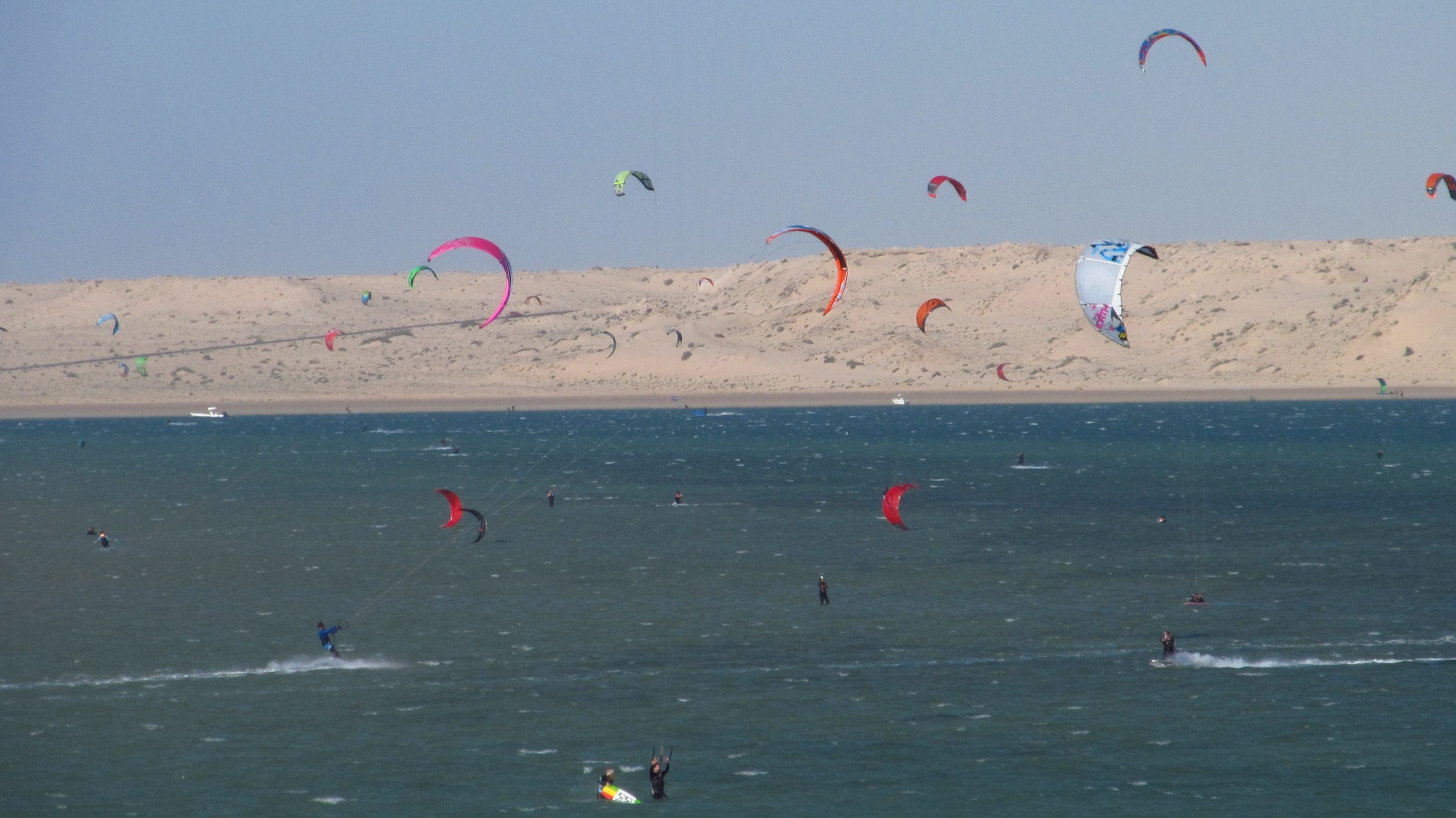
Dakhla is reached by air: Royal Air Maroc flies there from Casablanca and other Moroccan cities, and Ryanair from Madrid, while the road from Agadir alone runs to some 1,160 km. Give it three nights at least, and come in any month: the days stay between 22 and 27 °C on average all year, and the wind blows hard on most of them. The Dakhla lagoon is the reason to go: a long bay between a sandy peninsula and the desert, where kitesurfers learn on the lagoon side and surfers ride the ocean side, where a white dune slopes into the water, and where the oysters come from the bay.
This guide sets out where Dakhla is, the flights and the road, how many nights to give it, the wind and the water sports, the White Dune and Dragon Island, what to do on land, the table, and the weather month by month. Sehra Morocco plans tailor-made journeys across Morocco for families, couples and groups from India and elsewhere. The facts below come from official and public sources, listed at the end; the practical advice that follows from them is ours.
Dakhla, at a glance
The essentials, checked on 12 November 2026:
- Where
- Morocco’s far south, on the Atlantic, some 30 km north of the Tropic of Cancer: a town on a long sandy peninsula, and a lagoon about 37 km long behind it
- By air
- Royal Air Maroc from Casablanca and other Moroccan cities; Ryanair from Madrid twice a week. The airport is on the edge of the town
- By road
- About 1,160 km and fifteen hours without stops from Agadir, nearly 1,400 km from Marrakech: fly
- Nights
- Three at least, four or five to learn to kitesurf
- Weather
- Days of 22 to 27 °C and nights of 14 to 20 °C on average, in every month; almost no rain
- Wind
- At 36 km/h or more on some 323 days a year, most constant from June to September
- At the table
- Fish and oysters; vegetarian when asked for in advance; Jain on request
Flight schedules and activities change with the season and the wind: check them again before you book.
A lagoon between the desert and the ocean
Morocco’s tourist office calls Dakhla a small part of paradise, lost between the waters of the Atlantic and the sands of the Sahara, and the map explains the phrase. The town sits near the tip of a narrow peninsula, about forty kilometres long, that runs south along the coast; behind it, between the peninsula and the mainland, lies the bay, about 37 km long. On one side, the open ocean and its waves; on the other, the lagoon’s turquoise water, with the bare desert on its far shore.
The bay is also a sanctuary. It has been listed as a wetland of international importance under the Ramsar Convention since 2005, and the tourist office names migratory birds, pink flamingos and humpback dolphins among the life of its waters. Bring binoculars: the lagoon is as much a place to watch as to ride.
How to get to Dakhla
By air, from Casablanca and beyond
Royal Air Maroc lists Dakhla among its domestic destinations, and on 12 November 2026 its route pages listed flights to Dakhla from Casablanca, Rabat and Paris, with a few dates from Agadir; whether a given flight is non-stop or connects in Casablanca depends on the day, so check it when you book. For travellers flying in from India, Casablanca is the natural door: the long-haul connections are set out in flights from India to Morocco, and the visa rules in our guide to the Morocco visa for Indian passport holders.
From Europe, Ryanair’s published timetable, read on 12 November 2026, links Madrid and Dakhla twice a week through the winter, on Tuesdays and Saturdays, and on Mondays and Thursdays from 29 March 2027. Check which dates are open before you plan the rest of the journey around them.
The airport sits on the edge of the town, a few minutes from its centre. Many places to stay, though, are strung along the lagoon shore: the PK25 beach, a favourite of kitesurfers, is about 30 km and half an hour by road from the town. Ask where you sleep whether the airport transfer is arranged, and how long it takes.
By road: a journey of its own
The road exists, and it is long. Calculated on OpenStreetMap, the drive from Agadir covers about 1,160 km and some fifteen hours at the wheel, before a single stop; the tourist office gives a similar figure, nearly sixteen hours. From Marrakech, it is nearly 1,400 km. The UK government notes that poor lighting makes driving at night dangerous in Morocco, which rules out pushing on after dark. For a family, the plane is the only sensible way in; the road is for travellers who want the coast itself to be the journey.
How many nights in Dakhla?
Three, at the least. Dakhla is too far to visit for a night: the flights and transfers take most of the first and last days, and the wind sets the programme for the others. The tourist office suggests four days. In practice, the stay takes one of three shapes:
- Three nights, for the lagoon. A day on and around the water, a day for the White Dune and Dragon Island, and a spare half-day if the wind or the tide moves an outing.
- Four or five nights, to learn to kitesurf. Lessons come in sessions of about two hours, and a beginner needs several of them, on days when the wind suits a first lesson.
- A coda to a Moroccan journey. Marrakech, the desert or the mountains first, then a flight south to end on the water. For the Atlantic coast further north, see Essaouira from Marrakech and things to do in Agadir.
The wind, and kitesurfing on the lagoon
Dakhla’s fame rests on its wind, and the long-term averages of its weather station measure it. Between 1991 and 2020, the wind there reached at least ten metres a second, 36 km/h, on about 323 days a year: on 22 days or more in every month of the year, and on 29 to 30 days a month from June to September. Essaouira, Morocco’s other wind town, records the same strength on about 186 days a year.
The lagoon is where people learn. The tourist office points kitesurfers to PK25, a beach on the lagoon side known for its reliable winds, and surfers to Foum El Bouir, on the ocean side, where the waves are; it describes the tip of the dragon, a dune running out into the sea, as the most beautiful spot nearby for every board sport. Kitesurfing lessons on the lagoon come as semi-private sessions of about two hours, in high season and in low season alike, and surfing as two-hour group lessons.
Those who do not ride have plenty to do on the water: kayak, paddle board or pedalo for half an hour, jet skis for fifteen minutes to an hour with two riders at most, a tube or a banana for up to three, and wakeboarding or water-skiing in sessions of fifteen or thirty minutes. The UK government notes that providers of recreational and adventure tourism may not meet UK safety standards, and that some insurance policies do not cover water sports, boat trips or quad biking: check yours before anyone takes a board, a handle or a throttle.
The White Dune and Dragon Island
The two images everyone brings back from Dakhla lie on the far side of the lagoon from the town.
The White Dune
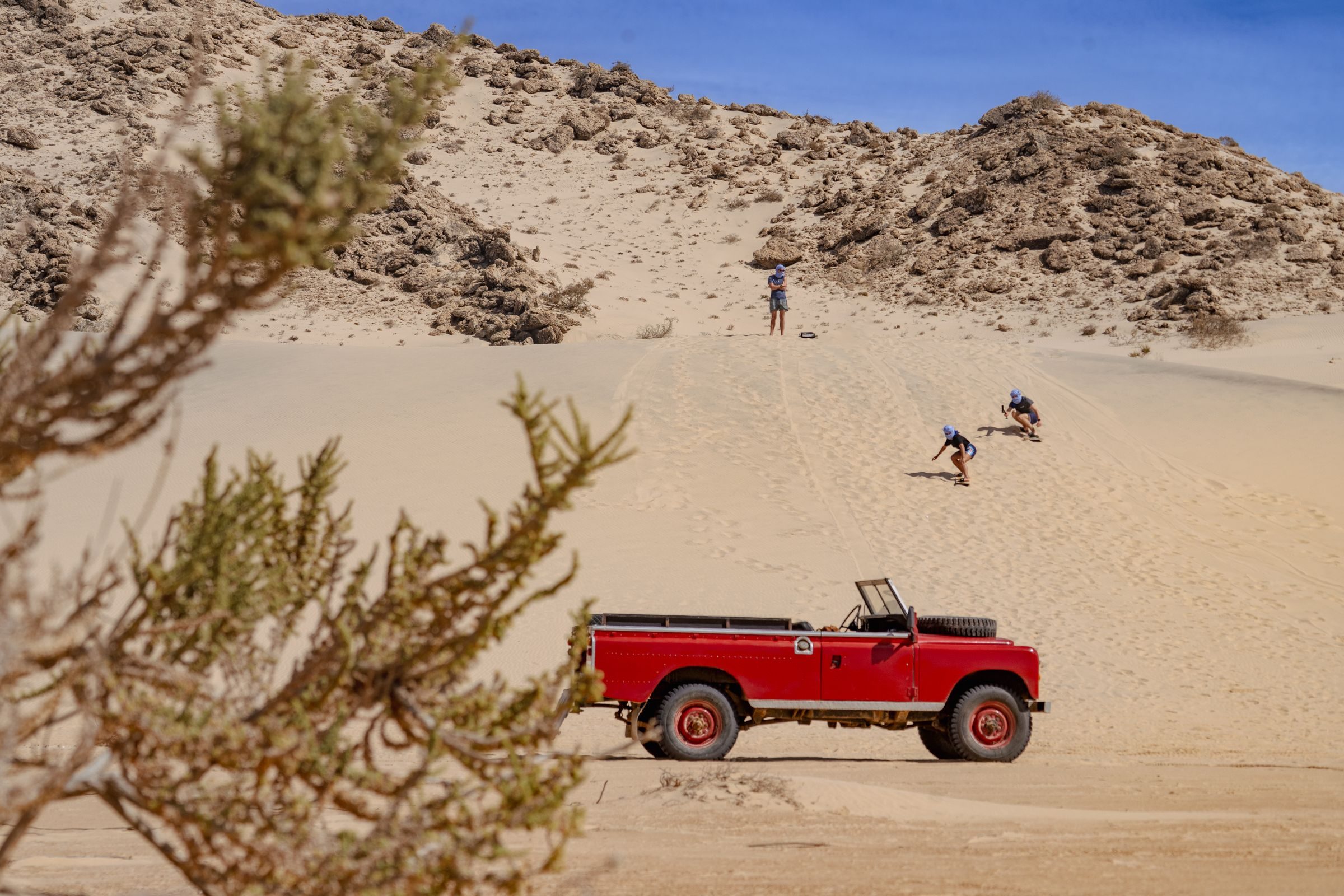
On the eastern shore, a dune of pale sand slopes down into the turquoise water: the White Dune, about 55 km and some three-quarters of an hour by road from the town. The tourist office suggests setting off by 4x4 to discover it, and that is how most people go, on outings of two to three hours, some at the end of the day, with sandboarding on the slopes. Riders can go on horseback, on a ride of about four and a half hours that is kept for confident riders. Longer 4x4 days, of four to six hours, add the hot spring of Asmaa and, on the longest, Imlili and Puerto Rico beach, where the tourist office says you can sleep in tents under the stars.
Dragon Island
Dragon Island, also known as Herné Island, is a small islet in the northern part of the lagoon, less than a kilometre long, a few kilometres from both PK25 and the White Dune. It is reached by boat, on outings of two to three hours in small parties of up to five, and some outings combine the island with the dune. Ask a day ahead what time the boat leaves and whether the tide affects the outing, and plan the rest of the day around it.
On land: horses, camels, buggies and a hot spring
Between the lagoon, the ocean and the cliffs, the desert around Dakhla is made for slow outings as much as noisy ones. Activity providers around the lagoon offer:
- Horse rides of one hour along the lagoon or the cliffs, up to three hours from the desert to the ocean and the lagoon, and pony rides of an hour for children.
- Camel rides of one hour to an hour and a half, by the cliffs, the ocean or the lagoon; an adult and a small child can share one camel, and some rides end with a tea ceremony.
- Quads and buggies, on circuits from half an hour on the cliffs to three and a half hours, with buggies of two or four seats for families who would rather sit together.
- The Asmaa spring, about 36 km from the town, where thermal water at about 38 °C rises from a well some 700 metres deep.
- Hammam and massage after the wind: hammam rituals of forty minutes to an hour, massages of forty-five to seventy-five minutes.
For quads, the UK government adds that accidents are frequent in resort areas, and that a crash helmet should always be worn. With grandparents, the camel at walking pace and the buggy with a driver make the gentler pair.
Oysters, fish and vegetarian tables
Dakhla lives from the sea: the town is a large fishing port, and the tourist office lists its oysters among the essentials of a visit. For those who would rather be on the water than at the table, outings by boat include an early breakfast at sea, of about three hours for two to four people, a meal at sea of about two hours, and fishing lessons of three or six hours. From the shore, surfcasting sessions last about two hours.
A vegetarian family will find the sea at every table but need not eat from it. Places to stay along the lagoon lie well outside the town, so most meals are taken where you sleep, and the request can be settled once, before you arrive. Vegetarian is simple when asked for in advance; Jain food is on request, and in a fishing town, where most meals are taken where you sleep, it is best settled with the kitchen before you arrive. The wording is in how to ask for a Jain meal as a traveller in Morocco.
When to go: Dakhla’s weather, month by month
Of the 25 Moroccan weather stations in the World Meteorological Organization’s climate normals, Dakhla has the smallest gap between its coolest and its warmest month: less than 5 °C. Its days average between 22 and 27 °C in every month of the year, and its nights between 14 and 20 °C; the whole year brings about 31 mm of rain, on five days. A January night in Dakhla averages 14 °C, against 6 °C in Marrakech; a July day 25 °C, against 38 °C. What changes through the year is the wind.
Dakhla’s averages, month by month
- October
- 26 °C by day · 19 °C at night
- 26 days of strong wind
- November
- 25 °C by day · 18 °C at night
- 24 days of strong wind
- December
- 23 °C by day · 16 °C at night
- 23 days of strong wind
- January
- 22 °C by day · 14 °C at night
- 26 days of strong wind
- February
- 22 °C by day · 15 °C at night
- 25 days of strong wind
- March
- 23 °C by day · 16 °C at night
- 27 days of strong wind
- April
- 23 °C by day · 16 °C at night
- 27 days of strong wind
- May
- 23 °C by day · 17 °C at night
- 28 days of strong wind
- June
- 24 °C by day · 18 °C at night
- 29 days of strong wind
- July
- 25 °C by day · 19 °C at night
- 30 days of strong wind
- August
- 26 °C by day · 20 °C at night
- 30 days of strong wind
- September
- 27 °C by day · 20 °C at night
- 29 days of strong wind
| Month | Average high | Average low | Days of wind at 36 km/h or more |
|---|---|---|---|
| October | 26 °C | 19 °C | 26 |
| November | 25 °C | 18 °C | 24 |
| December | 23 °C | 16 °C | 23 |
| January | 22 °C | 14 °C | 26 |
| February | 22 °C | 15 °C | 25 |
| March | 23 °C | 16 °C | 27 |
| April | 23 °C | 16 °C | 27 |
| May | 23 °C | 17 °C | 28 |
| June | 24 °C | 18 °C | 29 |
| July | 25 °C | 19 °C | 30 |
| August | 26 °C | 20 °C | 30 |
| September | 27 °C | 20 °C | 29 |
Long-term averages for 1991–2020 at Dakhla, from Morocco’s Direction de la Météorologie Nationale, in the World Meteorological Organization’s climate normals, rounded to the nearest whole number. A given day can be calmer or windier than the average.
For kitesurfing, the summer months, from June to September, bring the most constant wind; the tourist office calls the summer livelier on the coast. Spring and autumn, which it calls ideal, pair warm days with wind on most of them. From November to January, the wind is a little less constant and the evenings cooler: pack a warm layer for the boat and for the end of the day. For the rest of Morocco, region by region, see the best months to visit Morocco from India.
Six questions before you plan Dakhla
- Who will ride, and who will watch? Choose where you sleep by the lagoon if anyone wants to learn; the others will want shade out of the wind.
- How many nights can you give it? Fewer than three, and the flight outweighs the stay.
- Which flight, which day? Fix the flights first: the rest of the journey follows them.
- Who is the oldest, and who is the youngest? The mild climate suits both; long 4x4 days and fast boats less so.
- Does your insurance cover water sports, boats and quads? Check before you go, not on the beach.
- Who will cook? Vegetarian, and Jain on request: settle it with the kitchen before you book.
For a desert of high sand dunes rather than a lagoon, see the Merzouga desert from Marrakech; for the days in the red city before you fly south, see things to do in Marrakech with grandparents and children.
So, is the Dakhla lagoon worth the flight?
Yes, if you give it three nights or more. The Dakhla lagoon offers what no other corner of Morocco can: a climate that barely changes from January to December, wind on almost every day of the year, a white dune sloping into turquoise water, a boat to Dragon Island, and oysters from the bay. For a weekend it is too far; for a family that wants the sea, the desert and a few days of real rest at the end of a Moroccan journey, it is one of the country’s most striking endings.
Planning Dakhla for your family or your group? Write to us with your dates, the ages in your party and who wants to ride the wind, and we will answer by e-mail or video call.
Questions travellers ask about Dakhla
How do you get to Dakhla?
Can you drive to Dakhla from Marrakech or Agadir?
When is the best time for kitesurfing in Dakhla?
How many days do you need in Dakhla?
What are the White Dune and Dragon Island?
Can you swim in the Dakhla lagoon?
Editorial note
This guide draws on Morocco’s national tourist office; the World Meteorological Organization’s climate normals for 1991–2020, for the long-term averages of Morocco’s Direction de la Météorologie Nationale at Dakhla, Essaouira and Marrakech; the published timetable of Ryanair and the route pages of Royal Air Maroc; the UK government’s travel advice for Morocco; and Wikipedia, for the geography of Dakhla and its bay, its fishing port and the Asmaa spring. Road distances and driving times were calculated with the OSRM route planner on OpenStreetMap data, which also gives the size and position of Dragon Island. All were read on 12 November 2026. Activity durations and ages come from information provided by local activity providers in 2026; check them when you book.
Flight schedules, tides and activities change, sometimes without notice: check them before you travel. Apart from airlines and public bodies, no business is named, and none is recommended. Sehra Morocco plans journeys in Morocco; this guide describes no journey of its own.
- Moroccan National Tourist Office: Dakhla, sport, beaches and nature
- World Meteorological Organization, climate normals 1991–2020 (archived by NOAA’s National Centers for Environmental Information): stations of Dakhla (60096), Essaouira (60220), Marrakech (60230) and the 22 other Moroccan stations of the set
- Ryanair, timetable (Madrid – Dakhla, winter 2026–2027 and summer 2027); Royal Air Maroc, flights to Dakhla and our network
- GOV.UK, Morocco travel advice: safety and security
- Wikipedia (in French): Dakhla and Baie de Dakhla
- Road distances and driving times: OSRM on OpenStreetMap data, calculated on 12 November 2026, without stops
Written by Sehra Morocco. Last reviewed: .
Tell us about your trip.
By e-mail or video call. We reply within two working days.