Things to do in Agadir: the bay, the kasbah hill and the surf coast
A long curve of sand, a hill crowned by the walls of an old kasbah, and a city that is younger than many of its visitors: Agadir was rebuilt after a single night in 1960. Its climate barely changes through the year; it is the airport of the south, and the door to a coast of surf villages and wild estuaries.
Reviewed 12 November 2026 · Sources at the end
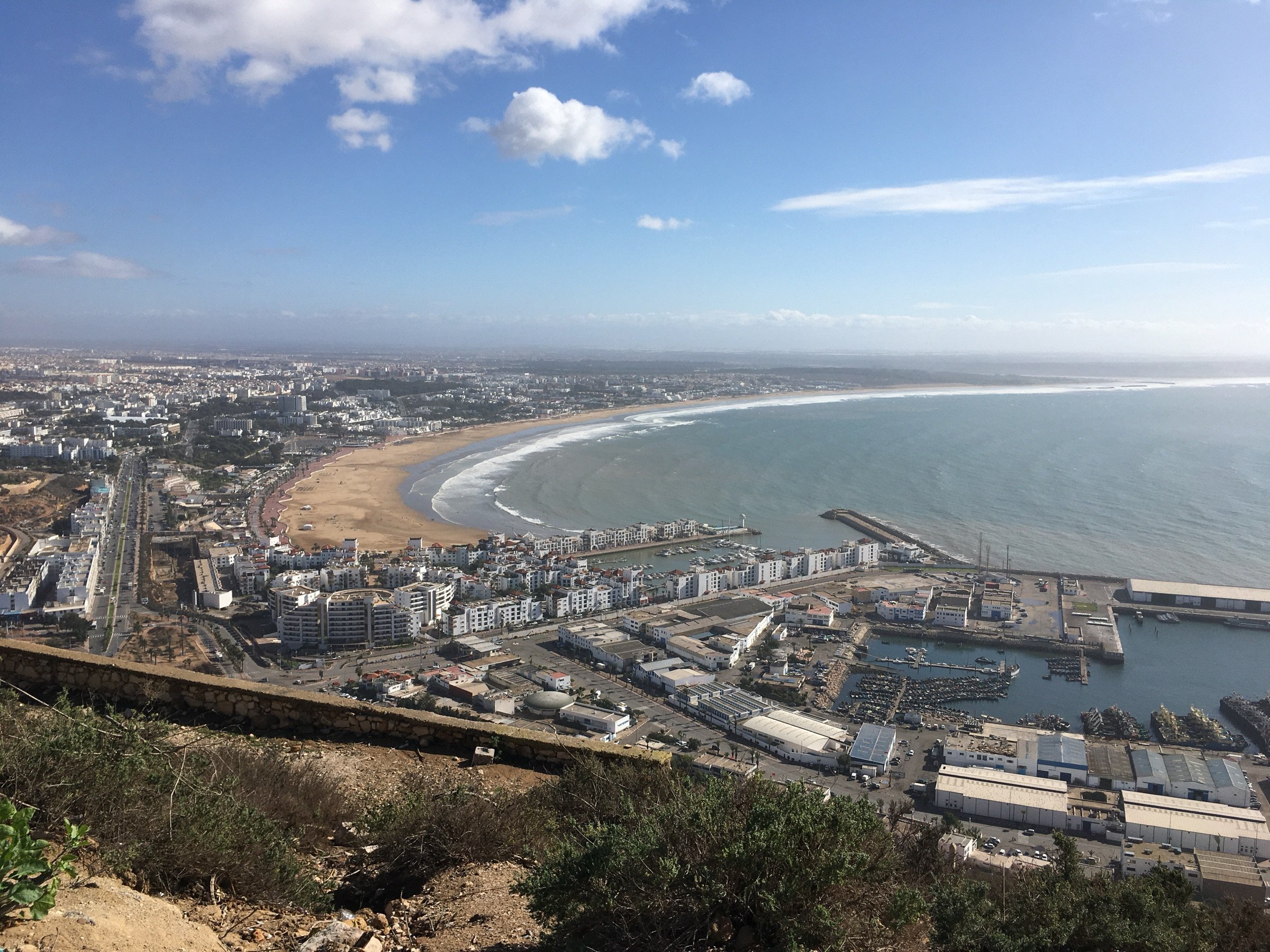
The best things to do in Agadir are the bay and its promenade, the view from the kasbah of Agadir Oufella, the story of the 1960 earthquake, a morning in Souk El Had, and a day out of town: south to the Souss-Massa National Park, or north to the surf villages of Taghazout and Imsouane. Give it three nights. Agadir suits families who want the sea without the heat of the interior, grandparents who prefer flat walks to long drives, and anyone who lands in the south of Morocco and wants to begin gently.
This guide explains why the city looks the way it does, then takes the hill, the beach and the market in turn, the park to the south and the surf coast to the north, the airport and the roads, how many nights to give Agadir and how to pair it with Taroudant or Essaouira, and the weather month by month. Sehra Morocco plans tailor-made journeys across Morocco for families and groups from India and beyond. The facts come from official and public sources, listed at the end; the advice that follows from them is ours.
Agadir, at a glance
The essentials, checked on 12 November 2026:
- Where
- On the Atlantic in south-west Morocco, where the Souss valley meets the sea; the country’s main seaside resort, in the words of its tourist office
- The bay
- A seafront of about ten kilometres, with a promenade along the beach
- Known for
- The kasbah hill of Agadir Oufella; a modern city rebuilt after the earthquake of 1960; Souk El Had and its 6,000 shops
- By air
- Agadir–Al Massira airport, about 30 km by road from the seafront: Royal Air Maroc by Casablanca, and direct flights from many European cities
- By road
- Marrakech about 245 km, some three hours by the motorway; Taroudant about 80 km; Essaouira about 175 km; Taghazout about 25 km. No railway yet
- Nights
- Three, in our view; four if you add both the surf coast and the national park
- Weather
- Average highs of 21 to 27 °C in every month; almost no rain from May to September
- At the table
- Vegetarian when asked for in advance; Jain on request
Distances and driving times are without stops and change with the roads; flights change with the seasons.
A city rebuilt in a single generation
Most Moroccan cities are read from their medinas outwards. Agadir is read from one night. Shortly before midnight on 29 February 1960, in the first days of Ramadan, a moderate but very shallow earthquake struck right under the town. It lasted less than fifteen seconds. The US Geological Survey puts the dead at between 12,000 and 15,000, more than a third of the population, and describes it as the most destructive ‘moderate’ earthquake of the twentieth century: few buildings had been built to resist a shock, because no one thought the area was at risk. In the old districts of Founti, the Kasbah and Yachech, almost nothing was left standing.
The city was not rebuilt where it fell. A new Agadir rose a little further south, on a planned grid, under strict earthquake rules, and the ground of the old districts was set aside as land where no one may build. Its architects, among them Jean-François Zevaco and Élie Azagury, gave it the clean lines of mid-century modernism, with Le Corbusier consulted on the plan, and the low ground was kept for public gardens. That is why Agadir has wide avenues and parks where other cities have lanes and ramparts: its monument is the city itself.
Talborjt: where the memory is kept
The district of Talborjt, rebuilt away from the old one it is named after, is the best place to feel this history. One of its avenues carries the date of the earthquake, the Avenue du 29 Février, and the Mohammed V mosque stands in the district. In the Olhão garden, a memorial museum keeps the memory of the disaster, largely through photographs of the city before and after: a short visit changes the way you see the rest of Agadir. With children, explain beforehand what they will see.
The hill of Agadir Oufella
North of the city, near the port, a hill rises some 236 metres above the sea, and on its top runs the restored wall of the kasbah of Agadir Oufella, ‘the fortress above’. A Saadian sultan, Abdallah al-Ghalib, built it in the sixteenth century, after the Saadians had taken the coast back from the Portuguese in 1541. The earthquake of 1755 brought it down once; that of 1960 left only its outer wall. The site was restored in 2002, then again from 2020. On the slope, an inscription in Arabic reads ‘God, Country, King’, and like the walls it is lit at night, above the bay.
Go for the view: the curve of the bay to the south and the ports below. Since October 2022, a cable car has run up from the Tildi bridge, about 1,700 metres of line: for grandparents, the easiest way to the top. In summer, the early morning and the end of the afternoon are kinder than midday on an open hilltop.
The bay: ten kilometres of sand and a promenade
Morocco’s tourist office describes a seafront of some ten kilometres, and it is the reason most visitors come. A promenade follows the beach, with cafés and restaurants at the water’s edge: the walk that a family of three generations can take every evening, each at their own pace, the oldest on the promenade and the youngest on the sand. Towards the northern end lie the marina and the port.
The water is the open Atlantic, cool and lively rather than a warm lagoon. The UK government’s travel advice is that lifeguard cover on Moroccan beaches is often thin or missing, that signs may be few, and that currents and sudden waves are a risk. Swim where others swim, keep small children within arm’s reach, and leave the quieter beaches for walking.
Souk El Had: the market of the south
Agadir has no old medina to wander, but it has one of the great markets of Morocco. Souk El Had stands inside its own walls, entered by several gates, and the tourist office counts more than 6,000 shops. It is organised by trades: fruit and vegetables, spices, clothes, furniture, crafts. Unlike the souks of Marrakech, it serves the city and the valley first, so the produce halls are as interesting as the craft stalls, full of the citrus fruit and vegetables of the Souss valley.
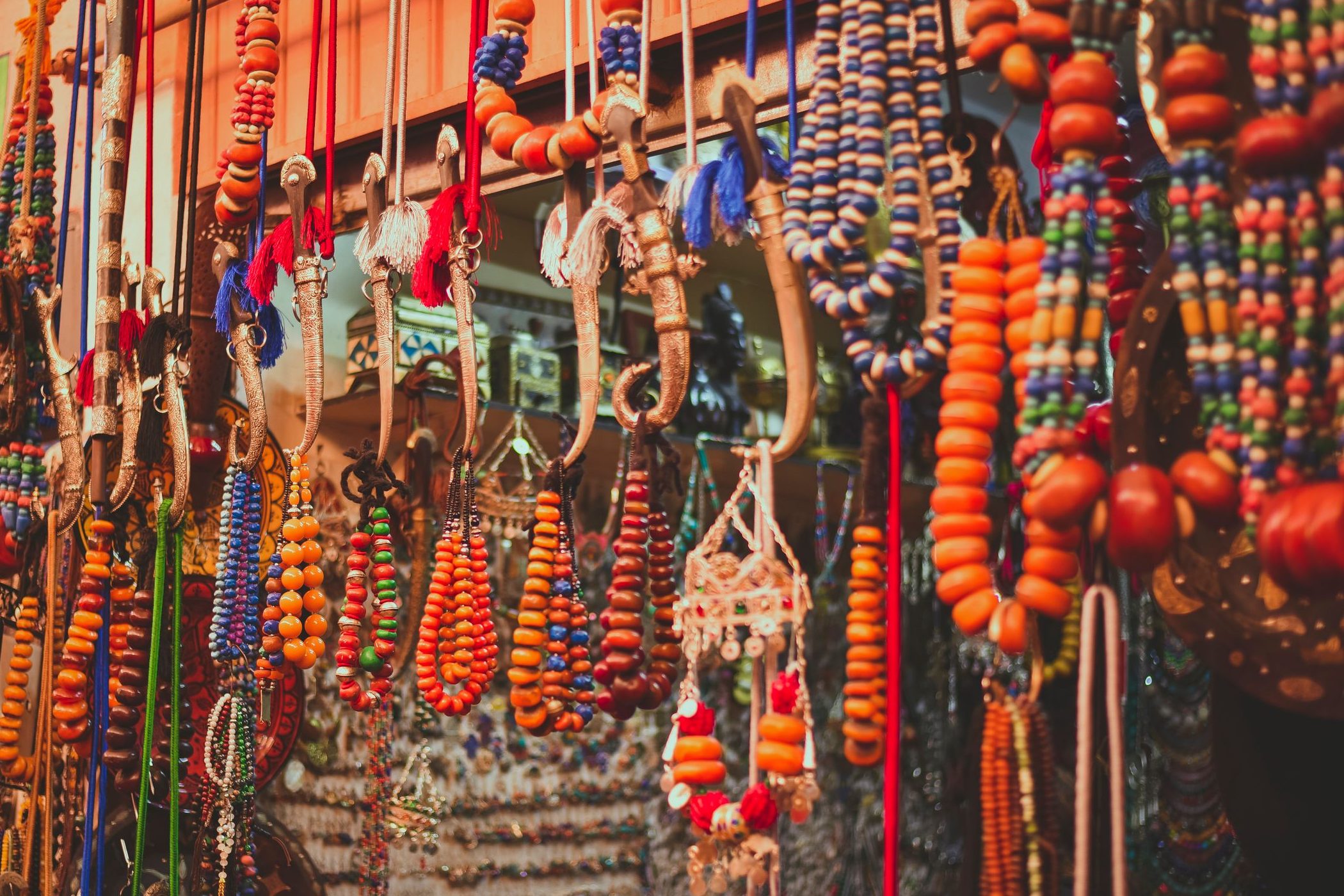
Go in the morning, while the air is cool, and agree on a meeting point at one of the gates before the family scatters: with so many lanes, it is easy to lose one another. Bargaining is expected in the craft stalls.
South to the Souss-Massa National Park
Morocco created the Souss-Massa National Park in 1991, on the coast between the mouth of the Souss, just south of Agadir, and the town of Aglou: some 33,800 hectares of dunes, beaches, steppe and wetland. The tourist office counts more than 300 plant species and more than 300 animal species, and mentions the park’s museum. Its fame among naturalists rests on one bird: the northern bald ibis, an endangered species. Three of Morocco’s four colonies nest on the park’s coastal cliffs, and with the fourth, close by, they hold almost all the world’s truly wild breeding birds. The park also runs captive breeding programmes for antelopes and gazelles of the Sahara, the addax and the scimitar oryx among them.
The estuary of the Oued Massa, about an hour’s drive south of the city, is the place to go: a river that holds water all year, a visitor centre, waders and gulls on passage, and spoonbills in winter. It makes a half-day of quiet walking, best with a guide who knows where the ibis feed. Bring binoculars, a hat and water.
North along the surf coast: Taghazout and Imsouane
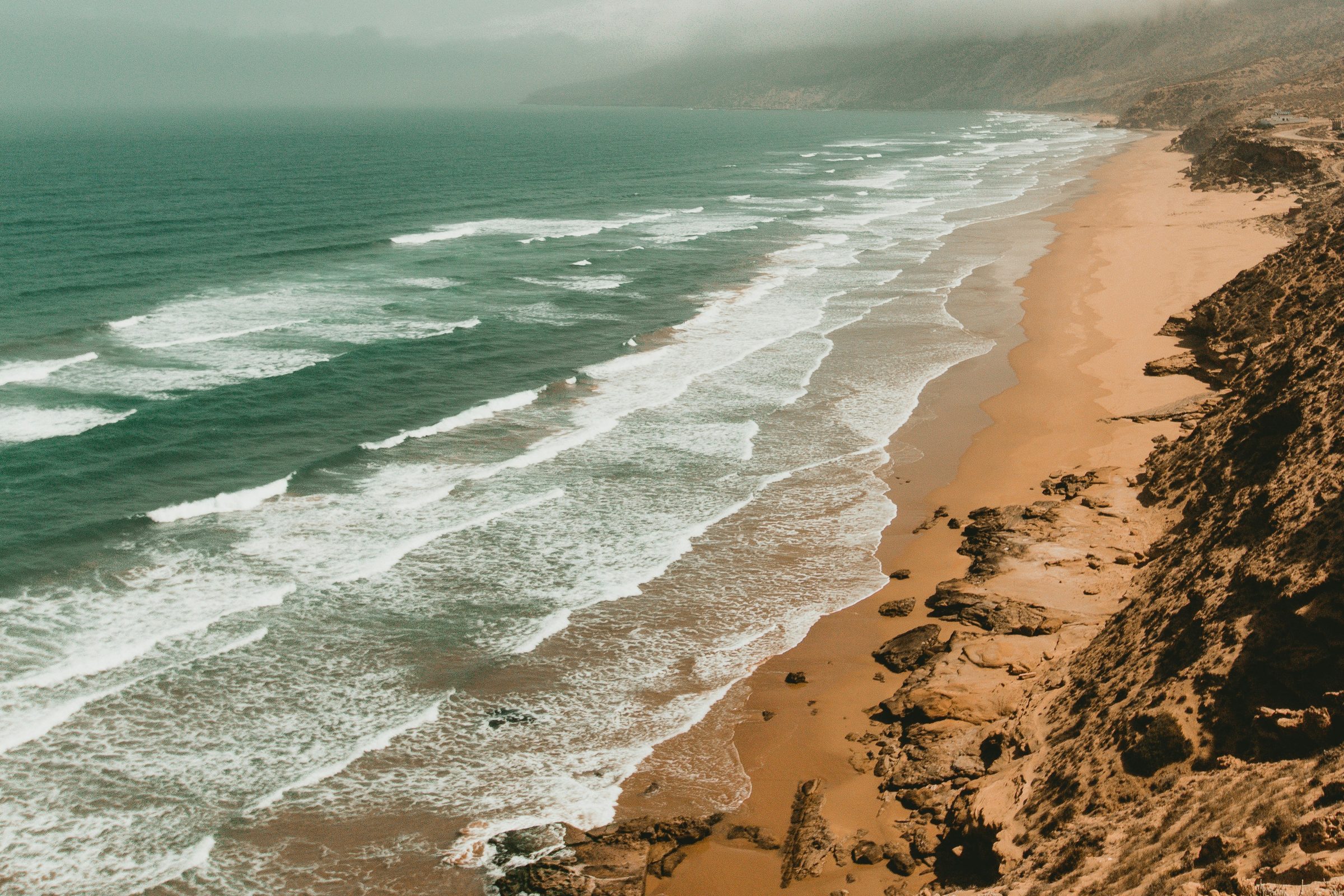
North of Agadir the coast road runs between the mountains and the sea, past a string of beaches and fishing villages that surfers from all over the world have made their own.
Taghazout
About 25 km from the city, some twenty-five minutes by road, Taghazout began as a Berber fishing village and has become a surfing destination known far beyond Morocco. Three kilometres to the north, the right-hand point break of Anchor Point is the most famous wave of the coast; the waves are at their best for experienced surfers from September to April. Between the village and its neighbour Tamraght, a large planned resort, Taghazout Bay, has grown along the shore. Inland, a road climbs to Imouzzer Ida Ou Tanane, about an hour and a quarter from Agadir, near the valley known as Paradise Valley, a classic day out from the coast.
Imsouane
Further north, about 95 km and an hour and three quarters from Agadir, Imsouane is a fishing port in a sheltered bay below the cliffs. Its long, slow point break, known as the Bay, is one of the best places in Morocco to learn, and longboarders come for the length of the ride; the more exposed Cathedral beach is for confident surfers. Imsouane lies about 80 km short of Essaouira, a little over halfway along the coast road, which makes it the natural lunch stop.
What to do in and around Agadir
Between the beach and the market, these are the outings local providers offer in and around Agadir; the durations are indicative.
- A guided bike tour of the city. About three hours by bicycle through the centre, with helmets and water. It is open to children, with separate arrangements for the youngest: give their ages when you book.
- A first surf lesson. At Imsouane, or further south at Mirleft, which the tourist office singles out among the places not to miss. A beginners’ session includes the board, the wetsuit and the instructors: a briefing on the sand, then instructors in the water beside you. If the waves are wrong on the day, the lesson may move to a better-suited beach.
- A hammam after the sea. At Imsouane, the traditional bath and scrub is the way to end a day of salt and wind.
- Lunch by the beach. On a surf day, lunch at the beach can be added, with vegetarian dishes when asked for in advance.
The city also holds the Timitar festival every summer, devoted to Amazigh music and the music of the world; its dates are announced each year.
Arriving: Agadir–Al Massira airport and the roads
Agadir is the air gateway to the south of Morocco. Its airport, Agadir–Al Massira, stands inland at Temsia, about 30 km by road and some forty-five minutes from the seafront, and on the Taroudant side of the city. Royal Air Maroc lists Agadir in its network, with connections through Casablanca, its hub. From Europe, on 12 November 2026, Ryanair’s published network linked Agadir with 29 airports, among them London Stansted, Manchester, Birmingham, Edinburgh, Dublin, Paris Beauvais, Madrid, Porto and Vienna, and within Morocco with Fès, Tangier and Oujda; check which routes run on your dates.
Royal Air Maroc lists no Indian city in its network, so travellers from India usually fly to Casablanca and connect there, or arrive in Marrakech and drive south, as set out in our guide to flights from India and the journey to Morocco. Agadir has no railway yet: a high-speed line from Marrakech is planned, with no opening date announced. By road, the motorway from Marrakech covers about 245 km in some three hours without stops.
How many nights in Agadir?
Morocco’s tourist office suggests four days with outings. We would say three nights for the city and one day out, and four for both the park and the surf coast. Agadir works best as one stage of a journey in the south, and three ways of fitting it in make sense:
- Agadir first, then Taroudant. Land at Al Massira, spend two or three nights by the sea to recover from the flight, then drive about 80 km inland, an hour and twenty minutes, to the walled town of Taroudant: see Taroudant and the Souss valley. The airport lies on that side of the city, about 65 km from Taroudant, which also makes Taroudant an easy last night before a flight.
- Up the coast to Essaouira. From Agadir, the coast road runs north by Taghazout and Imsouane to Essaouira, about 175 km and close to three hours without stops; with lunch at Imsouane, it becomes the most beautiful drive of the trip. See our guide to Essaouira from Marrakech for the town at the other end.
- A pause by the sea after Marrakech. Three hours down the motorway, Agadir offers what Marrakech cannot: flat walks by the water and cool evenings in summer. For the days in the red city before, see things to do in Marrakech with grandparents and children.
For the lagoon much further down the coast, a long flight or an expedition by road away, see our guide to the Dakhla lagoon.
Agadir’s weather, month by month
Agadir’s climate barely changes through the year. Its days average 21 to 27 °C in every month, with nights of 8 to 20 °C, and its rain, about 230 mm a year, falls almost entirely between October and April. In July it is some eleven degrees cooler by day than Marrakech. The tourist office calls spring and autumn ideal, with summer the liveliest season on the coast; for winter sun, January and February are hard to match.
- January
- 21 °C by day · 8 °C at night · 32 mm of rain over 4 days
- Mild days, cool nights: the winter sun
- February
- 22 °C by day · 10 °C at night · 29 mm of rain over 4 days
- Mild and mostly dry
- March
- 23 °C by day · 12 °C at night · 31 mm of rain over 5 days
- Spring; a few showers
- April
- 23 °C by day · 14 °C at night · 14 mm of rain over 4 days
- Bright and fresh; the rain fades
- May
- 24 °C by day · 16 °C at night · 5 mm of rain over 2 days
- Dry and pleasant
- June
- 26 °C by day · 18 °C at night · 1 mm of rain over 2 days
- Warm; the start of the summer season
- July
- 27 °C by day · 19 °C at night · 0 mm of rain over 1 day
- About 11 degrees cooler than Marrakech by day
- August
- 27 °C by day · 20 °C at night · 3 mm of rain over 2 days
- The warmest nights of the year
- September
- 26 °C by day · 19 °C at night · 4 mm of rain over 2 days
- Still summer, with fewer crowds
- October
- 26 °C by day · 17 °C at night · 21 mm of rain over 3 days
- Warm days; the first rains
- November
- 24 °C by day · 13 °C at night · 42 mm of rain over 4 days
- Mild; one of the wetter months
- December
- 22 °C by day · 10 °C at night · 47 mm of rain over 6 days
- The wettest month, still mild by day
| Month | Average high | Average low | Rain | Rainy days | What to expect |
|---|---|---|---|---|---|
| January | 21 °C | 8 °C | 32 mm | 4 | Mild days, cool nights: the winter sun |
| February | 22 °C | 10 °C | 29 mm | 4 | Mild and mostly dry |
| March | 23 °C | 12 °C | 31 mm | 5 | Spring; a few showers |
| April | 23 °C | 14 °C | 14 mm | 4 | Bright and fresh; the rain fades |
| May | 24 °C | 16 °C | 5 mm | 2 | Dry and pleasant |
| June | 26 °C | 18 °C | 1 mm | 2 | Warm; the start of the summer season |
| July | 27 °C | 19 °C | 0 mm | 1 | About 11 degrees cooler than Marrakech by day |
| August | 27 °C | 20 °C | 3 mm | 2 | The warmest nights of the year |
| September | 26 °C | 19 °C | 4 mm | 2 | Still summer, with fewer crowds |
| October | 26 °C | 17 °C | 21 mm | 3 | Warm days; the first rains |
| November | 24 °C | 13 °C | 42 mm | 4 | Mild; one of the wetter months |
| December | 22 °C | 10 °C | 47 mm | 6 | The wettest month, still mild by day |
Long-term averages for 1991–2020 at Agadir Inezgane, from Morocco’s Direction de la Météorologie Nationale, published by the World Meteorological Organization, rounded to the nearest degree and millimetre. A given day can be warmer, colder or wetter than the average.
The same figures, read season by season and set against the heat inland, are in our guide to Taroudant; for the rest of Morocco and the dates of Ramadan, see the best months to visit Morocco from India.
Vegetarian and Jain meals in Agadir
Vegetarian food is easy in Agadir when asked for in advance, and the produce of the Souss fills its market. Jain food is on request: mention it when the stay is planned, and read how to ask for a Jain meal as a traveller in Morocco.
So, what are the best things to do in Agadir?
Agadir is not a city of monuments, and it does not pretend to be. Its pleasures are the bay at the end of the day, the view from a hill whose walls are all that the earthquake left, a market that still feeds a region, and the coast on either side: the estuaries and ibis of Souss-Massa to the south, the surf villages to the north. Above all, it is the gentle start or the gentle end of a journey in the south, three nights by the sea before the walls of Taroudant or the road to Essaouira.
Planning the south of Morocco for your family or your group? Write to us with your dates, the ages in your party and the nights you can give the coast, and we will answer by e-mail or video call.
Questions travellers ask about Agadir
What are the best things to do in Agadir?
How many days do you need in Agadir?
What happened to Agadir in 1960?
Can you swim in the sea at Agadir?
How far is Taghazout from Agadir?
Is there a train to Agadir?
Are there direct flights to Agadir from India?
Editorial note
This guide draws on Morocco’s national tourist office, for Agadir (its seafront, Souk El Had, the Timitar festival, the suggested four days, the best seasons and Mirleft) and for the Souss-Massa National Park; the US Geological Survey, for the earthquake of 29 February 1960; the World Meteorological Organization, for the long-term averages of Morocco’s Direction de la Météorologie Nationale at Agadir Inezgane and Marrakech (1991–2020); the UK government’s travel advice for Morocco, for beach safety; the published networks of Royal Air Maroc and Ryanair; and Wikipedia, for the rebuilding of Agadir, Talborjt and its memorial museum, the kasbah of Agadir Oufella, the cable car, the airport, the railway, the national park, Taghazout and Imsouane. Road distances and driving times were calculated with the OSRM route planner on OpenStreetMap data. All were read on 12 November 2026.
Activity durations and ages come from information provided by local activity providers in 2026; check them when you book.
Flights, opening arrangements and road conditions change: check them before you book. Apart from public bodies and airlines, no business is named, and none is recommended. Sehra Morocco plans tailor-made journeys in Morocco; this guide describes no journey of its own.
- Moroccan National Tourist Office: Agadir-Taghazout and natural parks and lakes
- US Geological Survey: M 5.9, Agadir, Morocco, 29 February 1960
- World Meteorological Organization, World Weather Information Service: Agadir Inezgane and Marrakech
- GOV.UK, Morocco travel advice: safety and security
- Royal Air Maroc, our network; Ryanair, timetable and route network from Agadir
- Wikipedia: Agadir, 1960 Agadir earthquake, Agadir Oufella, Agadir–Al Massira Airport, Souss-Massa National Park, Taghazout and Imsouane
- Road distances and driving times: OSRM on OpenStreetMap data, calculated on 12 November 2026, without stops
Written by Sehra Morocco. Last reviewed: .
Tell us about your trip.
By e-mail or video call. We reply within two working days.