Things to do in Rabat: the Kasbah, the Hassan Tower and the river of Morocco’s garden capital
Rabat is often crossed on the way to somewhere else, and deserves better: a capital of gardens and wide avenues, with a twelfth-century citadel above the river and a Roman town among the storks. Here is what to see, how to arrive, and how long to give it.
Reviewed 12 November 2026 · Sources at the end
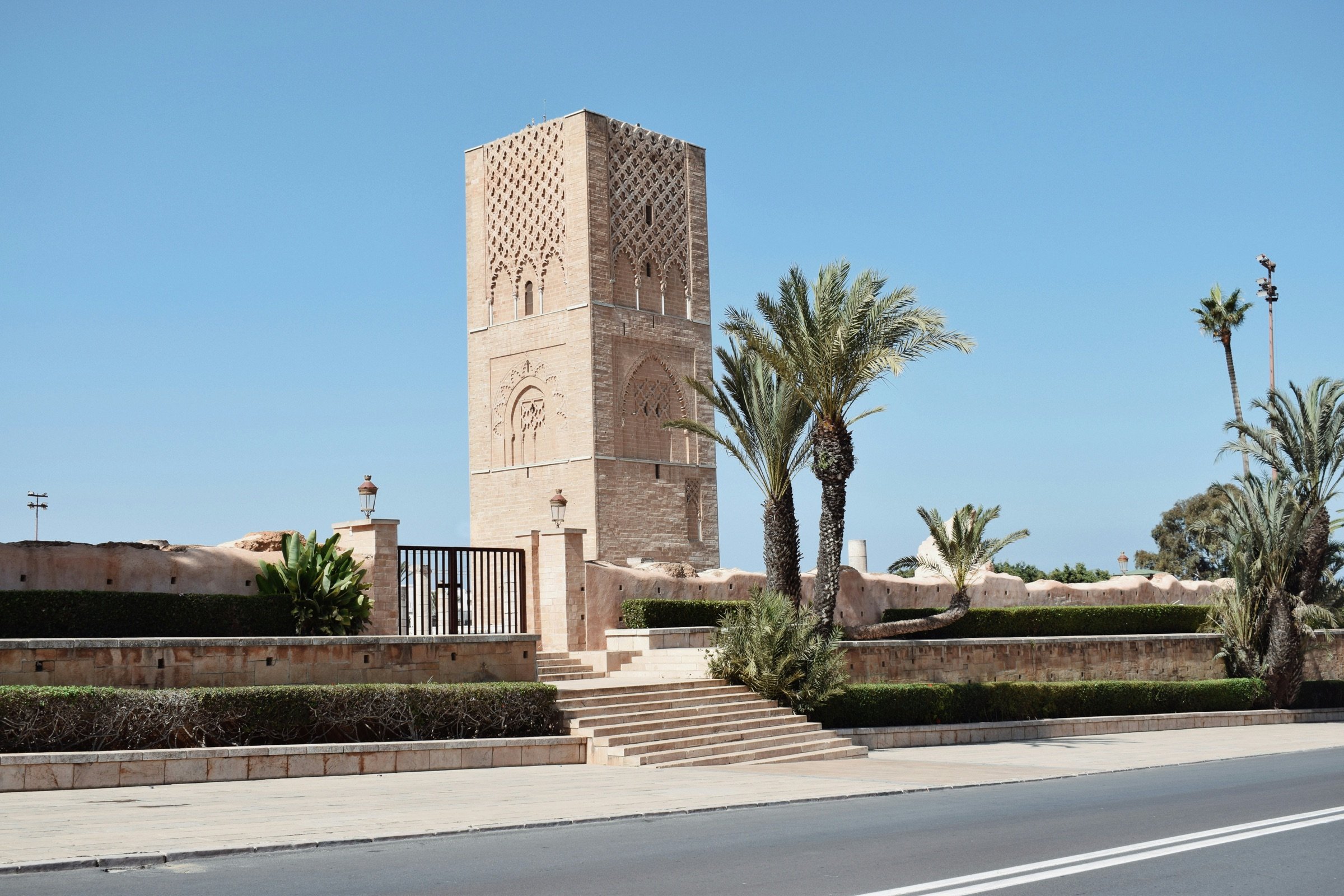
Give Rabat two nights: walk up to the Kasbah of the Oudayas above the mouth of the river, stand among the columns of the Hassan Tower beside the Mausoleum of Mohammed V, wander the ruins and gardens of the Chellah, spend an afternoon in one of the national museums, and cross the Bou Regreg to Salé. Those are the essential things to do in Rabat, and the city makes them easy: its monuments stand in open space, among gardens, and trains bring it within reach of Tangier, Casablanca and Fès.
Sehra Morocco plans tailor-made journeys across Morocco for families and groups from India and from around the world. The facts below come from UNESCO, Morocco’s national tourist office, its national museums foundation and other public sources, listed at the end; the advice is ours.
Rabat, at a glance
The essentials, checked on 12 November 2026:
- Where
- On the Atlantic coast of north-west Morocco, at the mouth of the Bou Regreg river, facing Salé: about 95 km north-east of Casablanca and 320 km north of Marrakech by road
- World Heritage
- “Rabat, Modern Capital and Historic City: a Shared Heritage”, inscribed by UNESCO in 2012: the new town built from 1912 and the city of the twelfth and seventeenth centuries
- By train
- About 1 hour 20 from Tangier by Al Boraq; about an hour from Casablanca; about 2 hours from Meknès, 2 hours 50 from Fès and 3 hours 40 from Marrakech
- By air
- Rabat–Salé airport, about 10 km and a quarter of an hour by road from the Hassan Tower; Royal Air Maroc lists Rabat in its domestic network
- Nights
- Two, as Morocco’s tourist office suggests; three with Salé, the river and the museums
- Best months
- April to June and September to October; winters are mild but wet, summers mild
- Getting around
- Two tram lines across the river to Salé; a car with driver between the monuments
- Museums
- The national museums open every day from 10 am to 6 pm, except Tuesdays
- At the table
- Vegetarian when asked for in advance; Jain on request
Train and flight timetables and museum hours change: check them again before you book.
A capital listed for its avenues as well as its ramparts
Most cities enter the World Heritage List for their old quarters. Rabat entered it in 2012 for two cities at once. The first is the new town, conceived and built under the French Protectorate from 1912 to the 1930s, when Rabat became the capital: royal and administrative quarters, residential streets, and the Jardins d’Essais, botanical and pleasure gardens. UNESCO calls it one of the largest and most ambitious modern urban projects built in Africa in the twentieth century, and probably the most complete. The second is older: the Hassan Mosque and the ramparts and gates of the Almohad caliphs, begun in the late twelfth century, and the remains of the Andalusian principality of the seventeenth.
What UNESCO admires is the way the two meet: the planners kept the medina, the Kasbah and the monuments intact, and borrowed from them in turn, so that a distinctive Moroccan style grew out of the exchange. You feel it as you walk, along tree-lined avenues and through the Jardins d’Essais, with the old walls never far away. Below the Kasbah, the medina keeps its souk, and the Almohad wall keeps Bab er-Rouah, its monumental western gate. For a garden outside the city, the tourist office points to the Exotic Gardens of Bouknadel, a few kilometres away.
The Kasbah of the Oudayas, where Rabat began
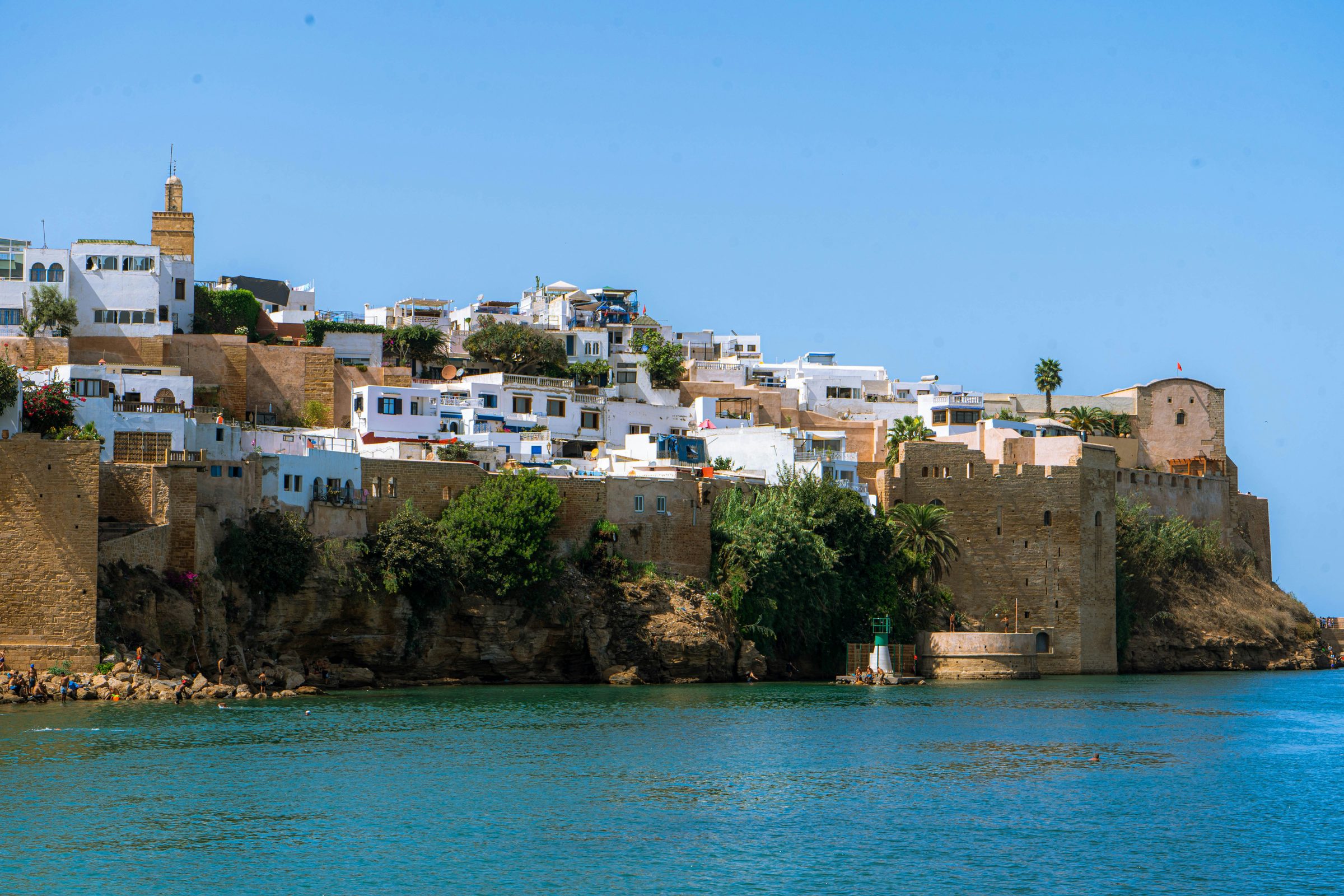
The Kasbah stands on a hill at the mouth of the Bou Regreg, looking across the water to Salé. The Almohad caliph Abd al-Mu’min built a citadel here around 1150, with a palace and a mosque; its Old Mosque, though much restored in the eighteenth century, is still the oldest building inside the walls. Enter by Bab Oudaya, the great gate added by the caliph Ya’qub al-Mansur between 1195 and 1199: more ceremony than defence, it is counted among the finest gates of Almohad architecture, and the curving forms at the foot of its arch are thought to be eels, a motif almost unknown elsewhere in Moroccan art.
The Kasbah’s second life began after 1609, when Spain expelled its Moriscos: refugees settled here and in Salé, and their republic on the river became a base for corsairs, the “Salé Rovers”, until 1666. The name came later, from the Oudaya tribe. Follow the Rue Jamaa to the broad platform the corsairs built on the edge of the kasbah: it looks over the river mouth and the ocean, one of the finest views in the city.
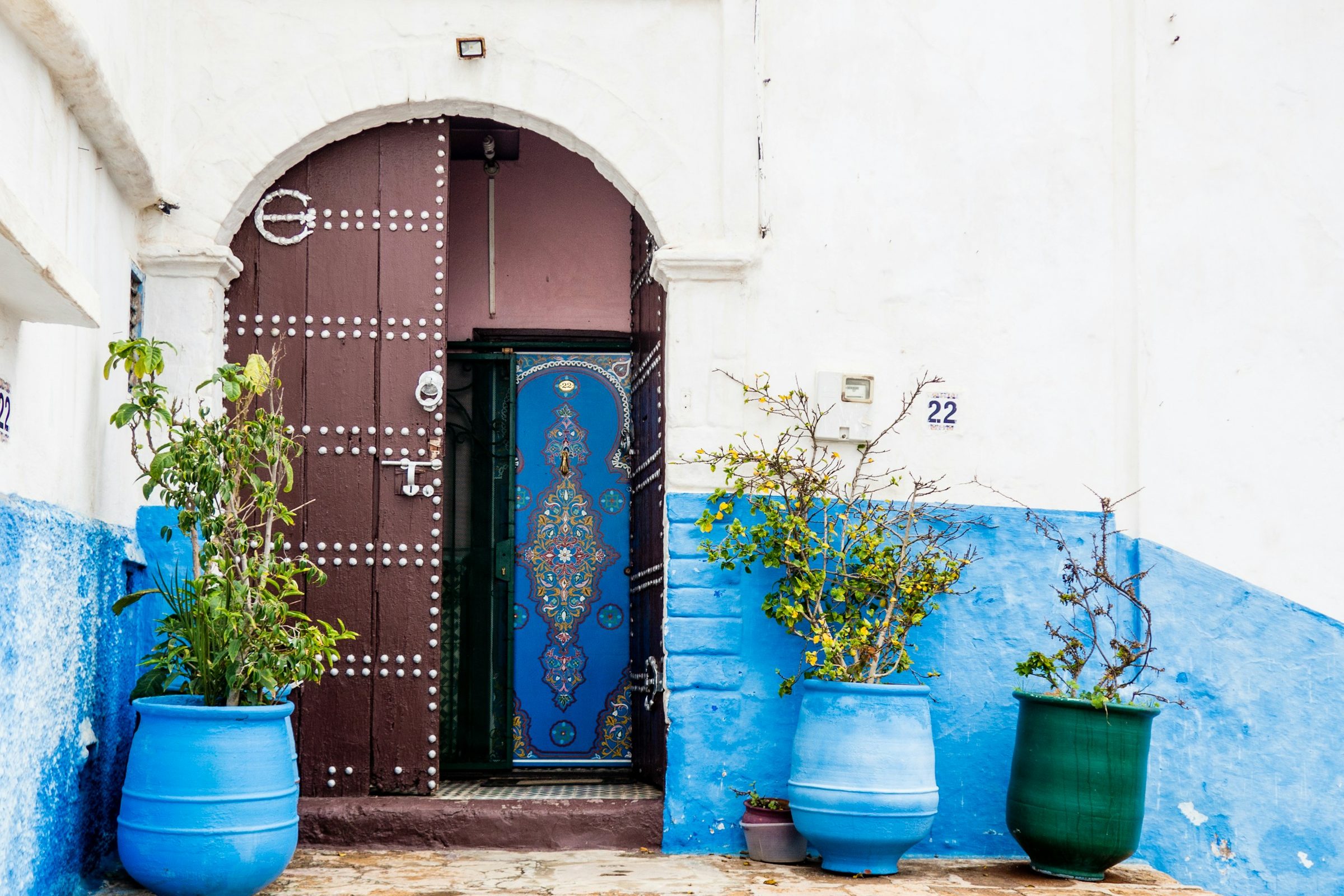
In the southern part of the Kasbah, the pavilion built by Sultan Moulay Ismail at the end of the seventeenth century reopened on 9 January 2023 as the Oudayas National Museum of Adornment, devoted to Moroccan jewellery; its collection was enriched by the personal collection of Amazigh jewellery of King Mohammed VI. Beside it, the Andalusian Garden, laid out between 1915 and 1918 with citrus trees and bougainvillea, is the place to sit down after the climb.
The Hassan Tower and the Mausoleum of Mohammed V
Ya’qub al-Mansur wanted a new imperial capital on the high south bank of the river, and a mosque to match: 183 by 139 metres, it would have been the largest in the western Islamic world. When he died in 1199, work stopped. What remains is a minaret of red ochre sandstone, 44 metres high where it was meant to reach at least 64, climbed inside by ramps rather than stairs, and a field of 348 column stumps that lets you trace the prayer hall that never was.
Across the esplanade, the Mausoleum of Mohammed V holds the tombs of King Mohammed V, who died in 1961, and of his two sons, King Hassan II and Prince Abdallah. Designed by the Vietnamese architect Cong Vo Toan and completed in 1971, it honours Moroccan craftsmanship as much as the king: white marble under a green roof outside, zellige and a dome of mahogany and coloured glass within. It is a place of national memory: dress modestly, covering arms and legs, and keep voices low. Tower and mausoleum share one esplanade, so they make a single visit.
The Chellah: a Roman town, a royal necropolis and its storks
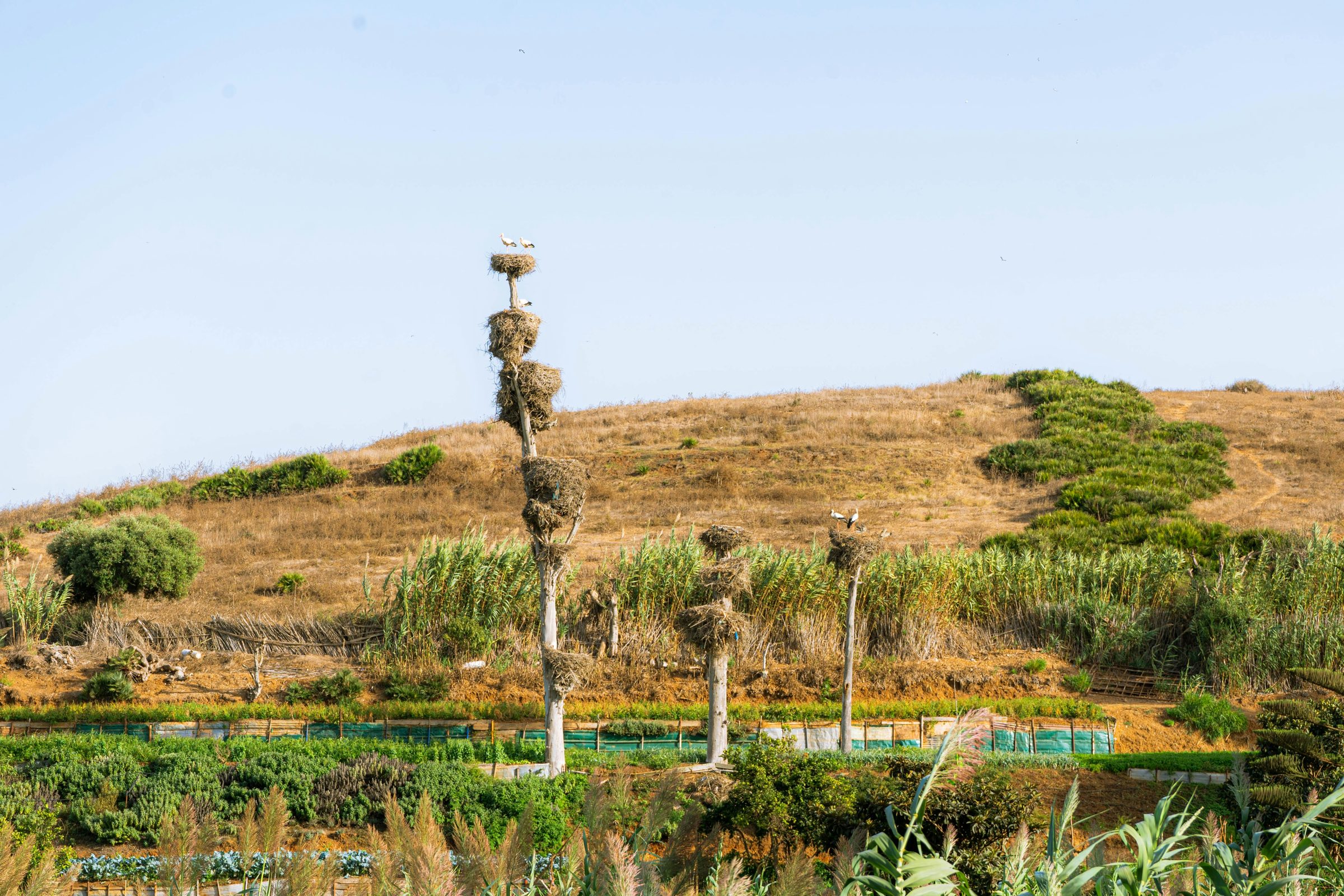
On the left bank of the estuary, the Chellah gathers the whole history of the river in one walled enclosure. Phoenician traders probably had a post here; the Mauretanian kings built temples; the Romans made it Sala Colonia, a port town whose forum, main street and triumphal arch can still be walked. From the late thirteenth century, the Marinid sultans turned the abandoned site into a royal necropolis, walled it, and built a mosque, a madrasa and their tombs; the most richly carved is that of Sultan Abu al-Hasan, who died in 1351.
Today the ruins are a garden, and the tourist office describes a walk among ancient remains, gardens and storks: a large colony nests in the trees and on the old minaret. Excavations go on: in 2023, archaeologists announced the discovery of a Roman port district. The Chellah also hosts the Jazz au Chellah festival and a stage of the annual Mawazine music festival; check their dates if you would like to hear music among the ruins.
Rabat’s museums: from the bronzes of Volubilis to modern art
Morocco’s Fondation Nationale des Musées runs four museums in Rabat, all open every day from 10 am to 6 pm except Tuesdays: keep that day for the Kasbah or the Chellah.
The Museum of History and Civilisations
Morocco’s national archaeological collection, reopened under this name in April 2017, runs from prehistory through the Punic and Roman periods to the Islamic dynasties, and its room of ancient marble and bronze holds the celebrated bronzes of Juba II, of Cato and of the ephebes, found at sites such as Volubilis. Seen before or after a day at the ruins, they bring Volubilis and the imperial city of Meknès to life.
The Mohammed VI Museum of Modern and Contemporary Art
The first museum in Morocco devoted entirely to modern and contemporary art keeps more than 500 paintings, from the great names of Moroccan painting such as Melehi, Gharbaoui and Belkahia, and international exhibitions that have brought Picasso, Giacometti, Goya and Delacroix to Rabat.
Photography on the corniche, jewellery in the Kasbah
The National Museum of Photography opened in 2020 in Fort Rottembourg, a late nineteenth-century fort on the corniche, and shows the young Moroccan photography scene; the jewellery museum of the Kasbah completes the four.
Across the river: Salé and the Bou Regreg
Salé, about ten minutes away according to the tourist office, is older than Rabat: founded in the eleventh century, it was a merchant port long before Rabat was a capital. Its medina keeps the Marinid gate of Bab el-Mrisa, from the 1270s, through which boats once entered the harbour; the Great Mosque, rebuilt by Ya’qub al-Mansur in 1196 and the third largest in Morocco; and beside it the Madrasa of Abu al-Hasan, from 1342, one of the architectural highlights of the city. The tram crosses the river on the Hassan II bridge, which makes Salé an easy half-day.
Between the two cities, the valley is where the new capital is rising: the Grand Theatre of Rabat, designed by Zaha Hadid, opened to the public in April 2026, and the Mohammed VI Tower, 250 metres high and the tallest building in Morocco, was inaugurated on the Salé bank the same month. Check the theatre’s programme when you plan your dates.
On the water
From the marina of the Bou Regreg, kayak outings of about two hours explore the river; a giant paddleboard takes up to eight people at once, a good family game; catamaran sailings are offered too, and groups of ten or more can take a private motor boat. Life jackets are provided, and every outing depends on the weather.
Hands-on Rabat: a kitchen, a hammam, a golf course and the coast
A cooking class and a hammam
Cooking classes last three to four hours, from mint tea to dessert, in French or in English, with a vegetarian menu; book at least three days ahead, and for parties of fewer than ten the morning begins at the market. The classic hammam pairs a scrub of about 45 minutes with a massage of an hour.
Golf
Golf is played around Rabat, and the tourist office lists it among the city’s sports. Tee times are booked at least 48 hours ahead, a caddie is compulsory, and beginners can take a one-hour introduction with a professional.
A ride by the ocean, and the beaches
On the coast road towards Casablanca, one-hour rides are taken at a walking pace only, in groups of up to eight, with a helmet. The tourist office describes kilometres of equipped beaches along this coast; the UK government warns that strong currents and unexpected waves occur on Morocco’s beaches and that many have little or no lifeguard cover, so keep children within reach and out of rough water.
Rabat with grandparents and children
Rabat suits families who travel at several speeds. Three things help:
- Mind Tuesdays. The national museums close that day; give it to the Kasbah, the Chellah or Salé instead.
- Plan a garden for every outing. The Andalusian Garden of the Kasbah, the Jardins d’Essais and the Chellah all give the oldest a bench and the youngest room to run.
- Dress for the monuments. The UK government suggests that women consider loose clothing covering the arms, legs and chest; this matters most at the Mausoleum and during Ramadan. It also notes that pickpocketing happens in medinas and on beaches.
For everything else families should know before a first journey to Morocco, see things to do in Marrakech with grandparents and children.
How to get to Rabat
By train, with ONCF
Rabat has two stations. Rabat-Agdal receives the Al Boraq high-speed trains, which link Tangier to Rabat in about 1 hour 20, about every hour through the day, before running on to Casablanca. Rabat-Ville, the central station, is served by the classic trains, now called Al Atlas: about an hour from Casablanca, with a shuttle every hour, about 2 hours from Meknès, 2 hours 50 from Fès and 3 hours 40 from Marrakech. Al Atlas trains carry a single first-class carriage, which can sell out, and ONCF opens bookings three months ahead.
By air
Rabat–Salé airport lies on the Salé side, about 10 km and a quarter of an hour by road from the Hassan Tower, and Royal Air Maroc lists Rabat in its domestic network. Most travellers from India land in Casablanca instead, about 110 km and 1 hour 25 by road from Rabat: the connections are set out in flights from India and the airports of Morocco.
By road
Calculated on OpenStreetMap without stops: about 95 km and 1 hour 15 from central Casablanca, 140 km and 1 hour 40 from Meknès, 205 km and 2 hours 25 from Fès, 245 km and under three hours from Tangier, 320 km and 3 hours 40 from Marrakech.
How many nights in Rabat?
Morocco’s tourist office suggests two days, and three shapes of stay work well:
- One night, on the way. Arrive by train from Tangier or Casablanca, walk the Kasbah at the end of the afternoon, and give the next morning to the Hassan Tower and the Mausoleum before going on.
- Two nights, the essentials. Add the Chellah and one museum, and an hour in the medina.
- Three nights, at the pace of the river. Add Salé by tram, an outing on the Bou Regreg, a second museum and, if the dates allow, an evening at the Grand Theatre.
Rabat in a journey through the imperial cities
Of Morocco’s royal capitals, Rabat is the one that joins the others up: it lies on the railway between Tangier, Casablanca and Fès, and makes a natural pause between the old medinas. Three routes work well:
- From the north. Tangier to Rabat by Al Boraq, two nights in Rabat, then the train inland to Meknès and Volubilis, about two hours away, and Fès, Morocco’s oldest imperial capital.
- From Casablanca. Land in Casablanca, give it a day, as described in things to do in Casablanca, and continue to Rabat an hour away by train.
- The full loop. Marrakech, Casablanca, Rabat, Meknès and Volubilis, Fès, and back south by the desert road through the dunes of Merzouga. At an easy pace, it is a journey of two weeks or so.
When to go: Rabat’s weather, month by month
The Atlantic sets Rabat’s climate. Morocco’s tourist office recommends April to June and September to October, and warns that winter can be rainy; the long-term averages show how gentle the city is, with 28 °C by day in its warmest month, against 35 °C inland at Fès.
Rabat’s averages, month by month
- September
- 27 °C by day · 17 °C at night · rain on 4 days
- Warm and mostly dry: one of the best months
- October
- 25 °C by day · 14 °C at night · rain on 7 days
- Soft days; the first autumn rains
- November
- 21 °C by day · 11 °C at night · rain on 9 days
- The wettest month by volume
- December
- 19 °C by day · 9 °C at night · rain on 10 days
- Mild days, frequent rain
- January
- 17 °C by day · 7 °C at night · rain on 9 days
- The coolest month; a warm layer for the evenings
- February
- 18 °C by day · 8 °C at night · rain on 9 days
- Mild and wet; Ramadan expected to begin
- March
- 20 °C by day · 10 °C at night · rain on 9 days
- Spring arrives, still showery
- April
- 21 °C by day · 11 °C at night · rain on 7 days
- Fresh, bright days: the season opens
- May
- 24 °C by day · 13 °C at night · rain on 5 days
- Warm and drier: one of the best months
- June
- 26 °C by day · 16 °C at night · rain on 2 days
- Warm, almost no rain
- July
- 27 °C by day · 18 °C at night · rain on 2 days
- Summer kept mild by the ocean
- August
- 28 °C by day · 18 °C at night · rain on 1 days
- The warmest month, and the driest
| Month | Average high | Average low | Rainy days | What to expect |
|---|---|---|---|---|
| September | 27 °C | 17 °C | 4 | Warm and mostly dry: one of the best months |
| October | 25 °C | 14 °C | 7 | Soft days; the first autumn rains |
| November | 21 °C | 11 °C | 9 | The wettest month by volume |
| December | 19 °C | 9 °C | 10 | Mild days, frequent rain |
| January | 17 °C | 7 °C | 9 | The coolest month; a warm layer for the evenings |
| February | 18 °C | 8 °C | 9 | Mild and wet; Ramadan expected to begin |
| March | 20 °C | 10 °C | 9 | Spring arrives, still showery |
| April | 21 °C | 11 °C | 7 | Fresh, bright days: the season opens |
| May | 24 °C | 13 °C | 5 | Warm and drier: one of the best months |
| June | 26 °C | 16 °C | 2 | Warm, almost no rain |
| July | 27 °C | 18 °C | 2 | Summer kept mild by the ocean |
| August | 28 °C | 18 °C | 1 | The warmest month, and the driest |
Long-term averages for 1991–2020 at Rabat-Salé, from Morocco’s Direction de la Météorologie Nationale, published by the World Meteorological Organization and rounded to the nearest degree; rainy days are days with measurable rain. A given day can be colder or warmer than the average.
Even in July and August the averages stay below 30 °C, which makes Rabat a good stop in the hottest weeks of a summer journey; from November to March, pack an umbrella. Ramadan is expected to begin in February 2027; what it means for travellers is in the best months to visit Morocco from India.
Vegetarian and Jain food in Rabat
Vegetarian meals are simple when asked for in advance, and cooking classes offer a vegetarian menu. Jain food is on request: agree it with the kitchen before you arrive. What to say is set out in how to ask for a Jain meal as a traveller in Morocco.
So, what are the best things to do in Rabat?
Climb to the Kasbah of the Oudayas and look out over the river mouth from the corsairs’ platform; walk among the columns of the Hassan Tower and pause at the Mausoleum of Mohammed V; lose an hour among the storks and Roman stones of the Chellah; see the bronzes of Volubilis or Morocco’s modern painters in the national museums, on any day but Tuesday; and cross the Bou Regreg by tram to the medina of Salé. Give it two nights, three if you can, ideally in spring or early autumn.
Coming from India? The journey is set out in our guide to travelling to Morocco from India; for the rest of the country, see our travel experiences across Morocco.
Planning Rabat for your family or your group? Tell us your dates, the ages in your party and the cities you would like to see, and we will answer by e-mail or video call. Travel agencies can read how we work with travel agencies.
Rabat: your questions answered
How many days do you need in Rabat?
Is Rabat worth visiting?
Can you visit Rabat as a day trip from Casablanca?
How do you get from Tangier to Rabat?
Are Rabat’s museums open every day?
What is the best time to visit Rabat?
Editorial note
This guide draws on UNESCO, for the World Heritage site of Rabat; Morocco’s national tourist office, for Rabat; the Fondation Nationale des Musées, for the four national museums of Rabat, their history and their hours; the World Meteorological Organization, for the long-term averages of Morocco’s Direction de la Météorologie Nationale at Rabat-Salé and Fès (1991–2020); the UK government’s travel advice for Morocco; the network of Royal Air Maroc; train journey times published by Seat61 and Rome2rio, as ONCF’s own website could not be reached on 12 November 2026; and Wikipedia, for the history of the Kasbah of the Oudayas, the Hassan Tower, the Mausoleum of Mohammed V, the Chellah, Salé and its Great Mosque, the tramway, the airport, the Grand Theatre of Rabat and the Mohammed VI Tower. Road distances and driving times were calculated with the OSRM route planner on OpenStreetMap data. All sources were read on 12 November 2026.
Activity durations and ages come from information provided by local activity providers in 2026; check them when you book.
Timetables, museum hours and festival dates change, sometimes without notice: check them before you book. Apart from public bodies, museums, an airline and a railway, no business is named, and none is recommended. Sehra Morocco plans tailor-made journeys in Morocco; this guide describes no journey of its own.
- UNESCO World Heritage Centre: Rabat, Modern Capital and Historic City: a Shared Heritage (inscribed 2012)
- Moroccan National Tourist Office: Rabat
- Fondation Nationale des Musées: Musée de l’Histoire et des Civilisations, Musée Mohammed VI d’art moderne et contemporain, Musée National de la Photographie and Oudayas, Musée National de la Parure
- World Meteorological Organization, World Weather Information Service: Rabat-Salé and Fès
- GOV.UK, Morocco travel advice: safety and security
- Royal Air Maroc, our network
- Train journey times: Seat61, train travel in Morocco (Al Boraq, Rabat stations, Al Atlas, booking period) and Rome2rio (Casablanca, Meknès, Fès and Marrakech to Rabat)
- Wikipedia: Kasbah of the Udayas, Hassan Tower, Mausoleum of Mohammed V, Chellah, Salé, Great Mosque of Salé, Rabat–Salé tramway, Rabat–Salé Airport, Grand Theatre of Rabat and Mohammed VI Tower
- Road distances and driving times: OSRM on OpenStreetMap data, calculated on 12 November 2026, without stops
Written by Sehra Morocco. Last reviewed: .
Tell us about your trip.
By e-mail or video call. We reply within two working days.