The Agafay desert from Marrakech: an evening, a night and the Atlas on the horizon
Within an hour of the medina, the city gives way to bare hills of stone, and on a clear evening the High Atlas stands along the horizon. The Agafay is not the Sahara, and does not pretend to be; here is what it is, how to go, and whether to stay the night.
Reviewed 12 November 2026 · Updated 23 November 2026 · Sources at the end
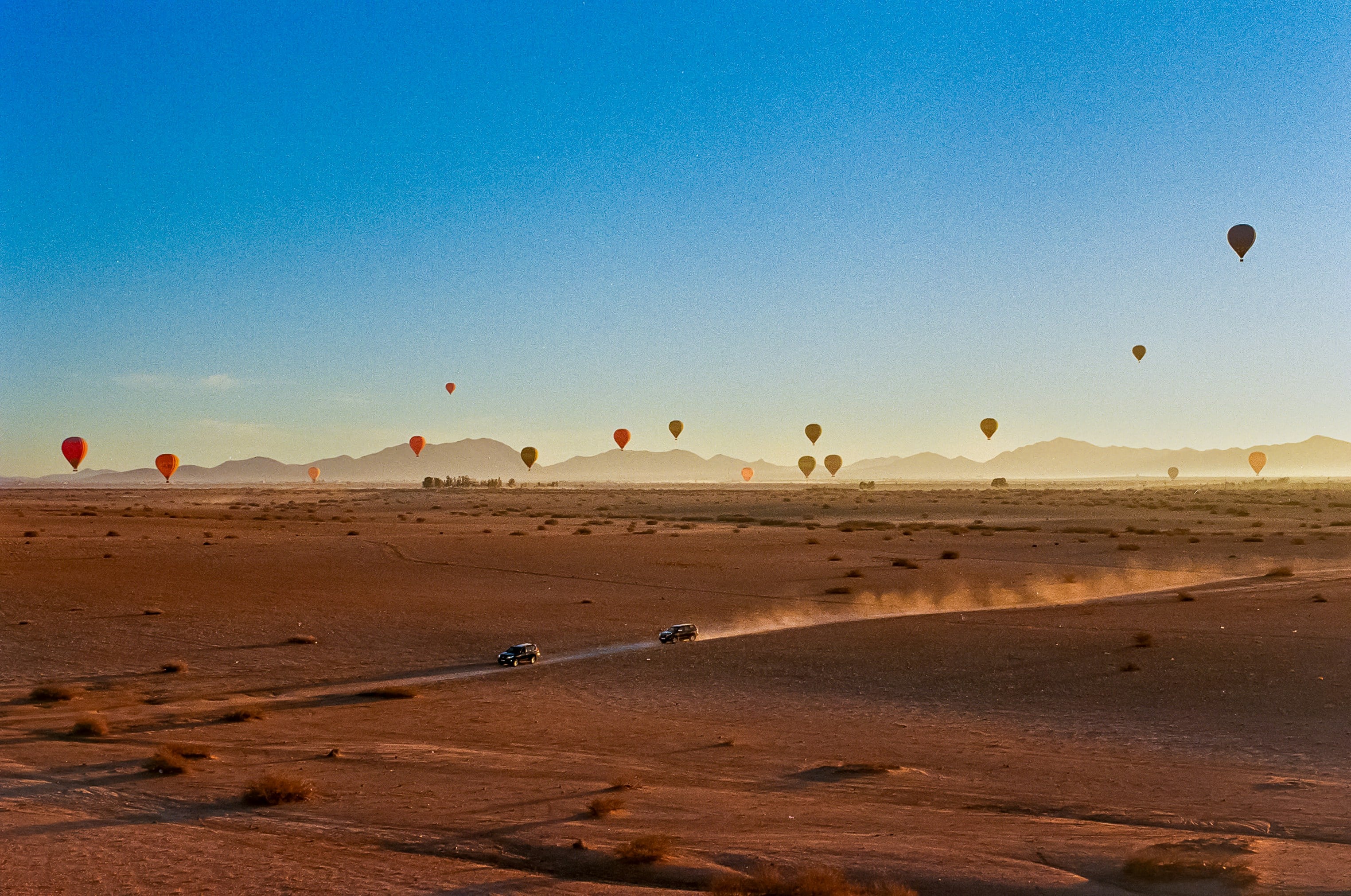
The Agafay is a stone desert some 30 to 40 km south-west of Marrakech, about 45 minutes to an hour by road: near enough for a sunset and a dinner with no night away, and wide enough for a night that feels far from the city. It has no sand dunes. The Agafay desert from Marrakech is, in short, the desert for travellers who have an evening rather than a week: grandparents who would rather not spend ten hours in a car, children who will be asleep by the time the car is back in town, couples who want one night under the stars between the souks and the mountains.
This guide explains what kind of desert the Agafay is, how to get there, an evening or a night, what to do at every age, the weather month by month, vegetarian and Jain meals, the lake of Lalla Takerkoust nearby, and when Merzouga is the better choice. Sehra Morocco plans tailor-made journeys across Morocco for travellers from India and from everywhere else. The facts come from official sources and from the information published or provided by camps and outdoor operators in the Agafay, listed at the end; the advice drawn from them is ours.
The Agafay, at a glance
The essentials, checked on 12 November 2026:
- Where
- A plateau of stony hills some 30 to 40 km south-west of Marrakech, near the Lalla Takerkoust lake
- What it is
- A stone desert: no sand dunes, but bare hills facing the High Atlas
- By road
- About 45 minutes to an hour from the medina, depending on where on the plateau you are going
- Time to give it
- An afternoon and an evening; a night if you want the dawn and the stars without the drive back
- Best months
- March to May and September to November; from December to February, nights of 6 to 8 °C on average in Marrakech
- Ages
- Every age for the sunset; quads and buggies have minimum ages, set by each operator
- At the table
- Vegetarian when asked for in advance; Jain on request
Camp arrangements, activities and minimum ages differ from one place to the next: check them again before you book.
Is the Agafay a real desert?
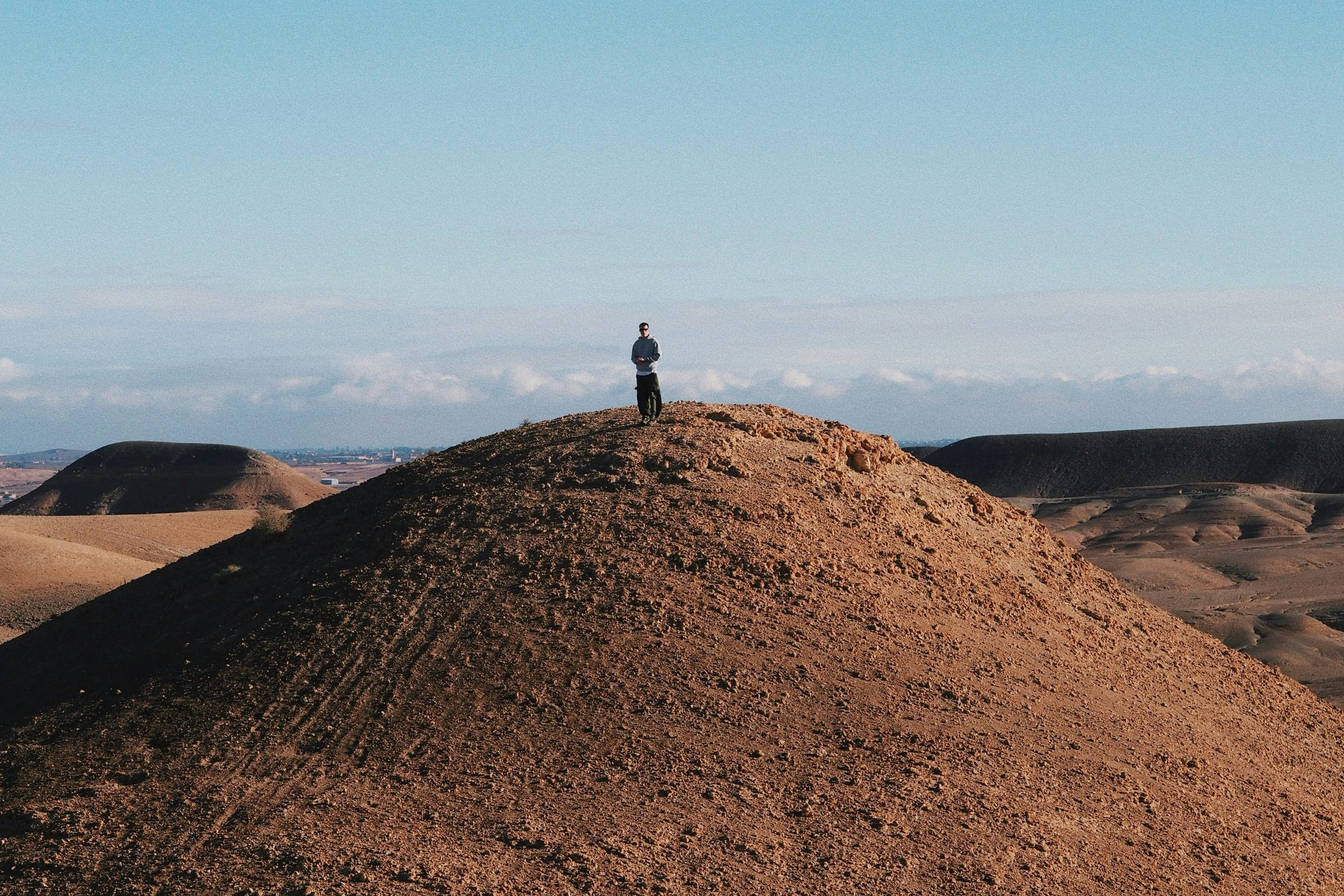
It is a desert of stone rather than sand. Geographers call this kind of ground a reg: here, a rolling plateau of white and ochre hills, covered in stones and rocks, on the first rises of the High Atlas. Wikipedia’s French edition goes further and calls it a semi-desert of modest extent rather than a desert in the strict sense. Rain is scarce: Marrakech, the nearest station with published long-term averages, receives some 220 mm in an average year, most of it between November and April.
Nor is it empty. Agafay is also a rural commune of the Marrakech prefecture, home to about 17,800 people at the 2024 census, in villages scattered across the hills; a small oasis of some seven hectares, planted with eucalyptus, olive trees and vines and fed by a nearby river, lies on the plateau, and the old caravan tracks between Marrakech and the country beyond once crossed it. Drive slowly through the villages, and ask before photographing anyone.
What the Agafay does not have is the Sahara’s great sea of sand. If a child has been promised dunes to roll down, this is not the place: those lie at Merzouga, about 560 km from Marrakech, a journey set out in our guide to the Merzouga desert from Marrakech. What it has instead is space and light: the low sun warms the stone hills at the end of the day, and on clear days the line of the High Atlas closes the view to the south.
How to get to the Agafay from Marrakech
Morocco’s national tourist office puts the Agafay about 45 minutes from Marrakech. Calculated on OpenStreetMap, the drive from Jemaa el-Fna to the heart of the plateau covers about 35 km, in 50 minutes to an hour without stops; the lake of Lalla Takerkoust, at its southern edge, is about 35 km and some 40 minutes away. One of the roads out leaves the city by way of Tameslouht. There is no airport to reach, no pass to cross and no night to give to the road.
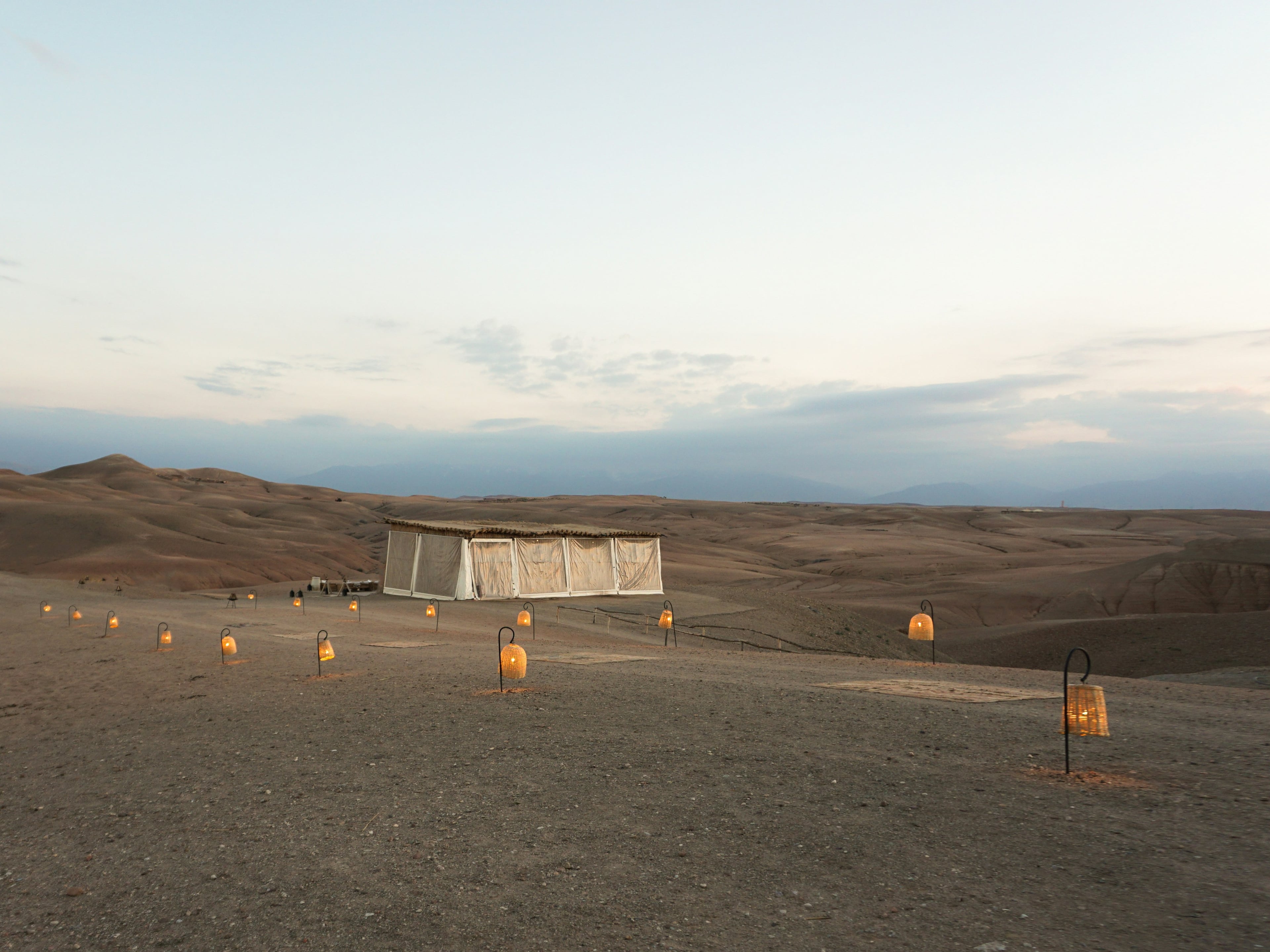
In practice, the camps and outdoor operators arrange the transfer from Marrakech, by car, van or 4x4, and it is often charged separately: ask whether it is included, and whether the vehicle goes all the way to the tent or the table. The last metres may be on foot, over stony ground, sometimes lit only by lanterns; at one dining site with no electricity at all, part of the way is walked, whatever vehicle brings you to the edge of the site.
Coming back after dinner means driving at night. The UK government warns that poor lighting makes night driving in Morocco dangerous, for pedestrians and animals as much as for other vehicles: rather than hiring a car, use a driver who knows the tracks. For a grandparent in a wheelchair, private excursions to the Agafay with wheelchair or scooter hire are offered from Marrakech by a specialist in accessible travel, to be booked about a month ahead.
An evening or a night in the Agafay?
The evening: afternoon to after dinner
The classic Agafay is an outing of an afternoon and an evening. Leave Marrakech in the afternoon, give the last hours of daylight to a camel, a quad or a slow walk along a ridge, watch the sun go down behind the hills, dine, and be back in the city late in the evening. It asks nothing of the luggage and nothing of the itinerary, which is why it fits so easily into a stay in Marrakech.
There is a quieter version for the hot months. Some camps open their pool and their table by the day, with lunch from late morning to late afternoon or with dinner from late afternoon into the evening, without a night: a long, lazy day out of town, with the same view.
What a night adds
A night turns an outing into a small journey. The drive back in the dark disappears; the stars come out over a sky darker than the city’s; and the morning belongs to you, with breakfast facing the hills and nothing to hurry for. At one camp, guests arrive from the middle of the afternoon and leave at the end of the morning, which leaves room for a sunset, a dinner, a dawn and a swim.
Camps in the Agafay range from a handful of lodges to large tented camps, and the better ones have tents with their own bathrooms, some of them air-conditioned, and pools for the warm months. Three questions are worth asking before you choose: does the tent take a third bed or a cot (not every one does), how is it heated in winter, and how far is it from the dining tent, on foot and after dark?
Where the Agafay fits in a stay
Because it is so close, the Agafay works almost anywhere in a stay in Marrakech: on the second or third day, once the long flight is behind you, or as the last night before the airport. It pairs naturally with the city and with a day in the High Atlas from Marrakech, which lies in the same direction; for the medina, the gardens and the crafts, paced for three generations, see things to do in Marrakech with grandparents and children. Those with an extra day can add the ocean at Essaouira, on the Atlantic coast, which the tourist office puts about two and a half hours from Marrakech, or the falls of Ouzoud, some three hours north-east of the city.
What to do in the Agafay
The sunset is the event, and everything else is arranged around it. Camps and outdoor operators in the Agafay publish a long list of things to do; here is what each involves.
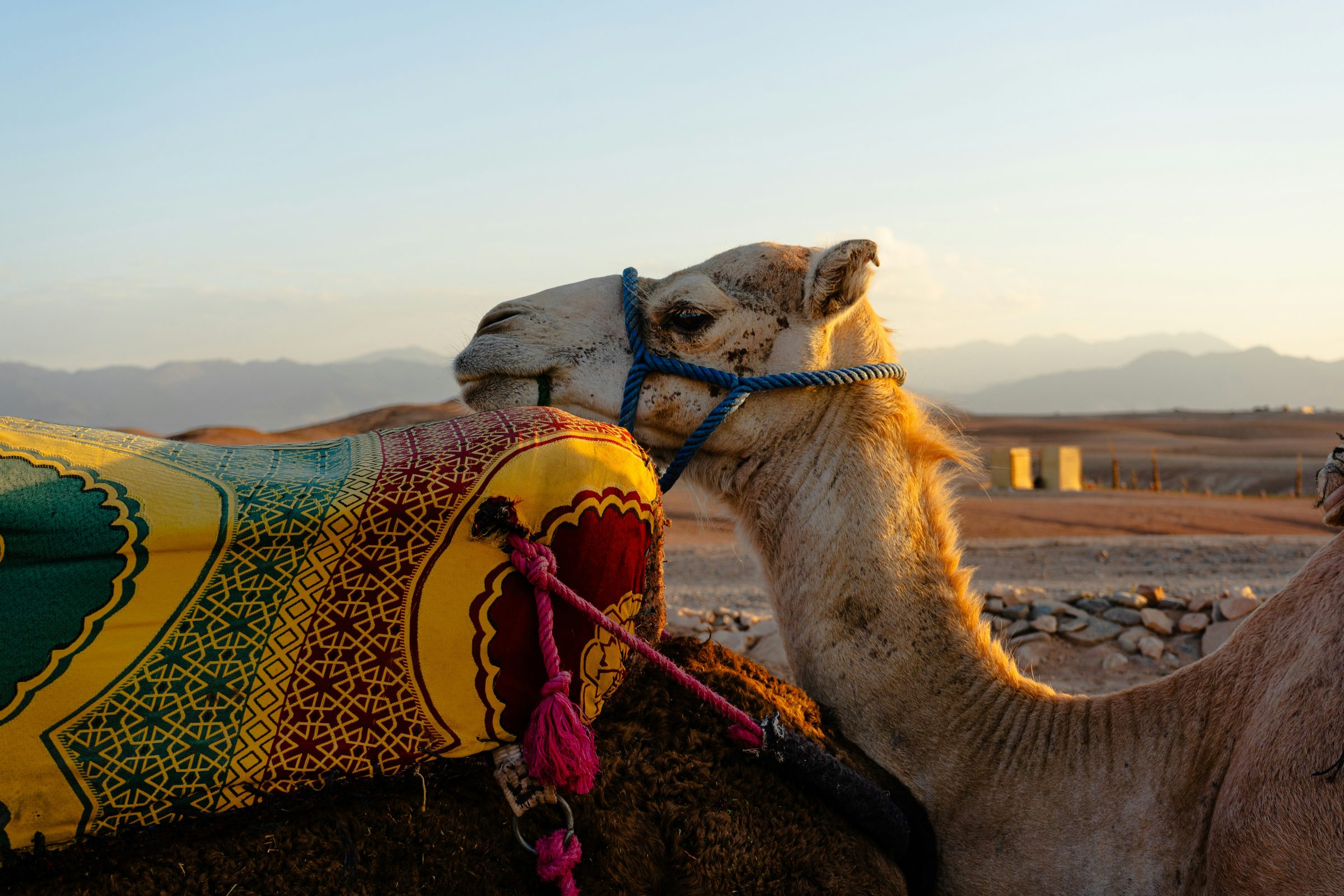
A camel at sunset
Rides last from about thirty minutes to an hour, and some operators offer half a day. For a small child or a hesitant grandparent, the half-hour ride is the right length: long enough for the photograph and the sway of the walk, short enough to end before the cold.
Quads and buggies
Quads and buggies are the noisy side of the Agafay, and the one teenagers ask for. A typical outing lasts one to two hours, or half a day with a pause for tea under a tent. Minimum ages are set by each operator: at one of them, drivers must be between 16 and 75, children ride as passengers from the age of 6 on a quad and from 3 in a buggy, and the outing is not recommended during pregnancy. The UK government notes that quad accidents involving British travellers are frequent in resort areas and that safety standards vary considerably: always wear a crash helmet, and check that your travel insurance covers quad biking, since some policies do not.
Horses, bicycles, yoga and the kitchen
Calmer hours are easy to fill. Camps and operators offer horse rides of about an hour, mountain-bike outings of a couple of hours, yoga sessions for a small group, massages, and cooking classes with the camp’s chef, the meal included. The cooking class is the one that gathers every generation at the same table.
The stars, and the music
Several camps can arrange a night of stargazing with an astronomer and a telescope, for groups from a handful of guests to about twenty; ask the camp for dates near the new moon, when the sky is darkest. At dinner, several camps invite Gnawa musicians, whose music, born of Sufi brotherhoods and of the memory of enslaved Africans, UNESCO inscribed on its list of the intangible heritage of humanity in 2019.
A balloon at dawn
Hot-air balloons rise over the plains around Marrakech at first light, and some Agafay camps arrange the flight, with the transfer, from the camp itself. The UK government advises booking balloon flights only through licensed operators; the ages, the pick-up and what passengers should know are in our family guide to Marrakech.
From the air: paragliding at Aguergour
On the hills of Aguergour, above the lake of Lalla Takerkoust, tandem paragliding flights with an instructor last fifteen to twenty minutes, weather permitting, and take about half a day with the transfer from Marrakech. Children usually fly from the age of five or six, the usual weight limit is about 115 kg, and the pilots have the last word on every flight.
By jeep
For those who prefer a seat to a saddle or a handlebar, jeep tours of about two hours cross the plateau.
The lake of Lalla Takerkoust
At the southern edge of the plateau, a dam on the N’Fiss river, built between 1929 and 1935 and raised by nine metres between 1978 and 1980, holds back a lake about 7 km long. The town below takes its name from Lalla Takerkoust, a holy woman whose shrine now lies under the water. The lake waters the plain of the Haouz and makes electricity; on its shores, some operators offer horse rides and water sports. Swimming, though, is officially forbidden, and the UK government warns that swimming in open water, including dams and rivers, can be dangerous: deep mud and steep underwater slopes can trap swimmers. Enjoy the lake from its shore.
The Agafay for grandparents, children and groups
No desert in Morocco asks less of the oldest and the youngest. There is no long road, no night that has to be spent away, and no dune to climb. What deserves planning is smaller, and easy to settle in advance.
- For grandparents: the walking, and the dark. Ask where the vehicle stops, how far it is on foot to the table and the tent, whether there are steps, and how the paths are lit after dinner. Bring a shawl even in October, and a coat from December to February.
- For young children: the ages, and the hour. Choose the short camel ride, check the minimum age of any quad or buggy before you promise it, and remember that dinner ends late: for a four-year-old, a night in the camp is kinder than the drive back to the city half asleep.
- For teenagers: the machines, with a helmet. Quads from 16 to drive at one operator, buggies, a mountain bike; all of it after a word with your insurer.
- For groups: the size of the camp. The Agafay ranges from camps of ten lodges to dining sites that seat 150 to 200 guests, and some camps can be reserved entirely for one group. A large family or a company can therefore share the same evening, as long as the camp is chosen for the number.
When to go: Agafay weather, month by month
The World Meteorological Organization publishes no station in the Agafay; the nearest is Marrakech’s, some 30 to 40 km away, and its averages give the shape of the year. The national tourist office recommends March to May and September to November for Marrakech, with a very hot summer and mild winter days followed by cool evenings.
Marrakech’s averages, month by month
- October
- 29 °C by day · 16 °C at night
- Warm afternoons; a light jacket after dinner
- November
- 23 °C by day · 11 °C at night
- Golden afternoons, cool evenings
- December
- 20 °C by day · 7 °C at night
- Mild days; dinner outdoors asks for a coat
- January
- 19 °C by day · 6 °C at night
- The coldest nights of the year
- February
- 21 °C by day · 8 °C at night
- Cold evenings; Ramadan expected from around 8 February 2027
- March
- 24 °C by day · 10 °C at night
- Spring light; Eid al-Fitr expected around 10 March 2027
- April
- 26 °C by day · 12 °C at night
- Warm days, gentle evenings
- May
- 29 °C by day · 15 °C at night
- Hot afternoons: the plateau belongs to the evening
- June
- 34 °C by day · 18 °C at night
- Very hot by day
- July
- 38 °C by day · 21 °C at night
- The hottest month: only the last hours of daylight
- August
- 37 °C by day · 21 °C at night
- As hot as July
- September
- 33 °C by day · 19 °C at night
- Hot, easing as the month ends
| Month | Average high | Average low | What to expect |
|---|---|---|---|
| October | 29 °C | 16 °C | Warm afternoons; a light jacket after dinner |
| November | 23 °C | 11 °C | Golden afternoons, cool evenings |
| December | 20 °C | 7 °C | Mild days; dinner outdoors asks for a coat |
| January | 19 °C | 6 °C | The coldest nights of the year |
| February | 21 °C | 8 °C | Cold evenings; Ramadan expected from around 8 February 2027 |
| March | 24 °C | 10 °C | Spring light; Eid al-Fitr expected around 10 March 2027 |
| April | 26 °C | 12 °C | Warm days, gentle evenings |
| May | 29 °C | 15 °C | Hot afternoons: the plateau belongs to the evening |
| June | 34 °C | 18 °C | Very hot by day |
| July | 38 °C | 21 °C | The hottest month: only the last hours of daylight |
| August | 37 °C | 21 °C | As hot as July |
| September | 33 °C | 19 °C | Hot, easing as the month ends |
Long-term averages for 1991–2020 at Marrakech, from Morocco’s Direction de la Météorologie Nationale, published by the World Meteorological Organization and rounded to the nearest degree. The Agafay lies 30 to 40 km away, and a given evening can be colder or warmer than the average.
The evening is what to dress for. The figures are night-time lows in the city; out on an open plateau, with no walls to hold the warmth of the day, dinner outdoors can feel colder still. From December to February, when Marrakech nights average 6 to 8 °C, bring a real coat: a January night there is a little colder than one in New Delhi, at about 8 °C, and far colder than one in Mumbai, at about 17 °C. Ask the camp whether dinner is served outdoors, by a brazier, or in a heated tent.
In summer, the problem is reversed. With afternoons averaging 37 to 38 °C in July and August, the Agafay belongs to the last hours of daylight and to the night, and a camp with a pool earns its place.
Ramadan, expected to begin around 8 February 2027, with Eid al-Fitr around 10 March, also changes the evening. One outdoor operator in the Agafay runs no sunset outings and serves no dinners during the month, except on request for larger groups; ask every camp and operator what it keeps open. For the rest of Morocco and how its seasons meet India’s holidays, see the best months to visit Morocco from India.
Vegetarian and Jain meals in the Agafay
Every meal in the Agafay comes from a camp kitchen, and those kitchens are used to being asked. Several camps say they can serve a fully vegetarian dinner to a whole group, from vegetable tagines and couscous to, at some, Indian vegetarian dishes; one says it is used to welcoming groups of Indian travellers. Indian cooking is not universal, though: some camps offer Moroccan vegetarian food only.
Vegetarian is therefore simple when asked for in advance, and Jain food is on request: one dining site will study a Jain menu once it has the restrictions in detail, and another will look at both the menu and serving dinner before sunset. Set out the rules in writing before you book, from no onion, garlic or root vegetables to no egg or honey, and ask for the hour as well as the dishes. The words to use, and a list in French to show the kitchen, are in how to ask for a Jain meal as a traveller in Morocco.
The Agafay or Merzouga: what the comparison leaves out
Our guide to Merzouga already weighs the three deserts within reach of Marrakech, the Agafay, Merzouga and Zagora, and its verdict holds: the Agafay for an evening, the Sahara for those who can give it three nights or more. Seen from the Agafay, four things are worth adding.
- It need not be a choice. The two can share one journey: the Agafay in the first days, to see how the youngest and the oldest take to a camp, a camel and a cold evening, and the Erg Chebbi later, once everyone knows what to expect.
- The Agafay has the mountains. Its view is of the High Atlas, and the lake and the foothills are a short drive away: a different landscape from the dunes, not a smaller version of them.
- It costs no day of travel. From Marrakech, Merzouga asks for three or four nights, with long days on the road; the Agafay asks for an afternoon.
- It cannot replace the sand. If the dunes are the picture you came for, the Agafay will not give it to you, and the road to the Erg Chebbi, the flights and the nights are the answer.
So, is the Agafay desert worth it from Marrakech?
Yes, for what it is. Within an hour of the medina, the Agafay gives a desert evening to every generation: a camel at sunset, the Atlas turning blue, a long dinner and, for those who stay, the stars and a quiet dawn. Give it an afternoon and an evening between October and May, a night if the sky matters to you, a coat in winter and the kitchen’s notice in advance. Just do not ask it for dunes: that is another journey, and a longer one.
Flying in from India? Start with flights from India and the airport for Marrakech, and see the private experiences available across Morocco.
Planning an evening or a night in the Agafay? Write to us with your dates, the ages in your party and what you would like the desert to be, and we will answer by e-mail or video call.
Questions travellers ask about the Agafay
How far is the Agafay desert from Marrakech?
Does the Agafay desert have sand dunes?
Can you visit the Agafay as a day trip from Marrakech?
Is it worth spending a night in the Agafay?
How cold is the Agafay at night?
Is the Agafay suitable for grandparents and young children?
Agafay or Merzouga?
Editorial note
This guide draws on Morocco’s national tourist office; the World Meteorological Organization, for the long-term averages of Morocco’s Direction de la Météorologie Nationale at Marrakech (1991–2020) and of the India Meteorological Department at New Delhi (1901–2000) and Mumbai (1951–2000); the UK government’s travel advice for Morocco; UNESCO, for Gnawa; and Wikipedia, for the geography of the Agafay, the commune’s 2024 census figure, and the history of the Lalla Takerkoust dam and the N’Fiss river. Road distances and driving times were calculated with the OSRM route planner on OpenStreetMap data. Details of camps and activities (durations, minimum ages, meals, opening during Ramadan) come from information published or provided by camps and outdoor operators in the Agafay. The dates of Ramadan follow our guide to the best months to visit Morocco. All were read on 12 November 2026. The dates of Ramadan were checked again on 23 November 2026.
Camp arrangements, activities and minimum ages change: check them before you book. Apart from public bodies, no business is named, and none is recommended. Sehra Morocco plans journeys in Morocco; this guide describes no journey of its own.
- Moroccan National Tourist Office: Marrakech (day trips and best time to go)
- World Meteorological Organization, World Weather Information Service: Marrakech, New Delhi and Mumbai
- GOV.UK, Morocco travel advice: safety and security, updated 19 August 2026
- UNESCO, Intangible Cultural Heritage: Gnawa, inscribed in 2019
- Wikipedia: Désert d’Agafay (in French), Tourism in Morocco, municipalities and communes of Morocco (2024 census), Lalla Takerkoust (in French) and Nfiss
- Road distances and driving times: OSRM on OpenStreetMap data, calculated on 12 November 2026, without stops
- Information published or provided by camps and outdoor operators in the Agafay.
Written by Sehra Morocco. Last reviewed: . Text last updated: .
Tell us about your trip.
By e-mail or video call. We reply within two working days.