A small Indian wedding in Morocco, for 50 or 100 guests
Fewer guests do not make a smaller wedding. They make a different one: a whole palace or estate to yourselves, every ritual under one roof, and a family that wakes up in the same place each morning.
Reviewed 23 November 2026 · Sources at the end
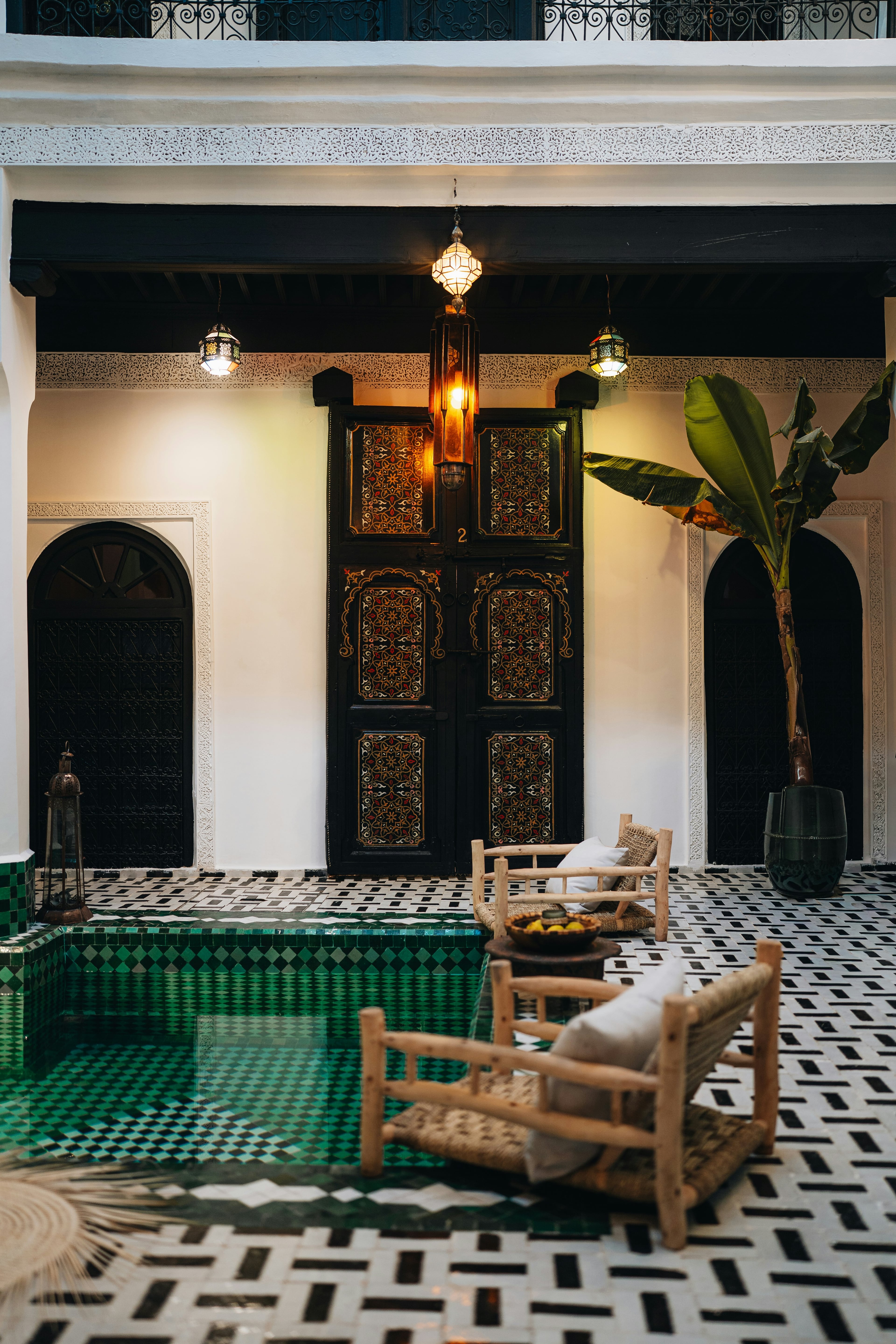
A small Indian wedding in Morocco, for 50 or 100 guests, means taking over one venue in full: at about two guests a room, an estate of twenty to thirty rooms for 50, a palace or kasbah of forty-five to sixty for 100. What decides the choice is less the size than three rules each venue sets: who may cook, whether a fire may burn, and when the music stops. An intimate wedding gives you what a large one cannot: everyone together, from the Mehendi to the last breakfast.
Below: why a small wedding changes everything, what 50 and 100 guests each call for, how venues set their terms for kitchens, fire and music, and how many nights to book. Sehra Morocco plans Indian weddings in Marrakech and across Morocco. The rules below are those set by palaces, estates, kasbahs and camps, given without their names; sources are in the editorial note, and the advice that follows from them is ours.
Why small changes everything: one venue, all yours
Published reports show that weddings of this size are held in Marrakech. A planner’s portfolio, published in November 2024, reports a wedding of 70 guests travelling from the United States and India; a South Asian wedding magazine reported one of 50 family and friends, with a Mehendi evening in one riad and the ceremony by day in another place.
Privatising matters more for a small wedding than for a large one. With 300 guests, the scale itself decides the venue, and our page on hosting 300 wedding guests in Morocco explains how a whole guest list is looked after. With 50 or 100, you can choose a place for its beauty, and the rules are agreed with one owner for every event.
A wedding for 50 guests
Fifty guests fill a private estate or a small palace of twenty to thirty rooms, at about two to a room. The Mehendi in the garden, the Sangeet in a courtyard, the ceremony on the lawn and the dinner under the stars all take place within a few steps of the rooms. Grandparents rest between events; children sleep upstairs while the dancing goes on.
The range is wide. Private estates, small palaces and boutique hotels of this size sleep roughly forty to sixty and are let for two or three nights, more at weekends. Outdoor music usually stops in the small hours. A strict Jain kitchen can come from an Indian caterer the house has already worked with; another venue may advise an outside caterer for all the celebrations.
Further away, a luxury camp in the Sahara, privatised in full, can suit a wedding of this size. Its kitchen and its outside caterers follow terms the camp sets: ask for them in writing.
A wedding for 100 guests
For 100 guests, look for forty-five to sixty rooms in one place: a palace or a kasbah, taken over in full; the larger venues sleep roughly eighty to a hundred. Some venues of this size make privatisation compulsory for any event, with setting up and clearing away inside the nights required. Once the venue is yours, every public space becomes a reception space.
Kitchens are where venues of this size differ most. One cannot serve a full Jain programme and offers a separate kitchen for the caterer of your choice. Another works the other way: no outside caterer and no specific Jain menu, but Indian and Indian-style vegetarian menus from its own chefs, with outside decorators, sound and light and DJs admitted. A third lets an outside Indian chef cook alongside its own brigade. Some venues also require exclusive use as soon as a group needs most of their rooms.
When the venue has fewer rooms than guests, the family splits. One published wedding of 100 guests in Morocco, in November 2024, placed close family and friends in the hotel’s 25 rooms and gave the other 75 hotel recommendations nearby. It is a fine wedding, but a different one: shuttles every evening, and a party that only meets at the events.
The three rules that decide: the kitchen, the fire and the music
In a small venue, nothing is hidden behind a ballroom door. Who cooks, where the fire burns and when the music stops shape the whole programme. Here is what venues set, summarised as ranges and without names:
- Guests it sleeps
- Roughly 40 to 60 in the smaller houses; roughly 80 to 100 in the larger ones.
Ask: The number of guests, two to a room or more, not the number of rooms.
- Nights of exclusive use
- Two at least wherever a minimum was stated; often three or four at weekends, in high season or in spring. Some venues are not let in full in their busiest months.
Ask: The nights required on your dates, and whether setting up and clearing away fall inside them.
- Indian kitchen
- Every case exists: an outside Indian caterer accepted or advised, a separate kitchen for your caterer, an entry fee, or no outside caterer at all (with Indian and Indian-style vegetarian menus from the house chefs).
Ask: Who may cook, and whether strict Jain or regional cooking is possible.
- Sacred fire
- Never a given. One venue studies a ritual fire case by case, on the fuel, the container and its size.
Ask: The place, the time and the person in charge of the fire, in writing.
- Music
- Where a time was stated, outdoor music stops in the small hours, between about one and three in the morning, in some cases on the local authorities’ instructions; a few allow later music on request, or set no limit.
Ask: The latest time for outdoor and indoor music, in writing.
| Rule | What venues set | What to ask |
|---|---|---|
| Guests it sleeps | Roughly 40 to 60 in the smaller houses; roughly 80 to 100 in the larger ones. | The number of guests, two to a room or more, not the number of rooms. |
| Nights of exclusive use | Two at least wherever a minimum was stated; often three or four at weekends, in high season or in spring. Some venues are not let in full in their busiest months. | The nights required on your dates, and whether setting up and clearing away fall inside them. |
| Indian kitchen | Every case exists: an outside Indian caterer accepted or advised, a separate kitchen for your caterer, an entry fee, or no outside caterer at all (with Indian and Indian-style vegetarian menus from the house chefs). | Who may cook, and whether strict Jain or regional cooking is possible. |
| Sacred fire | Never a given. One venue studies a ritual fire case by case, on the fuel, the container and its size. | The place, the time and the person in charge of the fire, in writing. |
| Music | Where a time was stated, outdoor music stops in the small hours, between about one and three in the morning, in some cases on the local authorities’ instructions; a few allow later music on request, or set no limit. | The latest time for outdoor and indoor music, in writing. |
Each venue may change its terms: confirm them for your dates. Figures are ranges; sources in the editorial note.
The kitchen
The answers cover every case: an outside Indian caterer accepted, advised, given a kitchen of its own, admitted for a fee, or not admitted at all. If your family needs Jain cooking, or the dishes of one region, ask this before anything else: it rules venues in or out at once. Our guide to Jain and Indian food in Morocco explains what to ask.
The fire
A sacred fire is a question each venue answers for itself. One venue studies a ritual fire case by case, on the fuel, the container and its size. Agree the place, the time and the person responsible for the fire in writing before you fix the muhurat.
The music
The latest time differs from one venue to the next: several stop outdoor music between about one and three in the morning, and a few allow it later on request or set no limit. It can also depend on the local authorities. For a Sangeet that runs late, this one line may choose the venue. For the performers, the stage and the henna, see our guide to the Mehendi and Sangeet in Morocco.
How many nights, and when
Every venue that stated a minimum asks for at least two nights of exclusive use. Weekends, high season and spring often mean three or four. Some months are not available at all: some venues are not let in full in their busiest months. Fix the season first with our guide to the best time for an Indian wedding in Morocco, then ask each venue for the nights it requires on your dates.
The kinds of places to consider
For a small wedding we look only at palaces and luxury houses, and at estates of rare charm: palaces, private estates and gardens, kasbahs in the Atlas, and luxury camps in the desert, each taken over in full. Our page on Indian wedding venues in Marrakech and Morocco describes these families of places and what we check first.
Five questions to ask before you choose
- How many people does it sleep? Not the number of rooms: the number of guests, two to a room or more.
- How many nights of exclusive use, in which months? And whether setting up falls inside them.
- Who may cook? An outside Indian caterer, a separate kitchen, or the house brigade alone.
- Where may the fire burn? Indoors or out, with which container, under whose watch.
- When does the music stop? Outdoors and indoors, in writing.
So, is Morocco right for a small Indian wedding?
Yes, and perhaps more than for a large one. For 50 guests, an estate or a small palace of twenty to thirty rooms becomes your family’s house for three days; for 100, a palace or a kasbah of forty-five to sixty rooms keeps everyone together. The beauty of the place matters, but the decision rests on three written answers, about the kitchen, the fire and the music, and on the nights each venue requires.
Planning a smaller wedding in Morocco? Tell us your guest count, your season and the rituals you will hold, and we will answer by e-mail or video call.
Questions families ask about a small wedding in Morocco
Can we privatise a whole venue for a wedding of 50 guests?
How many nights must we book?
Can our own Indian caterer cook at the venue?
Can we have a sacred fire in a small venue?
Until what time can the music play?
Where do the other guests sleep if the venue is too small?
Editorial note
The terms in this guide come from the written replies of venues in Morocco, received in October and November 2026 in answer to our questions. They are given without the venues’ names, summarised as ranges, and without any detail that would identify a venue. The published weddings cited come from reports by La Perle Events (November 2024), WeddingSutra, and Condé Nast Traveler (republished in February 2026), read on 18 November 2026.
Each venue sets and may change its own terms, including the nights required, outside caterers, fire and music: confirm them in writing for your dates. No venue is named or recommended here. Sehra Morocco is a new company: this guide describes no wedding of our own.
Written by Sehra Morocco. Last reviewed: .
Tell us about your celebration.
By e-mail or video call. We reply within two working days.